
TL;DR
APEC leaders met in Shenzhen on November 19, 2026, with draft proposals on AI, digital trade and a regional free trade area before them. Earlier ministerial commitments support AI use in trade and workforce skills, but the leaders’ declaration had not been published by 05:45 UTC, and APEC commitments are voluntary.
APEC leaders met in Shenzhen on November 19 with draft proposals on artificial intelligence and digital trade before them, while the meeting’s final declaration remained unpublished as of 05:45 UTC. Chinese President Xi Jinping described the digital economy and AI as “the engines of innovation-driven growth”; whether leaders will adopt the proposed measures is not yet clear.

Get business pricing on tech for your team
- Business-only prices and quantity discounts
- Tax-exempt purchasing
- Multiple users, one account, clear invoices
Senior officials sent leaders a proposed statement on the digital economy and AI “for people’s well-being,” a proposed Trade Digitalization Cooperation Framework for 2027–2030, and a draft statement on a Free Trade Area of the Asia-Pacific. These are proposals, not confirmed outcomes. The APEC Secretariat’s November 16 account of the officials’ meeting described the drafts, but the leaders’ decision had not been made public by the stated reporting cutoff.
Some related commitments are already on record. At a May 22–23 meeting in Suzhou, trade ministers committed to “harnessing AI’s benefits for trade” and encouraged economies to share AI policy information with smaller firms. In September, labor ministers adopted a joint statement on jobs, vocational skills and social security. These commitments set areas for cooperation; they do not establish a single AI policy for all 21 economies.
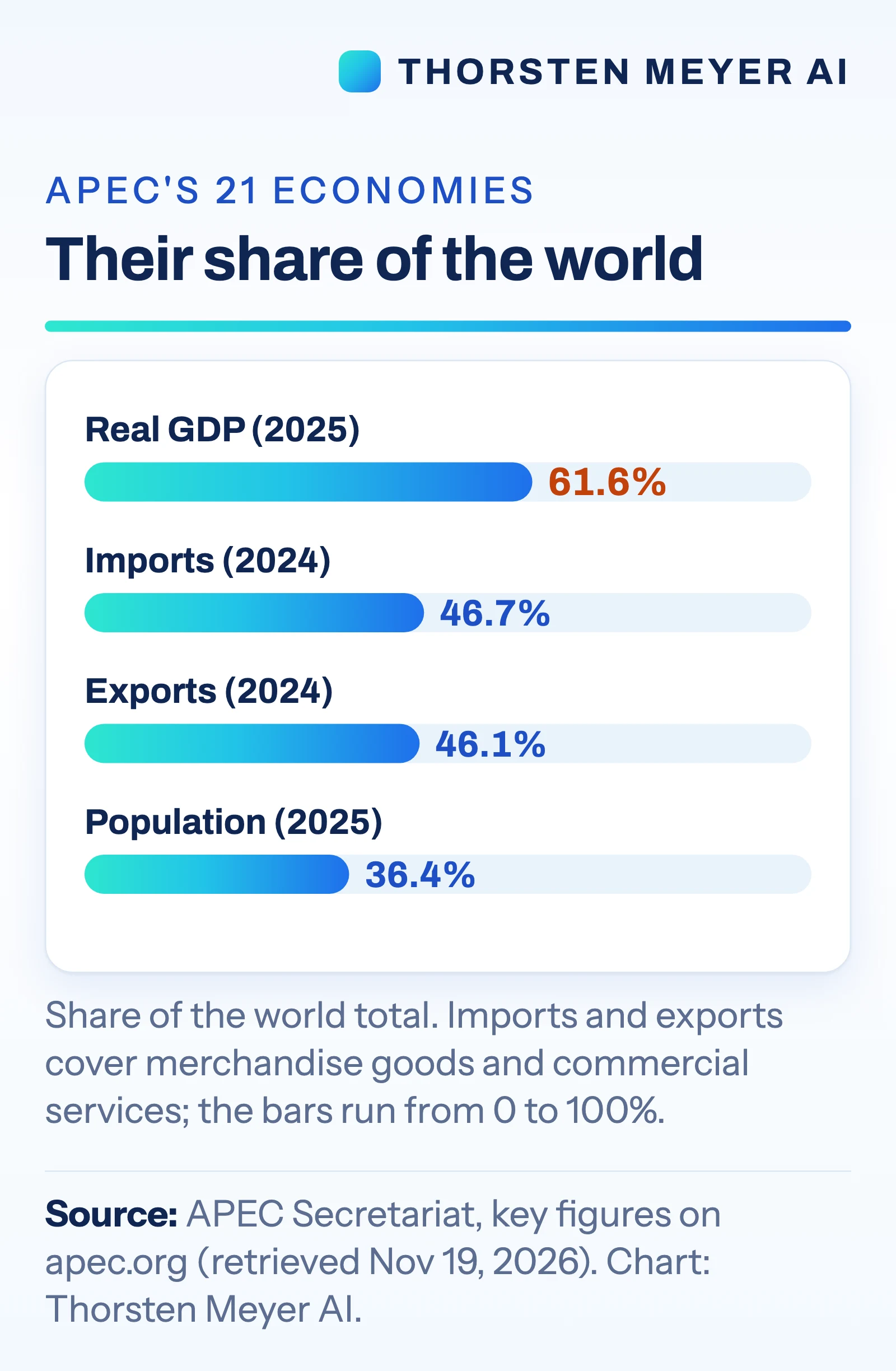
Xi also announced that China would provide US$20 million for APEC cooperation and establish cooperation institutions focused on digital technology, cross-border data flows, clean energy and small businesses. APEC’s 21 member economies represent 61.6% of global GDP in 2025 and about 46% of world trade in goods and commercial services in 2024, according to the forum’s figures. Those measures indicate the scale of the forum, but do not make its decisions binding.
AI Rules and Trade Across the Pacific
The proposals matter because they concern how economies approach AI in commerce, digital trade and cross-border data across a region that accounts for a large share of global output and trade. If adopted, the documents could give governments and businesses a shared direction for cooperation. The source material does not establish that they would impose common technical rules or change any company’s legal obligations.
For businesses moving goods or services across APEC economies, cooperation on trade digitalization could shape future discussions about how trade processes use digital tools. For workers, the September labor ministers’ statement puts skills and social security alongside AI’s economic uses. APEC’s regional outlook also cautioned that the benefits of technology investment could be uneven, even as it raised its 2026 regional growth forecast to 3.4% from 3.2%.
The forum’s reach should be weighed against its limits. APEC operates by consensus and its commitments are voluntary. A leaders’ declaration can express a shared direction, but the text alone does not change national laws, tariffs or rules on advanced chips. Any effects on businesses or workers would depend on later action by individual economies.
Products Worth Considering

DJI Mini 5 Pro Fly More Combo with DJI RC 2, 1-Inch CMOS

Bose QuietComfort True Wireless Earbuds with Active Noise Cancellation, Bluetooth 5.3, USB-C Charging, and IPX4 Water Resistance

Apple MacBook Air 15-inch (2026) with M5 chip, 16GB memory, 512GB SSD — Midnight
As an affiliate, we earn on qualifying purchases.
From Ministerial Talks to Shenzhen
APEC, founded in 1989, brings together 21 member economies. Its annual leaders’ meeting comes after working-level and ministerial discussions that shape the agenda. In 2026, trade ministers met in May, labor ministers issued their statement in September, and foreign and trade ministers prepared the leaders’ agenda in a November 3 meeting held by video. Senior officials met in Shenzhen on November 14–15 and sent the proposals to leaders.
The host year’s economic picture includes strong technology-related investment and trade, according to the APEC Policy Support Unit. On November 15, it forecast regional growth of 3.4% in 2026 and 3.1% in 2027. It reported that export values rose 22.5% year on year in the first half of 2026 and export volumes rose 10.8%, supported by semiconductor demand. These are regional figures and forecasts, not evidence that the proposed AI measures caused the growth.
Xi welcomed U.S. President Donald Trump in Shenzhen on November 18. The source also said Xi would hold a China-Russia-U.S. summit with Trump and Russian President Vladimir Putin on November 19. Those diplomatic meetings are part of the wider setting, but the available material does not show that they determine APEC’s AI proposals.
““Harnessing AI’s benefits for trade.””
— APEC trade ministers, joint statement from their May 22–23 meeting
Drafts Await Leaders’ Decision
As of 05:45 UTC on November 19, the leaders’ declaration had not been published. It is therefore not possible from the available source material to say whether leaders adopted, revised or set aside the proposed AI statement, digital trade framework or free trade area statement.
The proposals’ final wording, any implementation timetable and how individual economies might act on them also remain unknown. The source material does not identify new binding rules for AI, data flows, tariffs or chip access. APEC’s voluntary process means any later domestic measures would need to be confirmed separately by the economies involved.
Watch for the Leaders’ Declaration
The next concrete development is publication of the APEC leaders’ declaration and any accompanying statements. Those documents will show which proposals, if any, leaders endorsed and the language they used to describe future cooperation. Their publication was still pending at the reporting cutoff.
After that, readers will need to track whether member economies take follow-up steps at home or through later APEC meetings. The forum’s consensus process can set shared priorities, while implementation and any effects on businesses or workers depend on decisions beyond the declaration itself.
Key Questions
What AI policies are APEC leaders considering in Shenzhen?
Proposals include a statement on the digital economy and AI “for people’s well-being” and a trade digitalization framework for 2027–2030. As of 05:45 UTC on November 19, whether leaders adopted them was not known.
Did APEC already agree to use AI in trade?
Trade ministers committed in May 2026 to “harnessing AI’s benefits for trade” and encouraged economies to share AI policy information with smaller firms. That is a ministerial commitment, not a single binding AI policy for all members.
Will an APEC declaration change AI laws or tariffs?
Not by itself. APEC works by consensus and its commitments are voluntary; changes to laws, tariffs or other rules would require action by the relevant economies.
What does the Shenzhen meeting mean for workers?
Labor ministers adopted a September statement addressing jobs, vocational skills and social security. The available source material does not specify new worker protections or a common regional program resulting from the leaders’ meeting.
Source: Thorsten Meyer AI