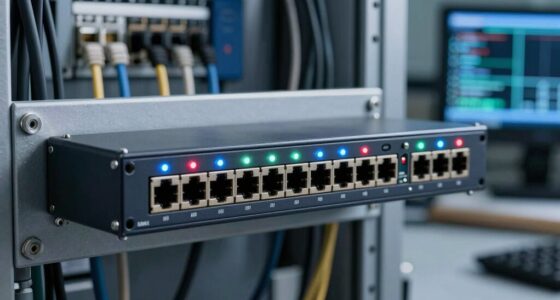

5G and Edge AI team up to deliver ultra-fast, low-latency applications that change how you connect and process data instantly. With 5G’s increased speed and capacity, along with Edge AI’s ability to analyze data locally, you gain real-time responsiveness for autonomous vehicles, healthcare, smart cities, and more. This powerful combo enables seamless, secure, and efficient experiences in your daily life. Keep exploring to discover how these innovations will impact your world even further.
Key Takeaways
- 5G provides higher speeds and lower latency, essential for real-time data processing and low-latency applications.
- Edge AI enables local data analysis, reducing delays and improving responsiveness in time-sensitive tasks.
- Combining 5G and Edge AI supports autonomous vehicles, industrial automation, and healthcare with instant decision-making.
- Local processing minimizes reliance on distant data centers, enhancing privacy, security, and data transfer efficiency.
- These technologies drive innovation across industries by enabling smarter, faster, and more responsive systems.
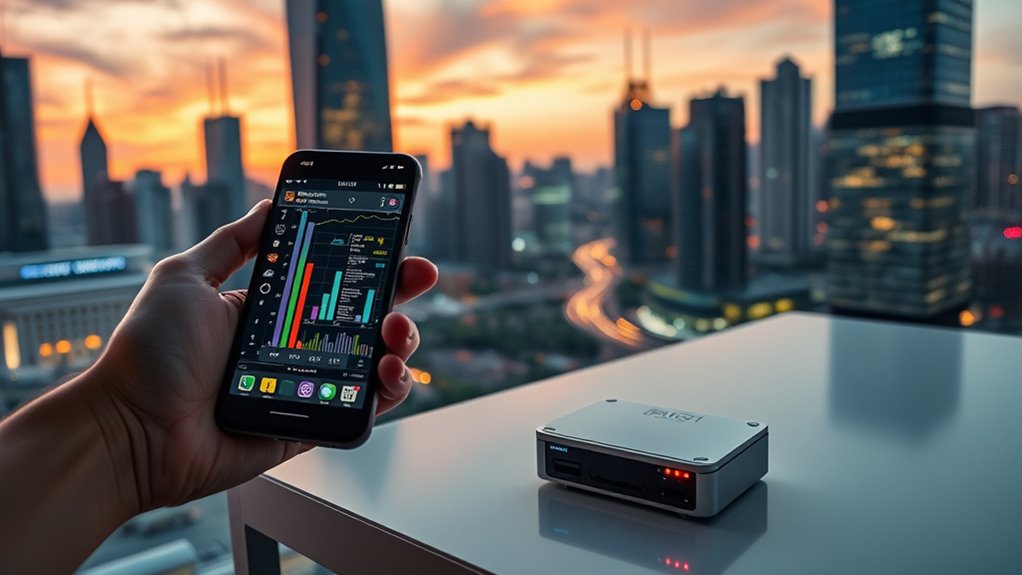
As 5G networks roll out worldwide, they are transforming how devices connect and share data. The increased speed, capacity, and reduced latency of 5G open up new possibilities for real-time applications that demand near-instant communication. When combined with Edge AI, 5G becomes a powerful tool for enabling low-latency processing at the device or local network level. Instead of relying on distant data centers, data can be analyzed and acted upon locally, drastically reducing delays and making applications more responsive.
Imagine autonomous vehicles maneuvering busy streets. With 5G’s rapid data transfer, these vehicles can communicate with each other and with traffic infrastructure almost instantaneously. Edge AI processes sensor data right on the vehicle or nearby, allowing for quick decisions without waiting for cloud-based analysis. This setup reduces the risk of accidents and improves traffic flow, all thanks to the synergy between 5G and Edge AI. Similarly, in industrial settings, machines equipped with Edge AI can detect anomalies and perform maintenance tasks in real time, preventing costly downtime. The low latency ensures that commands and alerts are delivered instantly, keeping production lines smooth and efficient.
In healthcare, this combination enhances telemedicine and remote diagnostics. Devices can transmit high-resolution images or patient data swiftly, while Edge AI analyzes the information immediately on-site. This enables doctors to make faster, more accurate decisions during emergencies or routine checkups. For smart cities, 5G and Edge AI work together to manage traffic lights, surveillance, and public safety systems. Data from sensors is processed locally, allowing city officials to respond promptly to incidents or adjust systems dynamically, improving urban living standards.
You benefit from this technology in your daily life through smarter devices and services that react faster and operate more reliably. Streaming high-quality videos, playing augmented reality games, or using connected home devices all become smoother experiences. Privacy also gets a boost because processing data locally means less sensitive information needs to travel over the network, reducing security risks. As the trustworthiness of AI systems improves, the integration of these technologies will become even more secure and reliable.
Ultimately, 5G and Edge AI empower applications that require real-time decision-making and ultra-fast response times. They enable a new wave of innovation across industries, making systems more intelligent, efficient, and responsive. As you use these advancements, you’ll notice how much more seamless and instantaneous your connected world becomes—delivering smarter solutions right when you need them most.

Samsung Galaxy A17 5G Smart Phone 128GB, US 1 Yr Manufacturer Warranty Gray
- Display: 6.7-inch FHD+ Super AMOLED screen
- Charging: Super Fast Charging technology
- Camera: Triple-lens camera for versatile shots
As an affiliate, we earn on qualifying purchases.
As an affiliate, we earn on qualifying purchases.
Frequently Asked Questions
How Does 5G Improve Connectivity for Edge Devices?
You experience faster, more reliable connections for your edge devices because 5G offers higher bandwidth and lower latency. It reduces data transmission delays, allowing your devices to communicate seamlessly in real-time. With 5G’s enhanced capacity, you can connect more devices simultaneously without performance drops. This improved connectivity supports advanced applications like autonomous vehicles, smart cities, and IoT, making your edge device interactions smoother and more efficient.
What Are the Main Security Concerns With Edge AI?
You might worry that edge AI introduces new security risks, and you’re right to. Data breaches, unauthorized access, and malware are real threats, especially since edge devices often lack robust security measures. You should guarantee encryption, strong authentication, and regular updates. Recognizing these concerns helps you stay vigilant, protecting sensitive information and maintaining trust in your AI-powered systems. Security isn’t optional; it’s essential for effective edge AI deployment.
How Is Latency Reduction Achieved in Edge AI Deployments?
You achieve latency reduction in edge AI by processing data locally on devices or nearby servers, rather than sending it to distant data centers. This minimizes transmission time, allowing for faster responses. Implementing efficient algorithms and hardware accelerators also speeds up processing. Additionally, optimizing network routes and reducing data volume transferred further cuts latency, ensuring real-time performance essential for applications like autonomous vehicles and industrial automation.
What Industries Benefit Most From 5G and Edge AI Integration?
You’ll find healthcare, manufacturing, and autonomous vehicles benefit most from 5G and Edge AI integration. Healthcare accelerates remote diagnostics and real-time monitoring, boosting patient care. Manufacturing improves through faster data processing, predictive maintenance, and automation. Autonomous vehicles rely on low latency for safe navigation and instant decision-making. These industries gain competitive edges, increase safety, and access innovative possibilities by leveraging ultra-fast, reliable connectivity and intelligent edge computing.
What Are the Cost Implications of Adopting 5G and Edge AI?
Adopting 5G and Edge AI can be costly upfront, as you’ll need to invest in new infrastructure, devices, and cybersecurity measures. However, these expenses often pay off through increased efficiency, reduced latency, and enhanced service quality. You might also face ongoing maintenance costs. Overall, while initial investments are significant, the long-term benefits generally outweigh the costs, especially for businesses aiming to innovate and stay competitive.
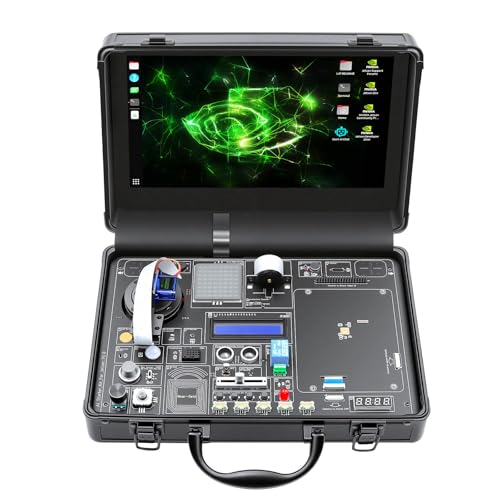
ELECROW AI Starter Kit for Jetson Orin Nano with 11.6" Screen, 30 Sensors
- No-Solder Sensor Board: 30 integrated plug-and-play sensors
- Includes Accessories: 128G SD card, adapter, mounting plates
- 8MP Gimbal Camera: Supports face and target tracking
As an affiliate, we earn on qualifying purchases.
As an affiliate, we earn on qualifying purchases.
Conclusion
As you harness 5G and Edge AI, you’re building a highway for real-time data, transforming possibilities into realities. Think of this technology as a lightning bolt—fast, precise, and powerful—unlocking applications that were once out of reach. With low latency and seamless connectivity, you’re paving the way for innovation that moves at the speed of thought. Embrace this wave, and you’ll ride the crest of the future, where what’s next is only a moment away.

AUTONOMOUS VEHICLE ENGINEERING AND INTELLIGENT MOBILITY SYSTEMS: Self driving technologies sensor fusion and adaptive transportation networks
As an affiliate, we earn on qualifying purchases.
As an affiliate, we earn on qualifying purchases.

Dream States: Smart Cities, Technology, and the Pursuit of Urban Utopias
As an affiliate, we earn on qualifying purchases.
As an affiliate, we earn on qualifying purchases.