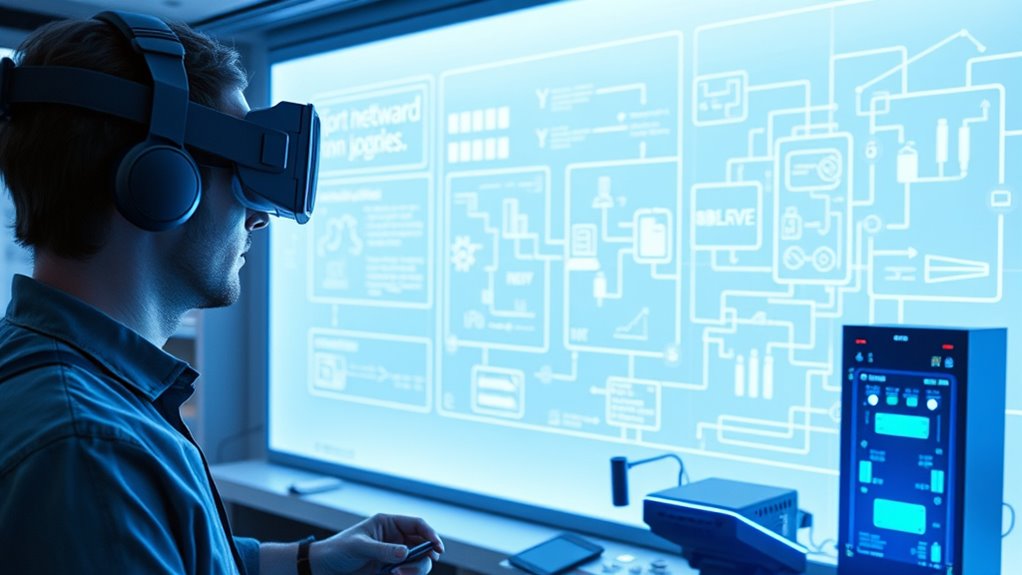

By integrating augmented reality and IoT into your DevOps pipelines, you can visualize complex system data directly within physical environments, making troubleshooting more intuitive and faster. IoT devices provide real-time operational data, enabling automated responses and smarter decision-making. AR supports remote collaboration by sharing immersive system views, which enhances team efficiency. This combination creates a dynamic, responsive ecosystem that boosts deployment speed and system reliability—continue further to discover how these innovations can transform your workflows.
Key Takeaways
- AR visualizes IoT sensor data within physical environments, enhancing troubleshooting and system planning in DevOps workflows.
- IoT devices provide real-time operational data, enabling automated testing, deployment, and monitoring through AR integration.
- AR facilitates remote collaboration by sharing immersive system views, improving knowledge transfer and reducing resolution times.
- Integrating AR and IoT increases data volume, requiring advanced data management, analysis, and security measures within pipelines.
- The combined use accelerates deployment, enhances system monitoring, and fosters proactive issue resolution in continuous DevOps processes.

As technology continues to evolve, integrating augmented reality (AR) and Internet of Things (IoT) into DevOps pipelines is transforming how teams develop, deploy, and monitor software. You now have the power to create more interactive, real-time experiences that enhance collaboration and streamline workflows. AR allows you to visualize complex data and system architectures directly within your environment, making troubleshooting and planning more intuitive. When combined with IoT devices, you can gather live data from physical assets, providing a richer context for your development and operational decisions.
Imagine walking through your production line with AR glasses, seeing live sensor data overlaid on machinery. You instantly identify issues, check system health, and make adjustments without needing to consult separate dashboards or logs. This seamless integration reduces downtime and accelerates problem resolution. IoT sensors continuously feed operational data into your DevOps pipeline, enabling automated testing, deployment, and monitoring processes based on real-time conditions. You no longer rely solely on pre-defined metrics; instead, you adapt proactively to actual system states, improving reliability and efficiency.
Visualize live sensor data on AR glasses to instantly troubleshoot, optimize, and streamline your production line.
Your teams can leverage AR to facilitate remote collaboration during complex deployments or troubleshooting sessions. Instead of relying on static documentation or screenshots, you can share immersive views of systems, guiding remote experts as if they were physically present. This not only shortens resolution times but also enhances knowledge sharing across distributed teams. IoT’s continuous data stream ensures your feedback loop is faster and more accurate, allowing you to implement changes or roll back updates based on live performance metrics. The combination of AR and IoT makes your DevOps pipeline more dynamic, responsive, and aligned with real-world conditions.
Additionally, real-time data management becomes critical as the volume and velocity of data increase, requiring sophisticated strategies to handle and analyze the influx of operational information effectively. However, integrating AR and IoT into DevOps isn’t without challenges. You need to guarantee data security as sensitive operational information flows between devices and systems. Compatibility issues may arise when connecting disparate IoT devices and AR hardware. You must also establish robust data management practices to handle the volume and velocity of real-time data. Despite these hurdles, the benefits are compelling: faster deployment cycles, more precise monitoring, and a more collaborative environment. As you adopt these technologies, you’ll find yourself better equipped to anticipate issues, optimize processes, and deliver higher-quality software faster.
Ultimately, embracing AR and IoT in your DevOps pipeline empowers you to operate smarter, respond faster, and innovate more effectively. You’re not just automating; you’re transforming your workflow into an interactive, data-rich ecosystem that bridges the physical and digital worlds. This evolution positions you at the forefront of technology, ready to meet the demands of modern software development and operational excellence.

RayNeo Air 4 Pro AR/XR Glasses – 201" HDR10 Video Display, Vision 4000 Chip, Audio by Bang & Olufsen, 3D Movies & Gaming Smart Glasses for iPhone 17,16,15/Android/Switch 2/Mac/PS4/5-4 Pro
World’s First HDR10 AR Display – Experience over 10 billion colors and ultra-deep contrast on a massive 201-inch…
As an affiliate, we earn on qualifying purchases.
As an affiliate, we earn on qualifying purchases.
Frequently Asked Questions
How Does AR Improve Iot Device Management in Devops?
AR enhances IoT device management in DevOps by providing real-time, immersive visualizations of device status and data. You can easily identify issues, perform remote diagnostics, and troubleshoot problems directly through AR interfaces. This reduces downtime, speeds up maintenance, and improves accuracy. With AR, you get a more intuitive way to oversee complex IoT networks, making your management process faster, more efficient, and less prone to errors.
What ARe the Security Concerns When Integrating AR With Iot?
Oh, great, now your AR devices are vulnerable to hackers sneaking in through holograms! When you merge AR with IoT, you risk exposing sensitive data, intercepting communications, or even maliciously manipulating device functions. You might also face privacy breaches as AR collects tons of visual data. So, remember, adding AR isn’t just fun and games; it’s a security nightmare unless you lock down those interfaces tight.
How Scalable ARe AR and Iot Integrations in Large Devops Teams?
You can scale AR and IoT integrations effectively in large DevOps teams by leveraging modular architectures and cloud platforms. As your team grows, cloud solutions enable seamless addition of devices and AR applications without major overhauls. Automated deployment and management tools help maintain consistency and security across the infrastructure. While scaling presents challenges like latency and data management, proactive planning guarantees your integrations remain efficient and responsive at enterprise levels.
What Hardware Is Necessary for Ar-Enabled Iot Monitoring?
You’ll need AR headsets or smart glasses, like Microsoft HoloLens or Magic Leap, to enable AR-powered IoT monitoring. These devices overlay real-time data onto physical assets. Additionally, verify you have IoT sensors and connected devices that transmit data wirelessly to your system. A powerful network, reliable Wi-Fi or 5G, and a robust backend infrastructure are essential to process and visualize the data effectively through AR interfaces.
How Does Real-Time Data Processing Work in AR and Iot Integrations?
You process real-time data in AR and IoT integrations by continuously collecting sensor information through IoT devices, then transmitting it to a central system via secure networks. This system analyzes the data instantly, often using edge computing to reduce latency. The processed information updates your AR interface instantly, allowing you to see live insights. This seamless flow enables you to make quick decisions, troubleshoot issues, and optimize operations efficiently.

Tapo Smart IR & IoT Hub with Chime – Universal Remote for TVs, ACS, & 18+ Device Types, Matter-Certified, Supports 8,000+ Infrared Brands, Voice & App Control, Custom Schedules & Automations, H110
UNIVERSAL REMOTE – SMART HUB FOR 8,000+ BRANDS: Matter-certified IR & IoT hub with built-in alarm. Control TVs,…
As an affiliate, we earn on qualifying purchases.
As an affiliate, we earn on qualifying purchases.
Conclusion
By integrating augmented reality and IoT into your DevOps pipelines, you can boost efficiency and real-time monitoring. Did you know that 85% of companies adopting IoT report faster problem resolution? Embracing these technologies not only streamlines development but also enhances collaboration and decision-making. So, don’t get left behind—leveraging AR and IoT today prepares you for a smarter, more responsive future in DevOps.

Augmented Reality for Remote Work: Simple AR Tools to Boost Your Productivity in 2025 (AR remote work 2025)
As an affiliate, we earn on qualifying purchases.
As an affiliate, we earn on qualifying purchases.

Microservices, IoT and Azure: Leveraging DevOps and Microservice Architecture to deliver SaaS Solutions
As an affiliate, we earn on qualifying purchases.
As an affiliate, we earn on qualifying purchases.