📊 Full opportunity report: Cross-platform buyer history for multi-marketplace resellers on IdeaNavigator AI — validation score, market gap, and execution plan.
TL;DR
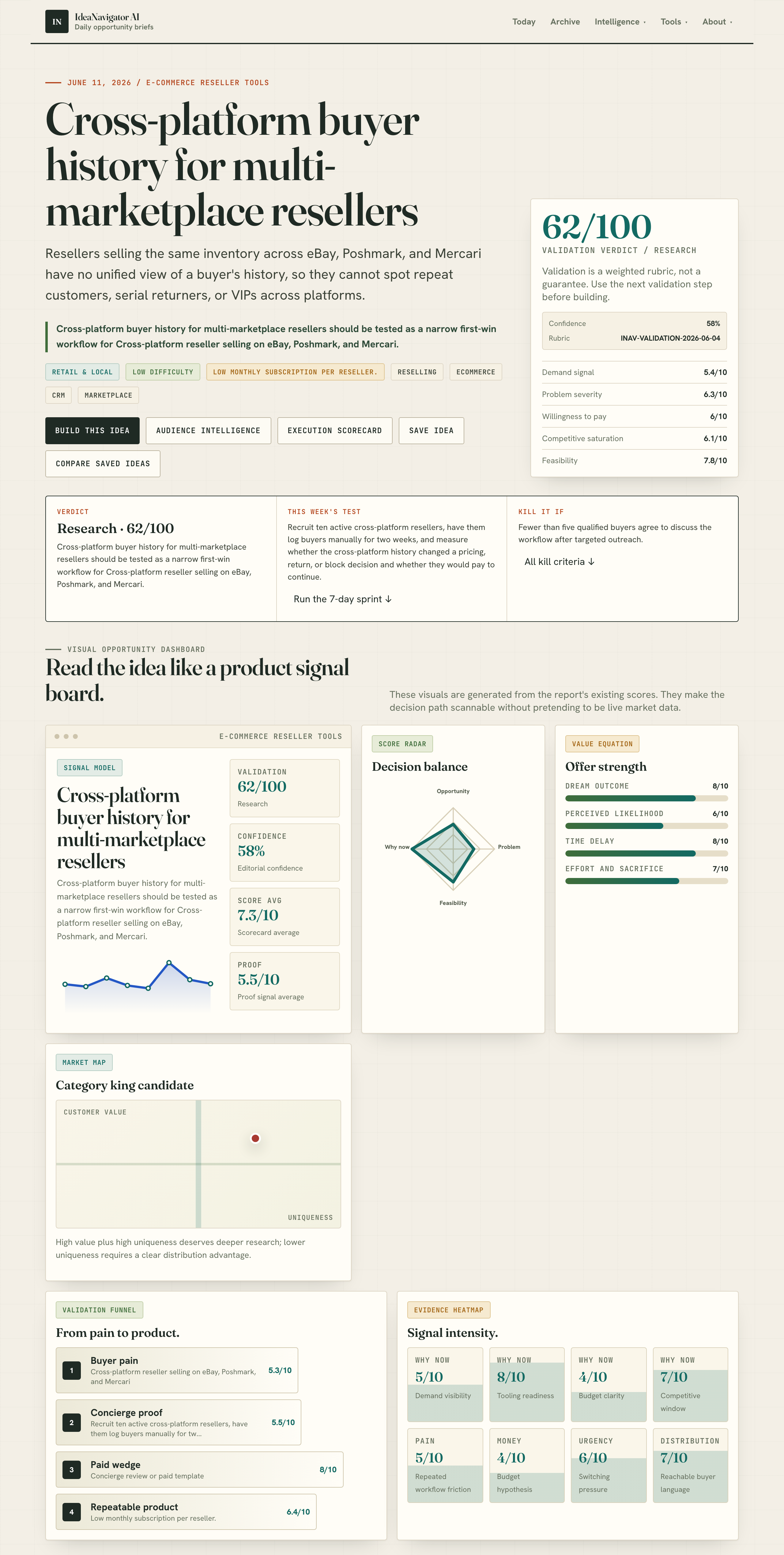
A new initiative is testing a manual buyer ledger to unify buyer history across multiple marketplaces. This approach aims to help resellers identify repeat customers and improve decision-making. Validation is underway with ten resellers over two weeks.
Resellers operating across eBay, Poshmark, and Mercari are beginning to test a manual buyer ledger designed to unify buyer history across platforms, addressing a key data silo issue that hampers customer relationship management and sales strategies.
The initiative involves resellers manually logging each buyer’s handle, platform, item details, and notes into a shared ledger. This simple, low-cost approach aims to create a cross-platform buyer history that can help identify repeat customers, serial returners, or VIP buyers, regardless of the platform used.
The test phase involves recruiting ten active resellers who will record buyer interactions over a two-week period. The goal is to measure whether access to cross-platform buyer data influences pricing, return decisions, or blocking of problematic buyers. The concept is viewed as a potential first step toward a broader automated system that consolidates buyer data across multiple marketplaces.
This manual ledger approach is being evaluated as a minimal viable product (MVP), with resellers paying a low monthly subscription if the system proves effective in improving sales outcomes and customer management.
Potential Impact on Multi-Platform Reselling Strategies
If successful, this manual cross-platform buyer history system could significantly change how resellers manage customer relationships across multiple marketplaces. By enabling sellers to recognize repeat buyers and VIPs regardless of platform, it could lead to more targeted marketing, better pricing decisions, and reduced fraud or serial return issues.
Moreover, this approach addresses a current gap where each marketplace silo buyer data, limiting resellers’ ability to build comprehensive customer profiles. A unified view could enhance efficiency and profitability for small and medium resellers operating across multiple channels.
buyer management spreadsheet for resellers
As an affiliate, we earn on qualifying purchases.
As an affiliate, we earn on qualifying purchases.
Growing Multi-Platform Listing Trends and Data Silos
Over recent years, more individual resellers have expanded their operations to list simultaneously on multiple marketplaces such as eBay, Poshmark, and Mercari. However, these platforms typically do not share buyer data, resulting in fragmented customer insights.
This fragmentation hampers resellers’ ability to identify repeat customers or VIPs, which are critical for personalized marketing and customer retention. Currently, some resellers manually track buyer interactions, but there is no scalable, integrated solution. The testing of a manual buyer ledger represents an initial step toward addressing this challenge.
“The manual buyer ledger is a low-cost way for resellers to test cross-platform customer insights without heavy technical investment.”
— an anonymous researcher

Logitech MX Master 3S – Wireless Performance Mouse with Ultra-fast Scrolling, Ergo, 8K DPI, Track on Glass, Quiet Clicks, USB-C, Bluetooth, Windows, Linux, Chrome – Graphite (Renewed)
- High-precision 8K DPI sensor: Works on any surface, including glass
- Quiet Clicks technology: 90% quieter clicks for a silent experience
- MagSpeed scrolling: 90% faster and more precise scrolling
As an affiliate, we earn on qualifying purchases.
As an affiliate, we earn on qualifying purchases.
Unclear Effectiveness and Long-Term Scalability
It remains unclear whether the manual ledger will significantly influence reseller decision-making or if it can be scaled into an automated, real-time system. The two-week testing period is limited, and broader adoption depends on measurable improvements in sales or customer management.
Additionally, the long-term viability and potential for platform integration are still under evaluation, with questions about data privacy and technical feasibility remaining open.

Sayglossy 2 Pack Ledger Books Columnar Log Books Accounting Notebook for Business Bookkeeping, 100 Pages, 8.5 x 11 Inch(12 Column)
- Package Includes: 2 ledger books with 12 columns each
- Page Count and Size: 100 sheets, 8.5 x 11 inches
- Flat-Lay Design: Lays flat for easy use
As an affiliate, we earn on qualifying purchases.
As an affiliate, we earn on qualifying purchases.
Next Steps for Validation and Potential Rollout
Following the two-week testing phase, resellers and developers will analyze data to assess the impact on sales decisions. If results are promising, plans may include developing an automated, integrated cross-platform buyer history system and expanding the pilot to a larger group of resellers.
Further research will explore technical integration with existing reseller tools and potential partnerships with marketplace platforms to facilitate data sharing.
reseller customer relationship management tools
As an affiliate, we earn on qualifying purchases.
As an affiliate, we earn on qualifying purchases.
Key Questions
How does the manual buyer ledger work?
Resellers log each buyer’s handle, platform, items purchased, and notes into a shared document, which they can search to view cross-platform purchase history.
Will this system be automated in the future?
If the manual approach proves effective, developers may create automated tools to consolidate buyer data across platforms, but this is still in planning stages.
What are the main benefits of cross-platform buyer history?
It helps resellers identify repeat customers, VIPs, or serial returners across multiple marketplaces, enabling more targeted marketing and better customer management.
What challenges might arise with scaling this system?
Technical integration, data privacy concerns, and the effort required for manual logging could limit scalability unless automated solutions are developed.
How long will the testing phase last?
The current pilot is scheduled for two weeks, after which results will be analyzed to determine next steps.
Source: IdeaNavigator AI