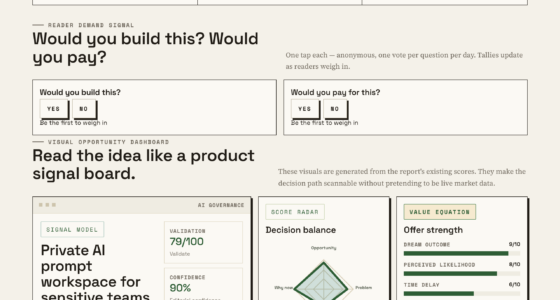

📊 Full opportunity report: How Anthropic Defends Claude: Security Shortcomings, Not Model Faults, Are The Culprits on ThorstenMeyerAI.com — validation score, market gap, and execution plan.
TL;DR
Anthropic has publicly stated that recent security incidents involving its AI model, Claude, resulted from security vulnerabilities rather than flaws within the model itself. However, specific details, evidence, and the scope of these incidents remain unclear, raising questions about the basis of their attribution.
Anthropic has publicly attributed recent security incidents involving its AI model, Claude, to security gaps rather than flaws within the model itself. The company’s position, reported by Dark Reading, emphasizes that the cause of these attacks lies outside the AI’s internal behavior, potentially shifting responsibility to deployment or access controls. However, no detailed technical evidence or incident reports have been disclosed, leaving the basis of this attribution unverified and the specifics of the attacks unclear.
According to a report by Dark Reading, Anthropic states that the recent attacks on Claude were caused by security gaps, not by inherent issues in the AI model. The company’s statement is a high-level attribution without providing technical details, incident timelines, or evidence supporting this claim. It remains unknown which specific attacks are being referenced, who conducted them, or what systems were involved.
Anthropic’s explanation does not specify the nature of the security gaps, whether they relate to account access, API controls, or software integrations. The company’s statement is an attribution rather than a verified forensic analysis, and no independent review or incident report has been made public to substantiate the claim.
As the available information is limited, security teams and affected organizations lack concrete evidence to evaluate whether the incidents were due to vulnerabilities in Claude or in the surrounding security infrastructure. The absence of detailed technical documentation means the true cause remains uncertain, and the scope or impact of the attacks is not specified.
Implications of Security Gaps Versus Model Flaws
This attribution influences how organizations respond to incidents involving Claude. If attacks are due to security gaps outside the model, remediation may focus on improving deployment controls, user permissions, and infrastructure security. Conversely, if the model itself were flawed, developer-led changes to Claude might be necessary.
Furthermore, the distinction affects contractual responsibilities, incident reporting, and risk assessments. Without clear evidence, organizations cannot determine whether to prioritize technical fixes within Claude or enhance their security controls around its deployment. The current lack of transparency complicates response strategies and risk management.

Artificial Intelligence for Cybersecurity: Develop AI approaches to solve cybersecurity problems in your organization
As an affiliate, we earn on qualifying purchases.
As an affiliate, we earn on qualifying purchases.
Background on AI Security Incidents and Attribution Challenges
Recent years have seen increased scrutiny of AI security incidents, with debates over whether vulnerabilities stem from the models themselves or from deployment environments. Companies often attribute attacks to external security flaws, but verifying such claims requires detailed forensic analysis.
Prior incidents involving AI systems have demonstrated how complex it can be to attribute causality accurately, especially when multiple layers of software, user permissions, and integrations are involved. Anthropic’s public statement follows a pattern of companies emphasizing security controls, but the lack of detailed incident disclosures leaves the true cause uncertain.
“The recent attacks on Claude resulted from security gaps, not model issues.”
— Anthropic spokesperson (reported by Dark Reading)

Observability in the AI-Native Era: Leveraging AIOps to build, observe, and operate resilient systems
As an affiliate, we earn on qualifying purchases.
As an affiliate, we earn on qualifying purchases.
Unverified Nature of Attack Details and Evidence
It is not yet clear which specific attacks Anthropic refers to, when they occurred, or what systems were involved. The company has not disclosed incident timelines, technical logs, affected components, or the nature of the security gaps claimed to be responsible.
Additionally, there is no independent verification or third-party analysis confirming Anthropic’s attribution. The absence of technical documentation and forensic evidence leaves the true cause of the incidents unresolved.

BEYOND THE BASICS: ADVANCED POWER PAGES SOLUTIONS: Getting the most out of Microsoft Power Pages
As an affiliate, we earn on qualifying purchases.
As an affiliate, we earn on qualifying purchases.
Next Steps for Clarification and Security Verification
The next significant development would be the release of detailed incident reports from Anthropic or independent investigators. Such reports could clarify the attack vectors, identify the failing controls, and verify whether the cause was external security gaps or internal model flaws.
Customers and security teams should monitor for any new disclosures, updates on mitigation measures, or independent reviews. Clarification from Anthropic regarding the nature of the security gaps and any changes to safeguards will be crucial for assessing ongoing risks.

Securing AI Agents: Foundations, Frameworks, and Real-World Deployment (Advances in Data Analytics, AI, and Smart Systems)
As an affiliate, we earn on qualifying purchases.
As an affiliate, we earn on qualifying purchases.
Key Questions
What did Anthropic say caused the Claude attacks?
Anthropic reportedly attributed the attacks to security gaps rather than problems within the Claude model, but no detailed evidence or technical explanation has been provided.
Were flaws in Claude ruled out?
No, Anthropic’s statement suggests the model was not the cause, but without a technical report, model-related issues cannot be definitively excluded.
What specific attacks or victims are involved?
The available information does not specify the incidents, attackers, affected organizations, or the extent of the impact.
What evidence would confirm Anthropic’s claim?
Detailed incident timelines, technical logs, attack path analyses, and independent reviews would be necessary to verify the attribution.
Source: ThorstenMeyerAI.com