
📊 Full opportunity report: How Commercial Real Estate Marketplaces Serve Small-Town Main Streets on IdeaNavigator AI — validation score, market gap, and execution plan.

Get business pricing on tech for your team
- Business-only prices and quantity discounts
- Tax-exempt purchasing
- Multiple users, one account, clear invoices
TL;DR
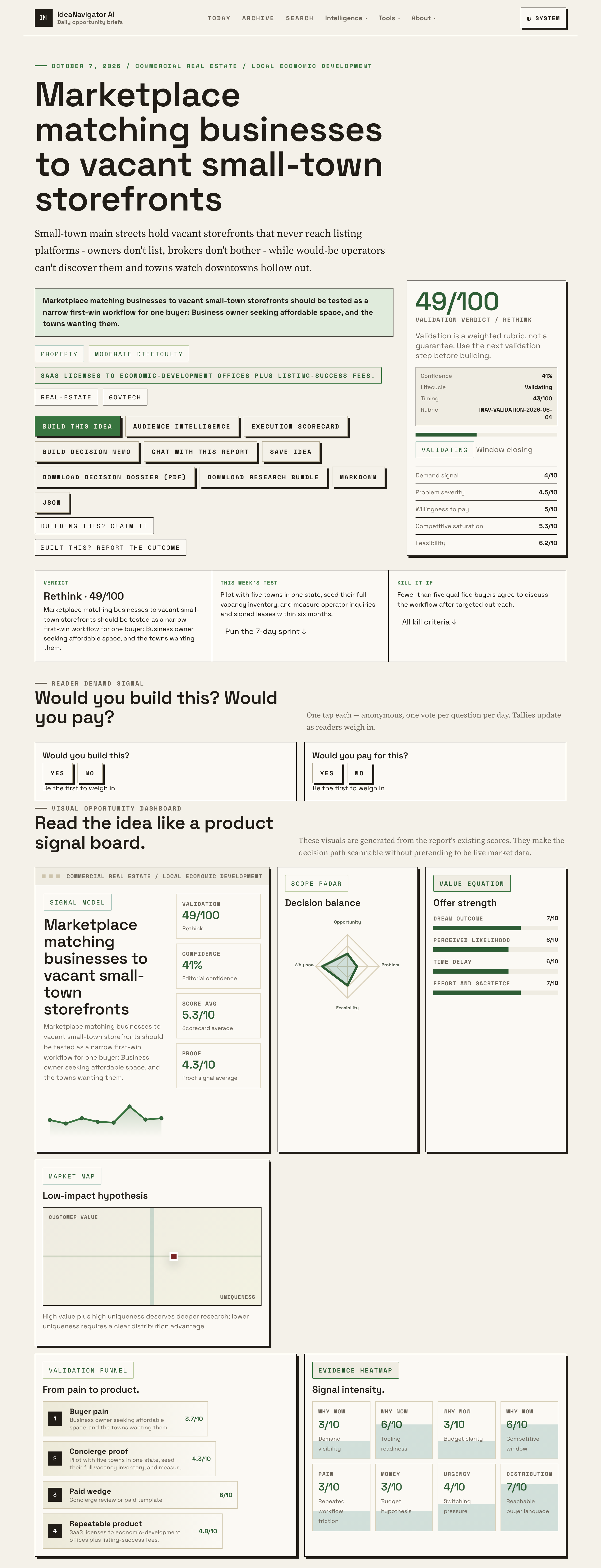
IdeaNavigator AI outlines a proposed marketplace to connect business operators with vacant storefronts in small towns and route interested prospects to local development offices. The concept has not been reported as a launched service; its proposed test is a five-town pilot tracking inquiries and signed leases over six months.
IdeaNavigator AI has proposed a digital marketplace to match vacant small-town storefronts with business operators, with local economic-development offices helping connect prospects to available incentives. The concept is a proposal, not a confirmed operating service; its suggested first test would cover five towns in one state and track inquiries and signed leases over six months, according to the IdeaNavigator AI proposal.
IdeaNavigator AI frames the proposal around a discovery gap: some small-town commercial property owners do not list vacant spaces online, while brokers may not pursue properties with limited demand. Operators searching for affordable premises can consequently struggle to find available units, even as towns seek businesses to occupy downtown storefronts. The proposal presents these conditions as a problem to test, not as a quantified measure of vacancies or lost leases.
For a minimum viable version, the proposal says property owners and towns would provide photos, floor area, rent and available incentive programs. Prospective operators could browse listings using town profiles and foot-traffic data. When an operator expresses interest, the platform would route the inquiry to the relevant local development office, with applicable grants or other incentives attached where available.
The proposed business model combines software licenses for economic-development offices with fees tied to successful listings. IdeaNavigator AI suggests seeding a pilot with each participating town’s full vacancy inventory, then measuring operator inquiries and signed leases within six months. The proposal identifies no participating towns, platform, funding commitments, cost estimates or pilot results.
Connecting Storefronts With Local Operators
If tested successfully, a shared marketplace could give small-business operators a more direct way to compare available spaces and give towns a channel to promote vacancies that are not on major listing platforms. IdeaNavigator AI’s proposal suggests routing prospects through development offices to put local incentives in front of potential tenants earlier in their search.
The proposal’s practical test is whether better visibility leads to qualified inquiries and completed leases, rather than simply adding listings. That distinction matters to town governments considering whether to pay for software and to property owners deciding whether to provide accurate information. The proposal provides no evidence that a marketplace would increase occupancy, improve downtown activity or produce a return for towns.
For business owners, a centralized inventory could reduce the effort involved in contacting multiple owners or offices. But the usefulness of the service would depend on whether listings are current, rents and terms are clear, and enough relevant spaces appear. A platform that misses unlisted properties or attracts few operators would not resolve the discovery problem it is meant to address.
Products Worth Considering

Bose SoundLink Flex (2nd Gen) Portable Bluetooth Speaker

Sony WH-1000XM6 Wireless Noise-Canceling Over-Ear Headphones, Blue, Bundle

Samsung 27 Odyssey OLED G5 (G50SF) QHD QD-OLED Gaming Monitor
As an affiliate, we earn on qualifying purchases.
The Proposed Pilot and Its Rationale
IdeaNavigator AI frames the idea around two groups: operators seeking affordable commercial space and towns hoping to attract businesses. Its proposal cites renewed interest in small-town commercial locations linked to remote-work migration and possible grant funding for business matching as reasons to explore the concept. It provides no migration figures, grant programs, budgets or named towns.
The suggested first step is deliberately limited: work with five towns in one state, compile their vacant-storefront inventories, and observe results for six months. As described by IdeaNavigator AI, this would let organizers test whether owners submit listings, whether operators use the search tools, and whether inquiries progress into signed leases. The proposal does not specify how foot traffic would be measured, which grant programs would be included, or how a lease would be attributed to the platform.
Pilot Details Remain Open
No launch or implementation is confirmed. IdeaNavigator AI’s proposal does not identify a developer, participating municipalities, property owners, investors or a schedule. It also provides no evidence that the suggested marketplace has been built, that a pilot has started, or that any storefront has been leased through it.
Several operating questions remain unresolved: who would verify listings and update rent or availability; how towns would supply comparable foot-traffic data; what qualifies as a successful listing; and how fees would be calculated. The proposal also does not name the grants that might be attached to inquiries or establish that funding is available to participating towns.
The stated six-month measurement period is a proposed validation method, not a reported result. Even if inquiries rise, the plan would need to distinguish casual interest from qualified prospects and completed leases. Without a baseline or comparison group, it may also be difficult to determine whether a lease resulted from the marketplace or other local efforts.
Evidence Needed Before Expansion
IdeaNavigator AI describes the next step as recruiting five towns in one state, gathering a complete inventory of vacant storefronts, and running the marketplace for six months. A useful public update would identify the participating communities, explain how listings and incentives are checked, and report counts of active properties, operator inquiries and signed leases.
Before towns adopt the service more broadly, they would need details on subscription and success-fee costs, data maintenance, privacy and the process for matching operators with owners. Results would also need enough context to show whether the pilot changed outcomes compared with existing leasing activity. IdeaNavigator AI has announced no timetable for recruitment, launch or publication of results.
Source: IdeaNavigator AI
Key Questions
Has the storefront marketplace launched?
No launch is reported. IdeaNavigator AI’s proposal describes a marketplace concept and a possible pilot, but does not name an operating platform or participating towns.
Who would use the proposed service?
The intended users, according to IdeaNavigator AI, are business operators looking for commercial space, property owners with vacant storefronts, and local economic-development offices that want to attract businesses.
What would listings include?
The proposal says listings would include photographs, storefront size, rent and available incentive programs. Operators would also be able to browse using town profiles and foot-traffic data.
How would the idea be tested?
IdeaNavigator AI suggests a six-month pilot across five towns in one state. Its proposed measures are operator inquiries and signed leases; no pilot results or participating locations have been reported.
Source: IdeaNavigator AI