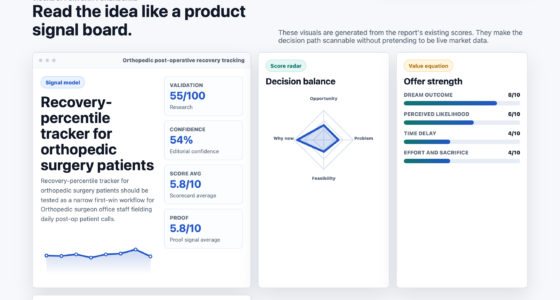

📊 Full opportunity report: AI Strategy Insights From Benchmark Partners You Can’t Find Elsewhere on ThorstenMeyerAI.com — validation score, market gap, and execution plan.
TL;DR
Benchmark’s Eric Vishria warns that AI markets will feature multiple winners across layers, challenging zero-sum assumptions. Differentiation and deep expertise are key for success.
Eric Vishria, a General Partner at Benchmark, has provided a detailed analysis of the evolving AI market, warning against the common misconception that a single winner will dominate. His insights, based on extensive experience and recent interviews, suggest a landscape where multiple companies will succeed across different layers, with no clear monopoly forming. This perspective challenges prevalent narratives and offers a nuanced view of AI’s economic reordering.
Vishria emphasizes that the AI market, much like the cloud industry before it, is too large and complex for a single entity to capture entirely. Drawing parallels from cloud computing’s evolution—where companies like Snowflake, Databricks, and Cloudflare thrived alongside Amazon and Microsoft—he argues that AI will follow a similar pattern of multiple large winners. His core warning is against zero-sum thinking, where industry narratives often assume one company will dominate an entire segment, which history shows is rarely the case.
He also highlights that many infrastructure and inference companies are not mere commodities, despite appearances. For example, Fireworks, a company running open-source models on NVIDIA hardware, achieves significantly higher efficiency than hyperscalers, illustrating that expertise and control can create durable advantages. Additionally, Vishria points out that hardware investments, such as those by Cerebras, differ fundamentally from software investments, requiring a different approach and understanding of control and moat-building.
Distilled from Eric Vishria (Benchmark) on Invest Like the Best. Less a set of predictions than a set of disciplines for reading this moment clearly rather than emotionally. Not investment advice.
The error that runs through every wrong AI prediction: carving up a fixed pie when the pie is exploding. The cloud era is the cautionary tale.
Implications of Multiple Winners in AI Markets
This analysis matters because it reshapes expectations around AI industry dominance. Instead of betting on a single company or technology, investors and entrepreneurs should recognize the likelihood of many successful players across different layers. The emphasis on differentiation and deep expertise suggests that building durable advantages is more about quality and control than scale alone, influencing investment strategies and competitive approaches.
As an affiliate, we earn on qualifying purchases.
Historical Lessons from Cloud Computing's Evolution
Vishria’s insights are grounded in the history of cloud computing, where initial skepticism gave way to a multi-vendor oligopoly with Amazon, Microsoft, and Google as dominant players. The period from 2007 to 2026 demonstrated that the market was too big for a single company to control, with many companies thriving in niches or on top of cloud infrastructure. This history informs his view that AI will follow a similar pattern, with multiple winners across different segments, rather than a single dominant entity.
"The market was simply too big for one vendor to consume. Snowflake, Databricks, and Cloudflare all became huge on top of Amazon and Microsoft, forming a durable oligopoly."
— Eric Vishria
AI model inference optimization tools
As an affiliate, we earn on qualifying purchases.
As an affiliate, we earn on qualifying purchases.
Unclear Aspects of AI Market Evolution
While Vishria's historical analogies and current observations are compelling, it remains uncertain how exactly AI market segments will fragment or consolidate over the next few years. The pace of technological breakthroughs, regulatory impacts, and shifts in enterprise adoption could alter the projected landscape. Additionally, the specific roles of emerging players and new business models are still developing, making precise predictions difficult.
As an affiliate, we earn on qualifying purchases.
Next Steps for Investors and Companies in AI
Stakeholders should focus on identifying and building deep expertise in specific AI segments, rather than seeking a single dominant platform. Monitoring how companies differentiate themselves through efficiency, control, and specialization will be crucial. Additionally, observing how the ecosystem evolves in terms of multiple large players and niches will inform strategic decisions. Further industry analysis and market data are expected to clarify the trajectory over the coming year.
As an affiliate, we earn on qualifying purchases.
Key Questions
Why does Vishria warn against zero-sum thinking in AI markets?
He argues that history shows markets are too large and complex for a single winner to dominate entirely, and zero-sum assumptions overlook the potential for multiple successful players across different layers and niches.
What does Vishria say about infrastructure companies like Fireworks?
He states that despite appearances, such companies are not mere commodities. Their efficiency gains come from deep expertise and control, which create durable competitive advantages.
How should companies approach differentiation in AI infrastructure?
Focusing on technical excellence, control over hardware or software layers, and specialized expertise are key to building sustainable moats in a competitive landscape.
Will there be a single dominant AI platform in the future?
According to Vishria, unlikely. Instead, expect an oligopoly with multiple large players succeeding across different segments, similar to the cloud industry.
What is the main lesson from cloud computing that applies to AI?
Markets are too big for one company to control fully; multiple winners will emerge, each carving out their niche through differentiation and expertise.
Source: ThorstenMeyerAI.com