📊 Full opportunity report: An Empty Trust Tracker For Organizing Probate Information on IdeaNavigator AI — validation score, market gap, and execution plan.

Get business pricing on tech for your team
- Business-only prices and quantity discounts
- Tax-exempt purchasing
- Multiple users, one account, clear invoices
TL;DR
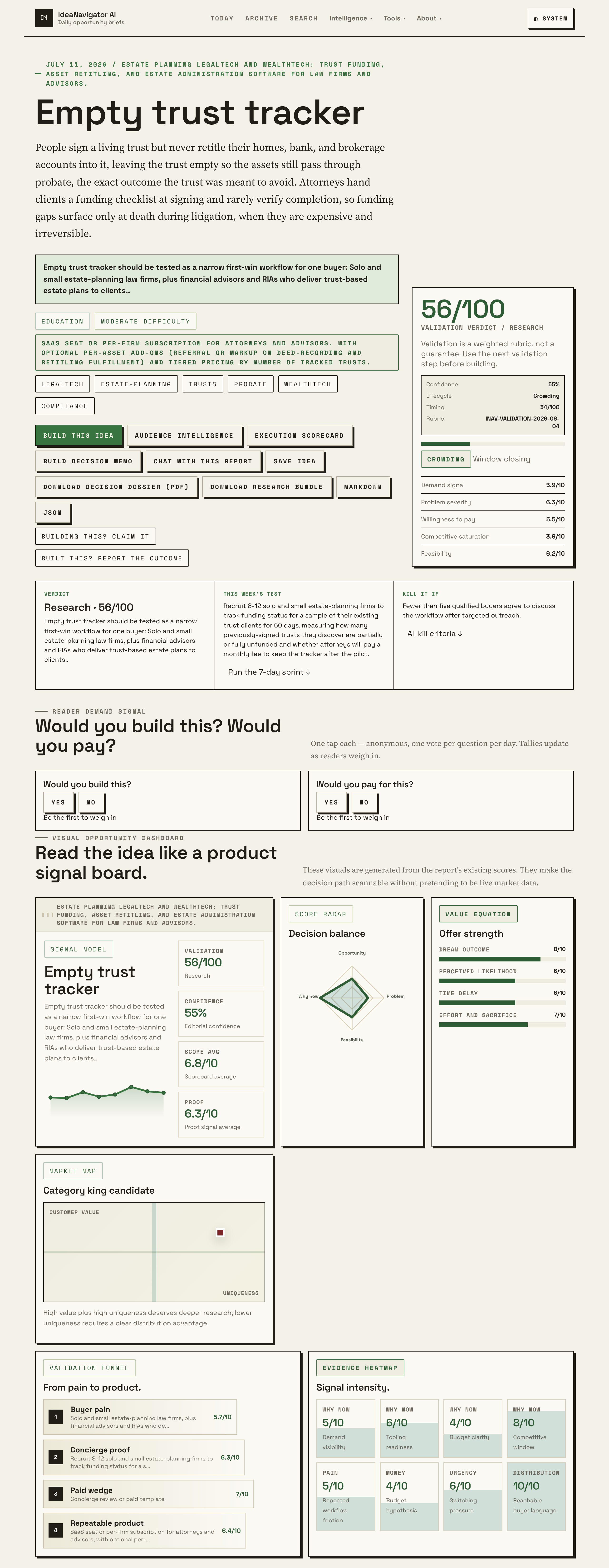
IdeaNavigator AI has outlined an empty trust tracker concept for small estate-planning law firms, financial advisers and RIAs. The proposed tool would record trust assets, funding status and supporting documents, but it is an idea for testing, not a launched product or a validated service.
IdeaNavigator AI has proposed an empty trust tracker for solo and small estate-planning law firms, financial advisers and registered investment advisers (RIAs), aiming to help them see whether clients transfer assets into living trusts after signing. The concept remains at the validation stage: no pilot results, product launch or customer commitments are reported.
According to the IdeaNavigator AI proposal, the service would let a firm create a funding checklist for each trust, covering assets such as real estate, bank and brokerage accounts, business interests and beneficiary designations. Staff or clients could mark items as pending, in progress or confirmed funded, then attach supporting records such as a recorded deed or a statement showing an account was retitled. The proposal also suggests automated reminders to prompt clients to complete outstanding steps.
The proposal describes a firm dashboard that would summarize the funding status across its client trusts, including each trust’s share of completed items. It suggests subscription pricing by seat or firm, with tiers based on the number of trusts tracked. Optional per-asset fees or referrals for deed recording and retitling services are described as possible revenue streams, not established pricing.
To test demand, the proposal calls for recruiting 8 to 12 small firms to track a sample of existing trust clients for 60 days. It suggests measuring how many signed trusts are found to be partly or fully unfunded, and whether participating attorneys would pay to keep using the tracker. The proposal does not identify participating firms, enrollment dates or pilot findings.
The Gap After Trust Signing
A signed living trust does not by itself move a person’s assets into the trust. The IdeaNavigator AI proposal focuses on that follow-through: when property or accounts are not retitled, those assets may not receive the probate-avoidance treatment the trust was intended to provide, depending on the asset, ownership and applicable law. The proposal suggests a shared tracker could give a firm a clearer view of unfinished steps while the client is available to address them.
The proposal’s premise is that firms often give clients a checklist at signing but do not routinely confirm each transfer, so problems may surface only after the trust maker dies, when correction can be difficult and disputes costly. Whether the proposed reminders and dashboard would materially improve completion rates, reduce disputes or save firms time has not been demonstrated.
Top picks for "empty trust tracker"
As an affiliate, we earn on qualifying purchases.
A Manual Step in Estate Planning
Trust funding involves moving or designating assets in ways that align with an estate plan. The IdeaNavigator AI proposal notes that the work can involve different institutions and processes, including recording a deed for real estate and changing ownership or beneficiary information for financial assets. Document-preparation systems may create trust paperwork, while the subsequent transfers still require action by clients, firms and third parties.
The proposal says that about 11% of Americans hold a trust, but does not give a date, survey method or definition for that figure. It also points to deed-funding services priced from $250 as evidence of a paid market, without details on providers, geography or service scope. These figures are claims in the proposal; they offer context for the idea but do not establish demand for a tracking product.
Pilot Results Are Not Available
The central question is whether firms and clients would use a tracker consistently enough to close funding gaps. The IdeaNavigator AI proposal provides no pilot data on the share of trusts left unfunded, how often clients respond to reminders, or whether firms would pay the suggested subscription. It also does not identify a product, launch date or participating organizations.
The proposed dashboard depends on accurate status updates and credible documentation. The proposal does not specify who would verify attached records, how the product would handle incomplete or conflicting information, or how it would protect sensitive estate and financial documents. It also does not explain how the workflow would vary across asset types or jurisdictions. These details would need to be addressed in product development and validation.
A 60-Day Firm Pilot
The next step described in the IdeaNavigator AI proposal is a 60-day pilot with 8 to 12 firms. A useful report from that test would need to state how firms select client files, what counts as funded, how many trusts have each status, and whether clients complete transfers after reminders. It would also need to distinguish newly discovered gaps from actions completed during the trial.
After the pilot, willingness to pay would help determine whether the tracker merits a subscription product or a different service model. The proposal gives no timetable for recruiting firms or publishing findings. Until results are available, it is best understood as a workflow concept responding to an administrative challenge, rather than evidence that a new tool has solved it.
Source: IdeaNavigator AI
Key Questions
What is the empty trust tracker?
It is a proposed tool for firms to record which assets clients intend to place in a living trust, track each item’s status and attach supporting documents. The IdeaNavigator AI proposal does not report a launched product.
Who is the proposed tracker for?
IdeaNavigator AI identifies solo and small estate-planning law firms, financial advisers and RIAs that provide trust-based estate plans as potential users.
How would the proposed pilot work?
The proposal calls for 8 to 12 firms to track funding status for a sample of existing trust clients over 60 days, then assess discovered funding gaps and attorneys’ willingness to pay.
Are pilot findings or prices available?
No pilot findings or confirmed tracker prices are reported. Subscription tiers and per-asset fees are suggested business models in the IdeaNavigator AI proposal, not announced rates.
Source: IdeaNavigator AI
Fall Picks
fall essentials
As an affiliate, we earn on qualifying purchases.