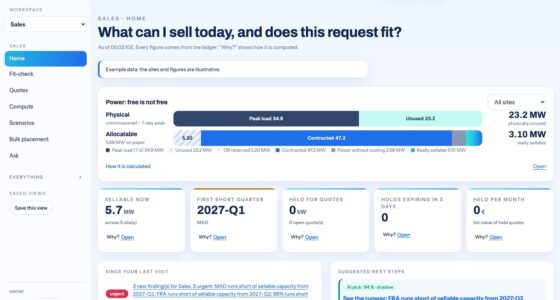
📊 Full opportunity report: Find The Right Influencer Mix For Your Ecommerce Launch on IdeaNavigator AI — validation score, market gap, and execution plan.

Get business pricing on tech for your team
- Business-only prices and quantity discounts
- Tax-exempt purchasing
- Multiple users, one account, clear invoices
TL;DR

A proposal from IdeaNavigator AI outlines a tool to help direct-to-consumer brands choose influencer rosters for product launches, using audience-fit signals, engagement authenticity and category sales history where available. The concept has not been shown to improve sales; its proposed test is to score rosters for 10 launches before they happen, then compare predictions with attributed sales.
IdeaNavigator AI has proposed a scoring tool to help direct-to-consumer brands select influencers for product launches, ranking candidates by audience fit, engagement authenticity and category sales history where data is available. The concept is a product proposal, not a reported launch or proven sales method; its suggested validation is to make predictions for 10 launches and compare them with later attributed sales.
These details come from IdeaNavigator AI’s published proposal; no independent test results are cited.
In its proposal, IdeaNavigator AI describes a workflow aimed at a DTC brand planning an influencer roster for a product launch. A brand would enter product and target-customer information, then receive a ranked list of candidate creators and suggested offer structures. The proposal does not specify how candidates would be sourced, how scores would be weighted or what data thresholds would be required.
IdeaNavigator AI says candidate assessments would combine audience-fit signals, checks on engagement authenticity and category conversion history where available. The proposal identifies affiliate links, post-purchase surveys and Spark Ads data as possible inputs for measuring sales impact, while saying that such information is spread across tools. It does not report that the data has already been integrated or that the scoring has been tested against campaign results.
The proposed business model is a subscription tiered by roster volume scored. To test predictive value, IdeaNavigator AI recommends scoring influencer rosters before 10 launches, preserving those predictions, and comparing them with realized sales attributed to each influencer. The proposal reports no completed tests, performance figures, pricing or customer commitments.
A Better Basis for Launch Rosters
For brands that spend on creator partnerships, the proposal addresses a measurement problem: a roster chosen by follower count or subjective impressions may not reveal which partners generated purchases. If pre-launch scores reliably forecast attributed sales, teams could use the results to make more consistent choices about creator selection and offer design, and potentially carry lessons from one launch into the next.
That value is conditional. IdeaNavigator AI’s proposed test would need to show that rankings align with sales outcomes, not simply that the tool can produce a score. Attribution can be incomplete or inconsistent across channels, and sales may reflect factors beyond a single influencer. The proposal supplies no results showing that its approach outperforms existing selection methods or improves return on spending.
influencer marketing analytics tools
As an affiliate, we earn on qualifying purchases.
As an affiliate, we earn on qualifying purchases.
From Creator Choice to Measurement
IdeaNavigator AI’s proposal describes a decision point for direct-to-consumer businesses: assembling a creator roster ahead of a product launch, when sales outcomes are not yet known. It argues that teams may rely on follower counts and subjective judgments, then assess partner performance after the campaign. The proposal’s premise is that this can leave brands paying repeatedly to learn which partnerships work, without a consistent record to guide later pricing or selection.
The proposal identifies data sources that can help connect creator activity to purchases, including affiliate links, post-purchase surveys and Spark Ads data. It says those signals are distributed across tools, but provides no audit of how commonly brands use them, how complete the resulting attribution is, or whether the signals can be compared reliably. The suggested product sits in influencer marketing analytics, but remains an outlined opportunity rather than a documented service.
influencer engagement authenticity checker
As an affiliate, we earn on qualifying purchases.
As an affiliate, we earn on qualifying purchases.
The Prediction Test Is Pending
No validation results are provided. IdeaNavigator AI presents the 10-launch exercise as a proposed method, not evidence that it has been conducted. The proposal does not identify participating brands or product categories, define attributed sales, set a tracking period, or explain how the scoring would handle creators with little category history.
The proposal also leaves open how it would verify engagement authenticity, account for differences in offer terms and campaign reach, and compare its rankings with simpler approaches such as follower counts or past sales. Pricing, data access, privacy practices and product availability are not specified. Those details matter because incomplete or uneven attribution could make a ranking appear more precise than the underlying evidence supports.
influencer sales attribution software
As an affiliate, we earn on qualifying purchases.
As an affiliate, we earn on qualifying purchases.
Compare Sealed Scores With Sales
IdeaNavigator AI’s proposal describes scoring rosters for 10 launches before results are known, preserving those predictions, and comparing them with per-influencer attributed sales after each launch. A useful report would explain the measurement window, attribution method, scoring criteria and comparison baseline, as well as how missing data is treated.
Until that work is reported, the concept should be understood as a testable product proposal. The source does not announce a launch date, participating brands or follow-up findings. The key development to watch is whether the proposed validation produces results showing that scores predict sales consistently enough to inform roster and offer decisions.
Source: IdeaNavigator AI
product launch influencer scoring tool
As an affiliate, we earn on qualifying purchases.
As an affiliate, we earn on qualifying purchases.
Key Questions
Is the influencer-scoring tool available now?
IdeaNavigator AI’s proposal describes an MVP concept, but does not say that a product has launched or is available to brands.
What information would the proposed tool use?
According to the proposal, it would take product and target-customer details, then assess candidates using audience fit, engagement authenticity and category conversion history where available. It also identifies affiliate links, post-purchase surveys and Spark Ads data as possible sales-measurement inputs.
Has the scoring method been shown to increase sales?
No results are reported in IdeaNavigator AI’s proposal. Its suggested validation is to score rosters for 10 launches in advance and compare the predictions with realized attributed sales.
How would the proposed business make money?
The proposal outlines a subscription with tiers based on the number of influencer rosters scored. It gives no specific prices or subscription plans.
Source: IdeaNavigator AI
Halloween Picks
halloween
As an affiliate, we earn on qualifying purchases.