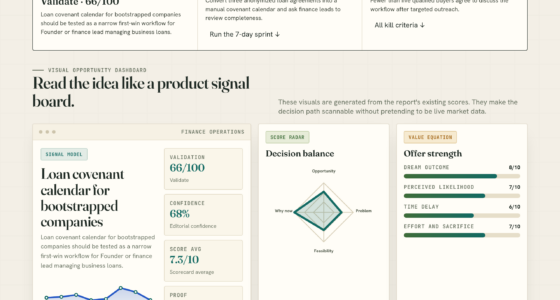
📊 Full opportunity report: How Automated Kitchen Inspections Improve Food Safety Outcomes on IdeaNavigator AI — validation score, market gap, and execution plan.

Get business pricing on tech for your team
- Business-only prices and quantity discounts
- Tax-exempt purchasing
- Multiple users, one account, clear invoices
TL;DR
Automated kitchen inspections using vision-model AI are being tested to verify food safety compliance. Early results suggest these tools can improve accuracy and consistency, potentially transforming restaurant safety protocols.
Automated kitchen inspections using vision-model AI are being tested at several restaurant locations to verify food safety compliance more reliably than traditional checklists. This development aims to address longstanding issues with manual inspections, which often rely on tick-boxes that do not verify actual conditions, potentially improving food safety outcomes.
The initiative involves capturing photos during morning walk-throughs of kitchen areas, including prep stations, storage, and sinks. A vision model analyzes these images to detect violations such as uncovered food, propped cooler doors, or missing date labels, and assigns severity ratings. The system then generates timestamped reports, enabling managers to track compliance trends across multiple locations.
According to an anonymous researcher involved in the project, initial testing at five restaurant sites over two weeks will compare the AI’s flagged violations against findings from a hired health-inspection consultant. This validation aims to establish the accuracy and reliability of the AI system in real-world conditions.
Potential Impact on Food Safety Monitoring
This technology could significantly improve the accuracy of food safety inspections by providing verifiable, timestamped photographic records. It reduces reliance on subjective human judgment and tick-box checklists that often fail to capture actual conditions, potentially leading to fewer violations and safer food handling practices.
For restaurant operators, this means more consistent compliance, easier documentation for audits, and the ability to identify recurring issues before they escalate. If successful, this approach could set a new standard for food safety monitoring in the industry.
As an affiliate, we earn on qualifying purchases.
Current Challenges in Restaurant Food Safety Inspections
Traditional inspections rely heavily on manual checklists completed by staff or inspectors, which are prone to oversight and sometimes intentionally incomplete. Many violations, such as uncovered food or improper labeling, are often only discovered during formal health inspections. Recent advancements in AI vision models now enable automated analysis of photos taken during routine walk-throughs, offering a potential solution to improve verification and accountability.
While the technology shows promise, it is still in early testing phases, with validation required to confirm its effectiveness across diverse kitchen environments and operational workflows.
“The AI system can reliably flag violations from standard phone photos, turning routine walk-throughs into verifiable inspection data.”
— an anonymous researcher
kitchen inspection photo analysis tool
As an affiliate, we earn on qualifying purchases.
As an affiliate, we earn on qualifying purchases.
Uncertainties Surrounding AI Inspection Effectiveness
It is not yet clear how well the AI system will perform across different kitchen layouts, lighting conditions, and food preparation styles. The accuracy of violation detection and the rate of false positives or negatives remain to be fully established through ongoing testing. Additionally, the long-term impact on compliance rates and food safety outcomes has yet to be measured.
restaurant compliance verification device
As an affiliate, we earn on qualifying purchases.
As an affiliate, we earn on qualifying purchases.
Next Steps in Validation and Industry Adoption
The ongoing testing at five restaurant locations will continue for at least two more weeks, with results informing further development. If validation confirms high accuracy, vendors plan to expand the system to more sites and introduce group dashboards for management oversight. Broader industry adoption will depend on demonstrated reliability and cost-effectiveness.
As an affiliate, we earn on qualifying purchases.
Key Questions
How does the AI system identify food safety violations?
The system analyzes photos taken during routine walk-throughs, automatically detecting issues such as uncovered food, improper labeling, or propped cooler doors, and assigns severity ratings based on the findings.
Will this replace human inspectors?
Currently, the AI system is designed to augment existing inspection processes by providing verifiable records and flagging potential violations, but human oversight remains essential for final assessments and compliance decisions.
What are the benefits of using AI in kitchen inspections?
AI can improve inspection consistency, reduce human error, provide timestamped records for audits, and enable early detection of violations, ultimately enhancing food safety outcomes.
When might this technology become widely available?
If validation proves successful, vendors expect to roll out the system to additional locations within the next year, with broader industry adoption following validation and refinement.
Are there privacy or operational concerns?
Since the system relies on standard phone photos taken during routine checks, privacy concerns are minimal. Operationally, integration with existing workflows will require training and adjustments, which are being addressed in pilot programs.
Source: IdeaNavigator AI
Fall Picks
fall essentials
As an affiliate, we earn on qualifying purchases.