
TL;DR
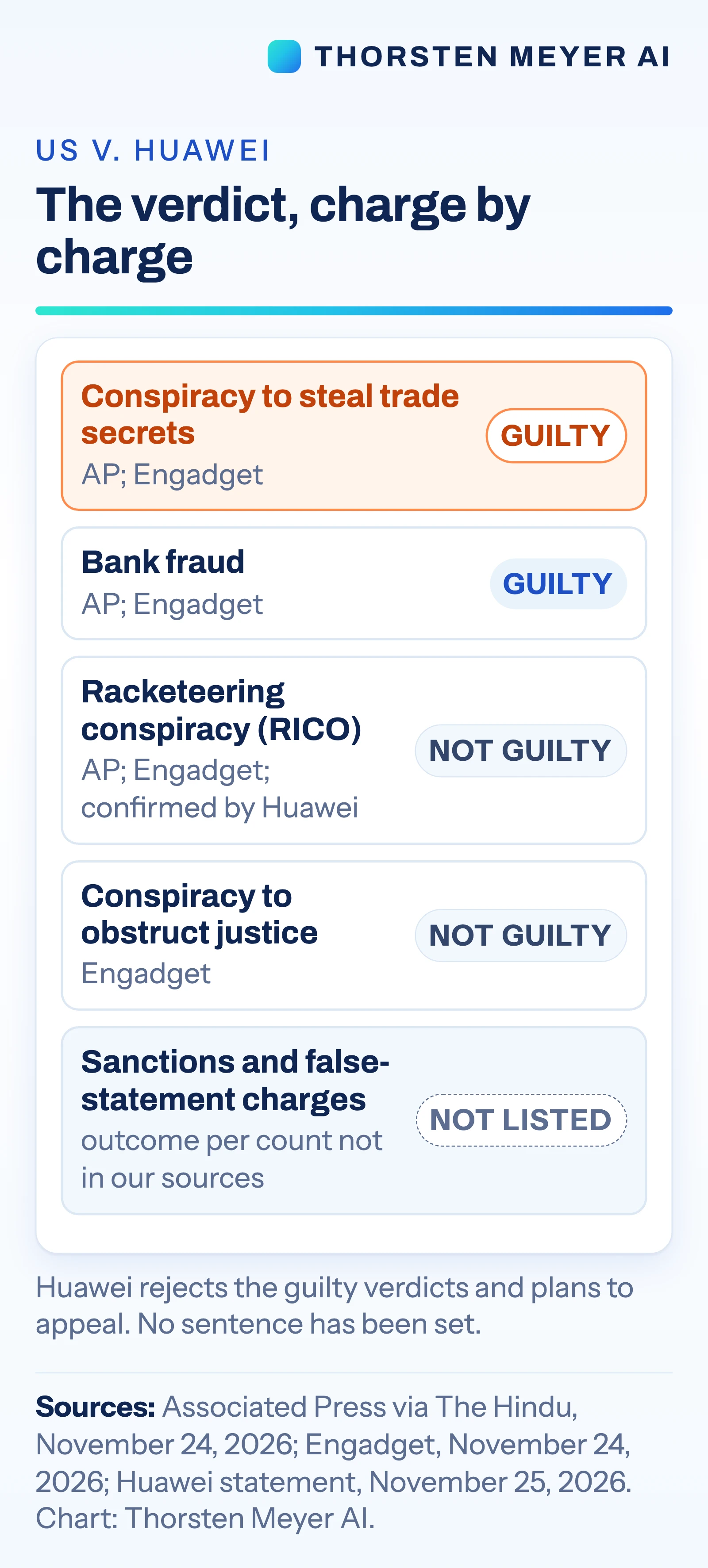
A federal jury in Brooklyn found Huawei guilty of conspiring to steal trade secrets and of bank fraud, while acquitting the company of racketeering conspiracy. Huawei rejects the remaining charges and plans to appeal; a sentencing date and possible penalty have not been reported in the available sources.
The eleven-week trial ended with a split decision on charges stemming from a U.S. case first brought in 2019 and later expanded. The jury convicted Huawei of trade secret conspiracy and bank fraud, according to the AP. It found the company not guilty of racketeering conspiracy, described in the source reports as the most serious charge.

Get business pricing on tech for your team
- Business-only prices and quantity discounts
- Tax-exempt purchasing
- Multiple users, one account, clear invoices
Huawei confirmed its acquittal on the racketeering charge in a statement and said it “welcomes this decision.” The company also called the remaining charges “without legal or factual merit” and said it rejects them. The AP reported that Huawei’s lawyer said the company plans to appeal. A possible penalty has not been set in the source material, which also gives no sentencing date.
Prosecutors alleged a pattern of obtaining competitors’ protected technology and making false statements to banks and U.S. officials. The indictment, as described by the AP, included allegations involving copied source code, photographs secretly taken inside a competitor’s trade show booth, and a robotic arm removed from a rival’s laboratory for measurement. These are prosecutors’ allegations; the verdict establishes the jury’s findings on the charges, not every allegation in the indictment.
What the Split Verdict Changes
The verdict leaves Huawei facing criminal convictions while drawing a boundary around what the jury found proven: it convicted the company on trade secret conspiracy and bank fraud, but did not find it guilty of racketeering conspiracy. The split matters because the racketeering count was the broadest charge described in the reports, and its rejection narrows the outcome of the case.
For businesses that hold valuable technical information, the allegations show the kinds of conduct prosecutors may pursue as trade secret theft: access to source code, devices, and laboratory equipment. The case also highlights that proving a corporate pattern under a racketeering charge is distinct from proving other alleged crimes. The jury’s decision does not by itself establish a general rule for future cases.
The immediate commercial effect appears limited based on the sources. Huawei was already barred from selling its equipment in the United States, and the reports do not identify a new trade restriction arising from this verdict. The AP has described Huawei as a major alternative to Nvidia chips within China, but the verdict does not itself change that market position, and the available reporting does not detail any effect on the company’s chip business.
Products Worth Considering

Bose TV Speaker (2nd Gen) Compact Soundbar with Bluetooth, HDMI-ARC, and Remote

Apple AirPods Pro 3 Wireless Earbuds with Active Noise Cancellation

Sony WH-1000XM6 Wireless Noise-Canceling Headphones, Black
As an affiliate, we earn on qualifying purchases.
How the Case Reached Trial
The U.S. government announced criminal charges against Huawei in early 2019 and later expanded the case, the AP reported. Prosecutors accused the company of trade secret theft, dealings involving countries under U.S. sanctions, and misleading banks and government officials. Huawei denied wrongdoing during the trial.
According to the AP’s account of the indictment and court records, companies named as alleged victims included Cisco Systems, Motorola Solutions, T-Mobile, Quintel USA, and Fujitsu. The alleged conduct included copied router source code, covert photographs of a competitor’s device at a Chicago trade show, and the removal of a robotic arm from a rival’s lab so it could be examined. The prosecution also alleged that Huawei concealed business with sanctioned countries including Iran and North Korea.
Trade secrets are commercially valuable information kept from public access, such as source code, circuit designs, or technical processes. The conspiracy charge concerned whether people acting for Huawei agreed to obtain protected information unlawfully and took steps toward that aim. Racketeering conspiracy was a separate charge. The jury’s acquittal on that count means it did not convict Huawei of that offense.
““Welcomes this decision.””
— Huawei, in a statement reported November 25, 2026
Sentencing and Appeal Still Pending
The available sources do not state when Huawei will be sentenced or what penalty prosecutors may seek. They also do not provide a court filing date or timetable for the planned appeal. Those steps could clarify how the convictions proceed, but no outcome should be assumed from the company’s stated intention to appeal.
The verdict resolves the charged counts as decided by the jury, but the source reports do not give a full count-by-count explanation of the trial evidence or the jury’s reasoning. They also do not establish whether the case will have any practical effect on Huawei’s operations outside the United States or on its position in China’s AI chip market.
Court Action and Appeal Ahead
The next reported milestones are sentencing and Huawei’s planned appeal. The company has said it rejects the remaining charges, but the available reporting does not specify when it will file an appeal or identify the arguments it intends to raise.
Until the court sets a sentencing date and further filings become public, the penalty and appeal schedule remain open. Updates from the court and statements from Huawei or prosecutors may clarify those points.
Key Questions
What did the jury find Huawei guilty of?
The jury convicted Huawei of conspiracy to steal trade secrets and bank fraud, according to the Associated Press.
Was Huawei found guilty of racketeering?
No. The jury acquitted Huawei of racketeering conspiracy, the most serious charge described in the source reports.
Will Huawei appeal the convictions?
Huawei said it rejects the remaining charges, which it called “without legal or factual merit.” Its lawyer told the AP the company plans to appeal. The available sources do not give a filing date.
Has the court set Huawei’s penalty?
No penalty or sentencing date appears in the available source material. Sentencing remains a pending step.
Does the verdict change Huawei’s U.S. sales status?
The source material says Huawei was already barred from selling its equipment in the United States. It reports no new sales restriction tied to this verdict.
Source: Thorsten Meyer AI