
📊 Full opportunity report: Operational SOP drift detector for franchise operators on IdeaNavigator AI — validation score, market gap, and execution plan.

Get tech for your team delivered free — and shop member deals
- Fast, free delivery on millions of items
- Access to Prime Big Deal Days deals on October 6–7
- Prime Video, Amazon Music and more included
TL;DR
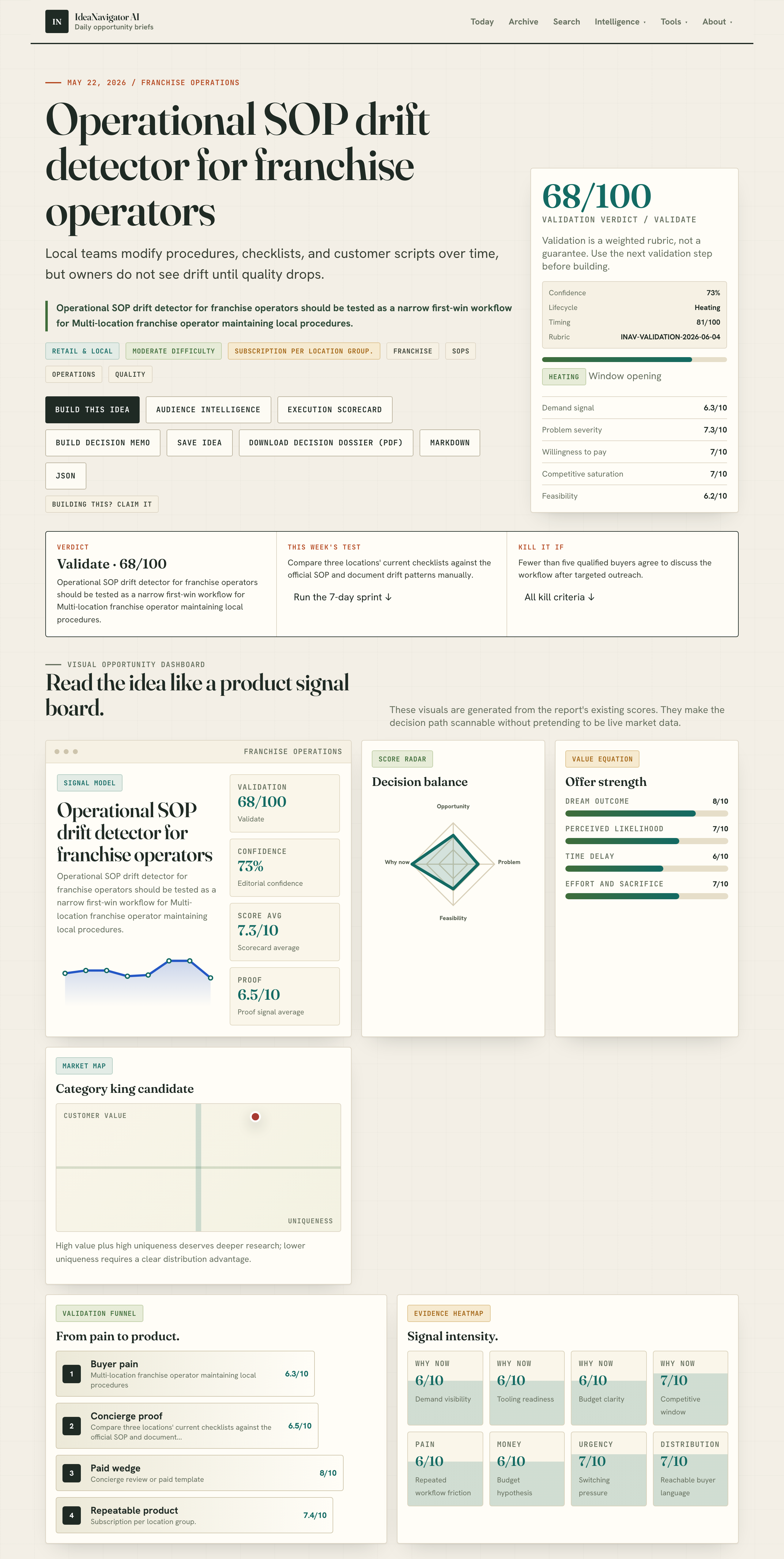
A prototype SOP drift detection tool is being tested for franchise operators managing multiple locations. It aims to identify deviations in procedures, helping maintain quality without costly enterprise software. The initial test compares checklists across locations to detect changes.
A new operational SOP drift detection tool is being tested for multi-location franchise operators to identify deviations in local procedures, helping maintain quality and consistency without requiring enterprise-level software.
The proposed tool is designed as a monthly comparison system that highlights changes in standard operating procedures, missing acknowledgments, and incomplete training follow-ups across franchise locations. It aims to address the common issue where local teams modify procedures over time, often without franchise owners’ awareness, leading to potential drops in service quality.
This initial prototype involves manually comparing checklists from three different locations against the official SOP to detect drift patterns. The approach is intended as a low-cost, scalable solution for small to medium franchise operators who seek better oversight without investing in expensive enterprise software.
Developed with franchise operations in mind, the tool would operate on a subscription basis per location group, providing regular updates and alerts when deviations are detected. The project is still in the validation stage, with further testing needed to refine its accuracy and usability.
Why Franchise Consistency Matters in Operations
Maintaining consistent procedures across multiple franchise locations is crucial for brand integrity, customer experience, and operational efficiency. Small franchise operators often struggle with ensuring local teams adhere to official standards, especially as procedures evolve over time. The introduction of a drift detection tool could offer a cost-effective way to monitor and address deviations proactively, reducing quality drops and safeguarding brand reputation.
By enabling franchise owners to identify procedural drift early, this technology could prevent costly mistakes, improve training effectiveness, and foster a more uniform customer experience across locations. It also offers a scalable solution tailored to smaller operators who cannot afford comprehensive enterprise software solutions.
franchise SOP compliance checklist
As an affiliate, we earn on qualifying purchases.
As an affiliate, we earn on qualifying purchases.
Addressing Procedure Drift in Franchise Management
Procedure drift occurs when local teams modify checklists, customer scripts, or operational steps over time, often without formal oversight. This phenomenon can lead to inconsistencies in service quality and compliance issues, especially in multi-location franchises. Currently, franchise operators rely on manual audits or periodic reviews, which can be time-consuming and reactive.
The idea of a drift detection system aligns with recent trends toward digital monitoring tools that help small and medium-sized franchises maintain standards without heavy investments. The concept has gained traction as franchise operators seek scalable, affordable solutions to ensure procedural adherence across multiple locations.
This initiative builds on existing challenges, aiming to provide a practical, monthly comparison process that highlights changes and facilitates timely corrective actions.
“A simple comparison tool could significantly improve oversight for small franchise operators by highlighting procedural changes before they impact quality.”
— an anonymous researcher
procedure drift detection software
As an affiliate, we earn on qualifying purchases.
As an affiliate, we earn on qualifying purchases.
Uncertainties in Deployment and Effectiveness
It is not yet clear how accurately the prototype will identify meaningful procedural drift, especially in larger or more complex franchise networks. The validation process is ongoing, and initial manual comparisons may not fully represent the system’s potential accuracy or usability in live environments. Additionally, the frequency of updates and the scope of detection features are still under development, and user feedback will be critical to refine the tool.
As an affiliate, we earn on qualifying purchases.
Next Steps for Validation and Scaling
The next phase involves expanding testing to more franchise locations to evaluate the tool’s effectiveness in real operational settings. Developers plan to automate the comparison process further, incorporate user feedback, and explore integration options with existing franchise management systems. If successful, the tool could be offered as a subscription service, with ongoing updates and feature enhancements based on user needs.
quality control checklist for franchises
As an affiliate, we earn on qualifying purchases.
As an affiliate, we earn on qualifying purchases.
Key Questions
How does the SOP drift detection tool work?
The tool compares official SOP checklists against local checklists from multiple locations each month, highlighting changes, missing steps, and incomplete acknowledgments to detect procedural drift.
Who is this tool designed for?
It is aimed at small to medium franchise operators managing multiple locations who want to ensure procedural consistency without investing in expensive enterprise solutions.
When will the tool be available for wider use?
The project is currently in testing, with further validation needed. A commercial release is not yet scheduled but could follow successful pilot results within the next year.
What are the main benefits of using this drift detector?
It can help franchise owners identify procedural deviations early, maintain brand consistency, improve training, and prevent quality issues across locations.
Are there limitations to the current prototype?
Yes, initial validation is manual, and accuracy in complex networks remains unproven. Automation and integration features are still under development.
Source: IdeaNavigator AI
Halloween Picks
halloween
As an affiliate, we earn on qualifying purchases.