📊 Full opportunity report: Retirement Care Planner on IdeaNavigator AI — validation score, market gap, and execution plan.

Get business pricing on tech for your team
- Business-only prices and quantity discounts
- Tax-exempt purchasing
- Multiple users, one account, clear invoices
TL;DR
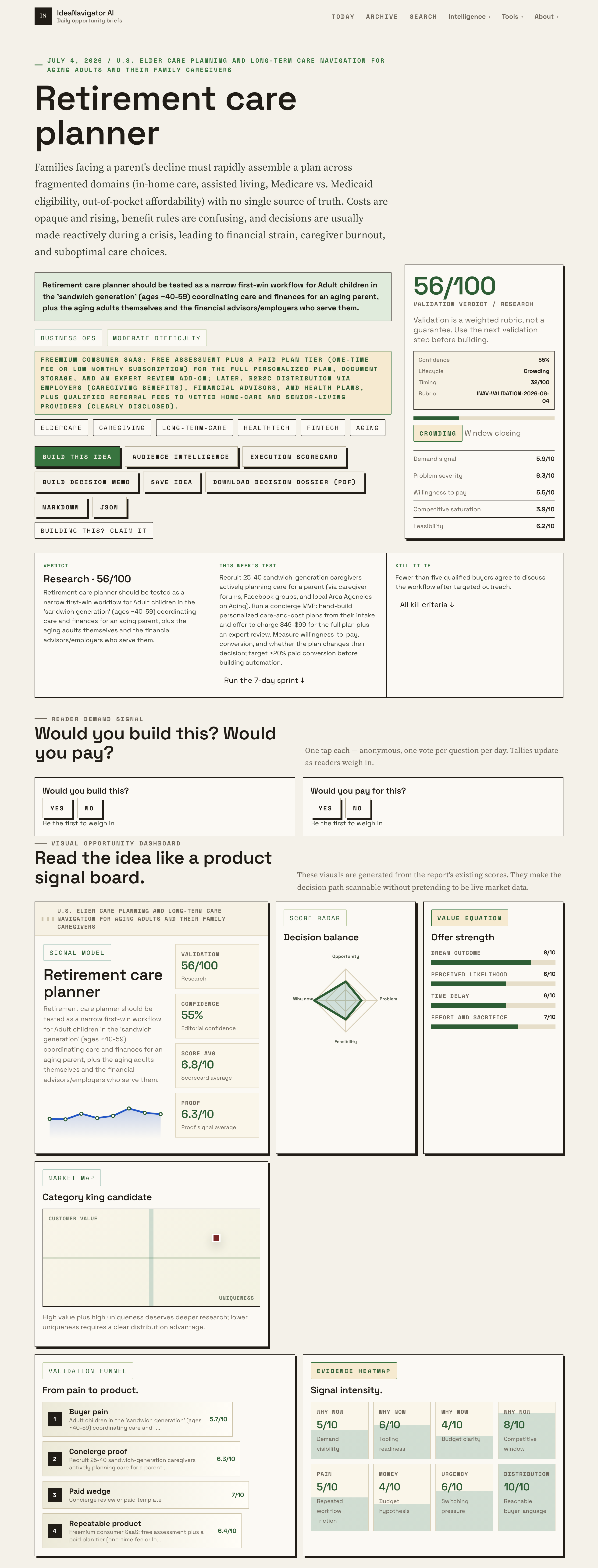
A proposed retirement care planning tool is in early testing to assist ‘sandwich generation’ families in managing complex elder care decisions. It offers personalized cost and care options based on individual situations. The initiative responds to rising costs and the need for structured guidance.
A new prototype web app designed to guide middle-aged family caregivers through planning for their aging parents’ long-term care is currently in the testing stage. This development aims to address the widespread challenges families face, including opaque costs, complex benefit rules, and reactive decision-making during crises.
The initiative targets adults aged 40-59 in the ‘sandwich generation’, who are balancing their own lives with the care of aging parents. You can learn more about appointment no-show recovery strategies for healthcare providers. The app, developed by a team exploring market needs, will provide a personalized care-and-cost plan after a brief intake process covering health, location, finances, and family dynamics. It will generate localized cost comparisons—such as in-home care versus assisted living or nursing homes—using public benchmark data, and explain Medicare versus Medicaid eligibility.
Early testing involves recruiting 25-40 caregivers actively planning or managing their parents’ care, primarily through caregiver forums and local agencies. Consider using an appointment no-show recovery planner to improve scheduling efficiency. The initial version will offer a free assessment, with a paid tier providing detailed plans, document storage, and optional expert review to support decision-making. The goal is to validate willingness-to-pay, plan impact on decision-making, and user engagement before automating the process further.
Potential Impact on Family Caregiving and Costs
This project addresses a critical gap in elder care planning by providing structured, personalized guidance to families facing complex, costly, and often reactive decisions. As the U.S. population ages—projected to reach 73 million Americans over 65 by 2030—such tools could reduce financial strain, caregiver burnout, and suboptimal care choices. The initiative’s success could lead to broader adoption of digital planning solutions, influencing how long-term care is coordinated and financed.
As an affiliate, we earn on qualifying purchases.
Rising Costs and Complexity Drive Need for Structured Planning
The U.S. elder care market has seen sharp increases in costs, with median assisted living expenses reaching approximately $6,200 monthly and nursing home costs around $115,000 annually. Meanwhile, the number of seniors needing long-term care is expected to grow significantly, putting pressure on families and the healthcare system. Currently, families often make decisions reactively, with fragmented information and opaque pricing, leading to financial and emotional stress.
Existing solutions are limited, and there is a growing demand for accessible, personalized tools that help families navigate this complex landscape proactively. The new app aims to fill this gap by offering tailored guidance based on local data and individual circumstances, starting with a single high-cost state to manage data complexity.
“Families need a structured way to understand their options and costs before crises force reactive decisions.”
— an anonymous researcher
As an affiliate, we earn on qualifying purchases.
Unclear Scope and Adoption Timeline
It is not yet confirmed how quickly the app will be adopted at scale or whether families will be willing to pay for the full service. The effectiveness of the prototype in changing decision-making behaviors remains to be validated through ongoing testing. Additionally, the long-term integration with providers and insurers is still under development, and broader deployment timelines are uncertain.
Medicare Medicaid comparison guide
As an affiliate, we earn on qualifying purchases.
As an affiliate, we earn on qualifying purchases.
Next Steps in Validation and Expansion Plans
The team plans to complete initial testing with targeted caregiver groups within the next six months, focusing on willingness-to-pay and decision impact. Based on feedback, they will refine the app’s features and prepare for broader pilot programs. Pending positive results, the plan is to introduce automation, expand geographic coverage, and explore partnerships with employers and health plans to embed the tool into caregiving benefits.
As an affiliate, we earn on qualifying purchases.
Key Questions
How will the retirement care planner determine local costs?
The app will use publicly available benchmark data from local agencies and industry sources to generate localized cost comparisons for different care options.
Will the tool include legal or insurance advice?
The initial version will focus on care options and costs; legal and insurance guidance may be added in future updates or through optional expert reviews.
Is this tool intended for professional use or individual families?
The primary target is individual families and caregivers, but there are plans to develop versions for financial advisors and employers to offer as part of caregiving benefits.
When will the full version of the app be available?
The current testing phase aims to validate the concept within the next year, with a broader rollout expected after successful pilot results.
How does the app handle different state Medicaid and Medicare rules?
The app will include simplified explanations of eligibility and benefit differences based on user location, with ongoing updates to reflect policy changes.
Source: IdeaNavigator AI
Halloween Picks
halloween
As an affiliate, we earn on qualifying purchases.