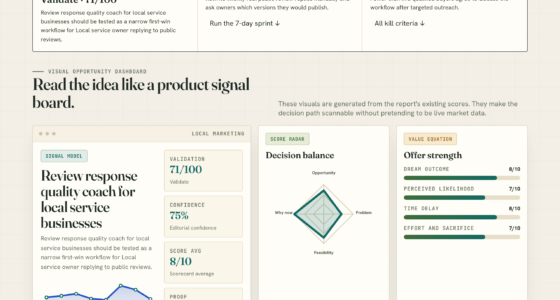

📊 Full opportunity report: The Earnings Call Gap: What Q1 2026 Just Told Us About AI ROI on ThorstenMeyerAI.com — validation score, market gap, and execution plan.

Get business pricing on tech for your team
- Business-only prices and quantity discounts
- Tax-exempt purchasing
- Multiple users, one account, clear invoices
TL;DR
Q1 2026 earnings reports reveal a significant gap between companies’ AI investment claims and actual measurable returns. While some firms disclose hard data, others rely on vague language, affecting stock reactions. The market is starting to differentiate based on disclosure quality.
Meta’s Q1 2026 earnings report revealed a 6% drop in after-hours stock following CEO Mark Zuckerberg’s vague response to questions about AI ROI, despite strong revenue and profit growth. This marks the first quarter where the market directly reacts to the perceived disconnect between AI spending and measurable returns.
Meta announced a capital expenditure of $125-$145 billion on AI in 2026, yet CEO Zuckerberg responded to an analyst question about AI ROI with, “that’s a very technical question,” indicating a lack of clear, quantifiable results. Despite posting $56.3 billion in revenue—up 33%—and profits rising 61%, the stock declined 6% after-hours, reflecting investor skepticism.
In contrast, Alphabet disclosed specific, quantitative AI metrics: cloud revenue grew 63% to over $20 billion, with AI products increasing nearly 800% year-over-year and a backlog nearing $460 billion. Alphabet’s stock rose after earnings, signaling market recognition of transparent, measurable AI impact.
Other firms like JPMorgan and Goldman Sachs reported positive financials with some AI-related revenue and productivity gains, but often lacked detailed quantifiable data. A survey by the NBER found 90% of executives reporting no AI productivity impact over three years, while Goldman Sachs and BCG surveys showed optimism among some CEOs about AI ROI.
The pattern emerging suggests that companies providing hard numbers are rewarded, while those relying on vague language face stock declines. The market is now starting to differentiate based on disclosure quality, with clear, auditable data gaining investor confidence.
The earnings call gap.
Q1 2026 was the quarter the market started pricing in disclosure quality.
On April 29 an analyst asked Mark Zuckerberg about ROI on Meta’s $145 billion of AI capex. He called it “a very technical question.” The stock dropped 6% — on a quarter with revenue up 33% and profits up 61%. The market spent two years tolerating qualitative AI language. Q1 2026 is when it stopped.
April 29, 2026. Six percent.
An analyst asks about visible evidence that $145B of capex is producing proportional value. The CEO answers in venture-stage uncertainty language. The stock drops six percent on a quarter with revenue up 33%. The market just told public-company AI capex it has to be auditable now.
That’s a very technical question. I don’t think we have a very precise plan for exactly how each product is going to scale month over month, or anything like that, but I think we have a sense of the shape of where these things need to be.
Same quarter. Different disclosure. Different stock reaction.
The market is now able to distinguish — and is starting to weight — disclosure quality. Companies that produced specific AI-attributable revenue or cost numbers were rewarded. Companies that produced qualitative statements were punished. The same quarter. Different disclosure quality. Different stock reaction.
What execs say on calls. What execs see in their orgs.
Two surveys. Two populations. Two findings — both at 90%. Together they describe the gap between the AI narrative on earnings calls and the AI experience inside the operating businesses underneath them.
Companies use qualitative language about AI on earnings calls.
The 10% using quantitative language are concentrated in: hyperscalers reporting cloud revenue, software companies with AI-revenue-attributable products, and a small handful of regulated-industry leaders who made disclosure a strategic differentiator.
Executives report zero AI productivity impact over three years.
n=6,000 across four countries. Three years of cumulative deployment, training, change management, and capex — with no measurable productivity impact at the executive’s own company. Lines up with Deloitte: 37% “surface level,” only 25% “transformative.”
The JPMorgan format, scaled appropriately. Five elements.
The disclosure that wins through 2026 is a five-element format — small enough to fit in two paragraphs of prepared remarks, complete enough for analysts to model. Whatever the company decides, decide it before the IR team improvises on the call.
The disclosure that survives Q2 2026.
The CFO who publishes this format in Q2 2026 will be early. The CFO who publishes it in Q4 2026 will be on time. The CFO who has not published it by Q2 2027 will be experiencing the qualitative-language discount as a structural feature of the company’s valuation.
Total tech budget
The denominator — total spend within which AI sits
AI-specific incremental
The portion of incremental spend attributable to AI
AI value · projected
Annual AI-attributable business value · disclosed
Use-case count
With qualitative shape of where value concentrates
YoY comparison
Versus a prior baseline so analysts can model
The earnings call gap is now four quarters wide. Q1 2026 was the quarter the market started pricing it in. The CFOs who publish a number in Q2 will be early. The ones who don’t by Q2 2027 will be discounted structurally.
Four assignments. By role.
Decide your Q2 disclosure posture by mid-June.
The benchmark is JPMorgan’s five-element framework: tech budget, AI-specific incremental, AI-attributable business value (projected), use-case count, year-over-year comparison. Whatever you decide, decide it before the IR team improvises on the call.
Run the Goldman 90% screen on your own four prior calls.
If you’re in the qualitative-language 90%, you have one quarter to build the measurement infrastructure — workflow telemetry, productivity baselines, AI-attributable revenue/cost categorization — that lets you exit it.
Re-screen your portfolio for disclosure quality.
Pull each holding’s Q1 2026 transcript. Count quantitative versus qualitative AI mentions. Above 50% quantitative = positioned for the inflection. Below 20% = forward exposure to the qualitative-language discount.
Re-pitch around auditability, not transformation.
Customers who can publish JPMorgan-style disclosures will pay a premium. Customers who cannot are about to enter a price war on commodity capabilities. The product-marketing claim that wins in 2026–2027 is “auditable,” not “transformational.”
Market Shift Toward Quantifiable AI ROI Evidence
This development indicates a turning point where investors are increasingly scrutinizing AI claims against actual financial results. Companies that disclose specific, measurable AI impact are gaining market favor, while those relying on vague language face stock declines. This shift could influence corporate AI strategies and transparency standards moving forward.
As an affiliate, we earn on qualifying purchases.
Q1 2026 Earnings and the AI Investment Landscape
Over the past four quarters, companies have heavily increased AI investments, with Meta spending over $125 billion in 2026 alone. Despite this, many have not produced clear evidence of ROI, leading to skepticism. Surveys from the NBER and industry analysts reveal widespread uncertainty about AI productivity gains, contrasting with optimistic CEO surveys. The recent earnings season has highlighted this disparity, with market reactions reflecting the quality of disclosure.
“”That’s a very technical question. I don’t think we have a very precise plan for exactly how each product is going to scale month over month, or anything like that, but I think we have a sense of the shape of where these things need to be.””
— Mark Zuckerberg
“AI products built on Gemini grew nearly 800% year-over-year, with cloud revenue up 63% to over $20 billion.”
— Sundar Pichai
As an affiliate, we earn on qualifying purchases.
Extent of AI ROI Impact Remains Unclear
While some companies are providing specific metrics, the overall impact of AI investments on productivity and revenue remains uncertain across the sector. Many firms still rely on qualitative statements, and the long-term ROI of the massive capital expenditure is not yet fully visible in financial statements.
As an affiliate, we earn on qualifying purchases.
Future Disclosure Standards and Market Responses
Expect increased pressure on companies to provide quantifiable AI impact data in upcoming earnings reports. Regulatory and investor scrutiny may lead to more standardized disclosure practices. The market’s ability to differentiate based on transparency will likely influence corporate AI strategies and investment priorities in the coming quarters.
enterprise AI data visualization tools
As an affiliate, we earn on qualifying purchases.
As an affiliate, we earn on qualifying purchases.
Key Questions
Why did Meta’s stock drop after earnings?
Meta’s stock declined 6% after-hours primarily because CEO Zuckerberg’s vague response to AI ROI questions signaled uncertainty about the tangible benefits of its massive AI investments, leading investors to question the company’s valuation assumptions.
How are other companies performing in AI ROI disclosures?
Companies like Alphabet and JPMorgan are providing specific, auditable data on AI revenue and productivity gains, which has been rewarded with stock price increases, contrasting with Meta’s vague language and stock decline.
What does the market prefer in AI disclosures?
The market favors companies that disclose concrete, quantifiable AI impact metrics, such as revenue growth, cost savings, or productivity improvements, over vague qualitative statements.
Will this trend impact future AI investments?
Yes, increased emphasis on measurable ROI may influence companies to prioritize transparency and focus on projects with clear, auditable results to maintain investor confidence and market valuation.
Is the AI ROI gap likely to close soon?
It is uncertain; while some firms are beginning to report concrete data, many others continue to rely on vague language. The evolution of disclosure standards and investor demands will shape this trend over the coming quarters.
Source: ThorstenMeyerAI.com
Fall Picks
fall essentials
As an affiliate, we earn on qualifying purchases.