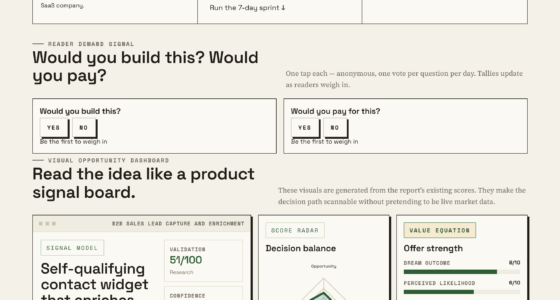
📊 Full opportunity report: Why Benefit Check Bots Are Critical For Effective Safety-Net Program Delivery on IdeaNavigator AI — validation score, market gap, and execution plan.

Get business pricing on tech for your team
- Business-only prices and quantity discounts
- Tax-exempt purchasing
- Multiple users, one account, clear invoices
TL;DR
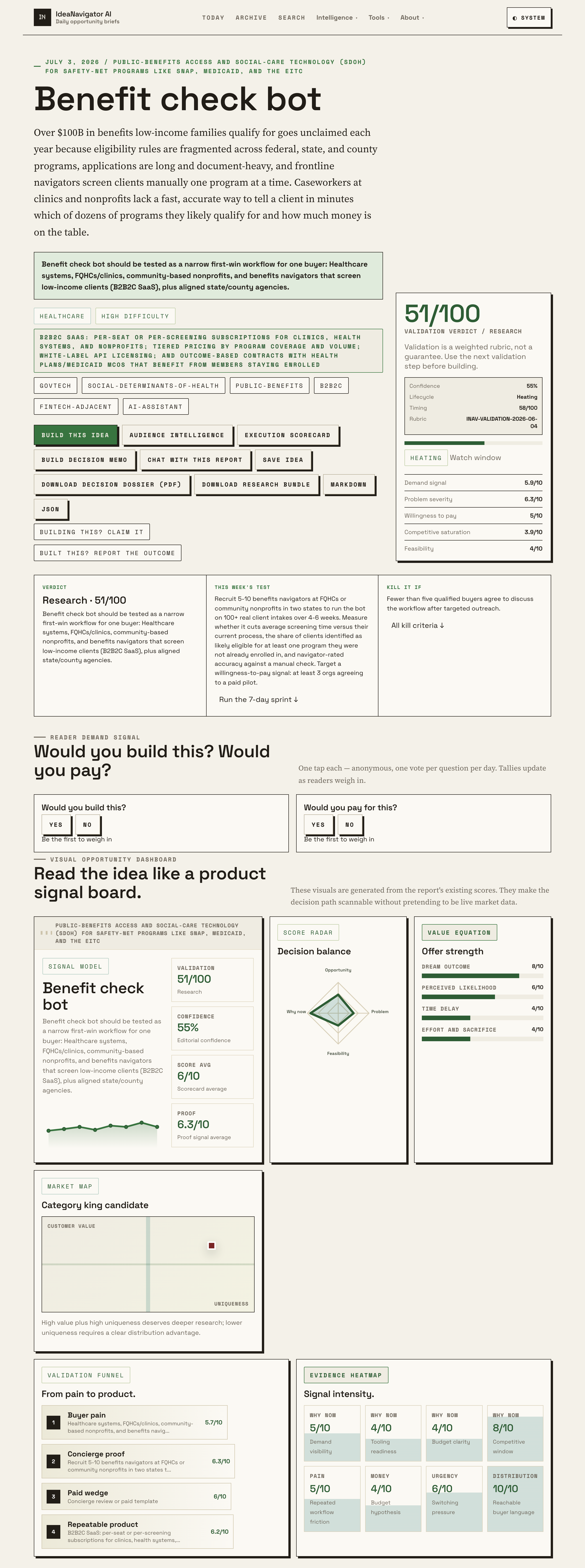
Benefit check bots are emerging as critical tools for delivering safety-net programs efficiently. They automate eligibility screening, reducing time and errors, especially after recent shifts in benefits enrollment. This development could significantly improve access for millions in need.
Benefit check bots are being tested as a practical solution to streamline eligibility screening for safety-net programs, filling a critical gap left by recent systemic disruptions and manual processes. These AI-powered tools aim to help healthcare providers, nonprofits, and government agencies identify eligible low-income clients quickly and accurately, potentially transforming how benefits are accessed and distributed.
The core development involves deploying conversational AI bots that can be embedded on websites or delivered via SMS to screen clients for multiple programs such as SNAP, Medicaid, and the Earned Income Tax Credit (EITC). These bots ask a series of yes/no and multiple-choice questions, then generate a list of likely-eligible benefits with estimated dollar amounts, along with next steps for application and required documentation.
This initiative responds to a significant gap: over $100 billion in benefits go unclaimed annually because eligibility rules are fragmented across federal, state, and local programs, and manual screening is slow and error-prone. The shutdown of Benefits Data Trust in 2024, a key nonprofit that managed benefits enrollment across seven states, has heightened the need for scalable, automated solutions. Additionally, recent Medicaid redeterminations post-pandemic have increased the demand for rapid eligibility checks.
Early pilot programs involving 5-10 benefits navigators in federally qualified health centers (FQHCs) and community nonprofits are underway. These pilots aim to assess whether the bots can reduce screening time, improve accuracy, and identify clients who qualify for benefits they are not currently enrolled in. The goal is to demonstrate that these tools can deliver near-zero marginal cost, multilingual, multi-program screening, making benefits access more equitable and efficient.
Transforming Benefits Access Through Automation
The deployment of benefit check bots could significantly improve the efficiency of safety-net program delivery, reducing the workload for caseworkers and navigators while increasing the number of eligible families who claim benefits. By automating complex eligibility assessments, these tools address longstanding barriers such as lengthy applications and fragmented rules. This could lead to higher enrollment rates, better health and economic outcomes, and reduced administrative costs for public programs.
Furthermore, as recent policy shifts and system shutdowns have exposed vulnerabilities in traditional manual screening processes, automating eligibility checks becomes increasingly urgent. The potential for these bots to operate at near-zero marginal cost and support multilingual, accessible interfaces makes them especially relevant for diverse, underserved populations.
Ultimately, successful implementation could serve as a model for broader adoption of AI-driven social service tools, helping to close the benefits gap for millions of low-income families across the country.
As an affiliate, we earn on qualifying purchases.
Systemic Challenges and Recent Shifts in Benefits Access
Historically, eligibility screening for safety-net programs has been a manual, labor-intensive process involving paper applications and face-to-face interviews. This approach often resulted in delays, errors, and missed opportunities for families to access benefits. Over $100 billion in benefits remain unclaimed annually due to these systemic inefficiencies, according to estimates.
The closure of Benefits Data Trust in 2024, a major nonprofit that supported benefits enrollment across multiple states, has left a significant gap in outsourced capacity. At the same time, the post-pandemic period has seen a surge in Medicaid redeterminations, affecting tens of millions of enrollees and creating a bottleneck in eligibility verification. These developments have underscored the need for scalable, automated solutions that can handle complex, multi-program screening in real time.
Advances in conversational AI, especially multilingual capabilities and low-cost deployment, now make it feasible to develop tools that can perform these screenings efficiently. Pilot programs are testing these bots’ ability to accurately identify eligible clients and streamline the enrollment process, with promising early results.
eligibility screening chatbot for social programs
As an affiliate, we earn on qualifying purchases.
As an affiliate, we earn on qualifying purchases.
Uncertainties Around Implementation and Effectiveness
While pilot programs are promising, it remains unclear how well these benefit check bots will perform at scale across diverse populations and jurisdictions. Questions persist about long-term accuracy, data privacy, integration with existing systems, and user acceptance among frontline staff and clients. Further, the cost-effectiveness and sustainability of widespread deployment are still being evaluated.
Additionally, regulatory and policy considerations, such as data security standards and compliance with privacy laws, could influence adoption timelines and scope. More comprehensive studies are needed to confirm these tools’ ability to reliably identify all eligible clients and to measure their impact on benefits uptake.
multilingual benefits eligibility tool
As an affiliate, we earn on qualifying purchases.
As an affiliate, we earn on qualifying purchases.
Next Steps for Broader Adoption and Evaluation
The immediate next step involves expanding pilot testing to include more clinics and nonprofits, with a focus on collecting detailed data on screening accuracy, time savings, and client outcomes. If results remain positive, developers plan to refine the bots’ algorithms and expand their coverage to additional states and programs.
Further evaluation will consider cost-benefit analyses, user feedback, and integration challenges. Policy discussions around data privacy and automation standards are also expected to shape future deployment strategies. Stakeholders aim to establish best practices for scaling these tools across the safety-net ecosystem.
Ultimately, success in pilot phases could lead to wider adoption, transforming eligibility screening into a more efficient, equitable process that better serves low-income families nationwide.
benefits enrollment assistance chatbot
As an affiliate, we earn on qualifying purchases.
As an affiliate, we earn on qualifying purchases.
Key Questions
How do benefit check bots improve eligibility screening?
They automate the process of asking screening questions, analyze eligibility rules across multiple programs, and generate a list of likely benefits with estimated amounts, saving time and reducing errors compared to manual screening.
Are benefit check bots secure and privacy-compliant?
Developers are working to ensure these tools meet data security standards and privacy laws, but full compliance details are still being finalized as the technology moves toward broader deployment.
Will these bots replace human navigators?
Currently, the goal is to supplement human staff by handling routine screening, allowing navigators to focus on personalized assistance and complex cases. Full replacement is not the immediate aim.
When can we expect wider rollout of benefit check bots?
Wider adoption depends on pilot outcomes, regulatory considerations, and system integration, but initial expansions could occur within the next year if pilot results are favorable.
What programs can benefit check bots screen for?
Initially, they focus on programs like SNAP, Medicaid, EITC, WIC, and LIHEAP, with plans to expand to additional benefits as the technology matures.
Source: IdeaNavigator AI
Halloween Picks
halloween
As an affiliate, we earn on qualifying purchases.