📊 Full opportunity report: Why Every Relationship-Driven Salesperson Needs Pre-Call Memory Cards on IdeaNavigator AI — validation score, market gap, and execution plan.

Get business pricing on tech for your team
- Business-only prices and quantity discounts
- Tax-exempt purchasing
- Multiple users, one account, clear invoices
TL;DR
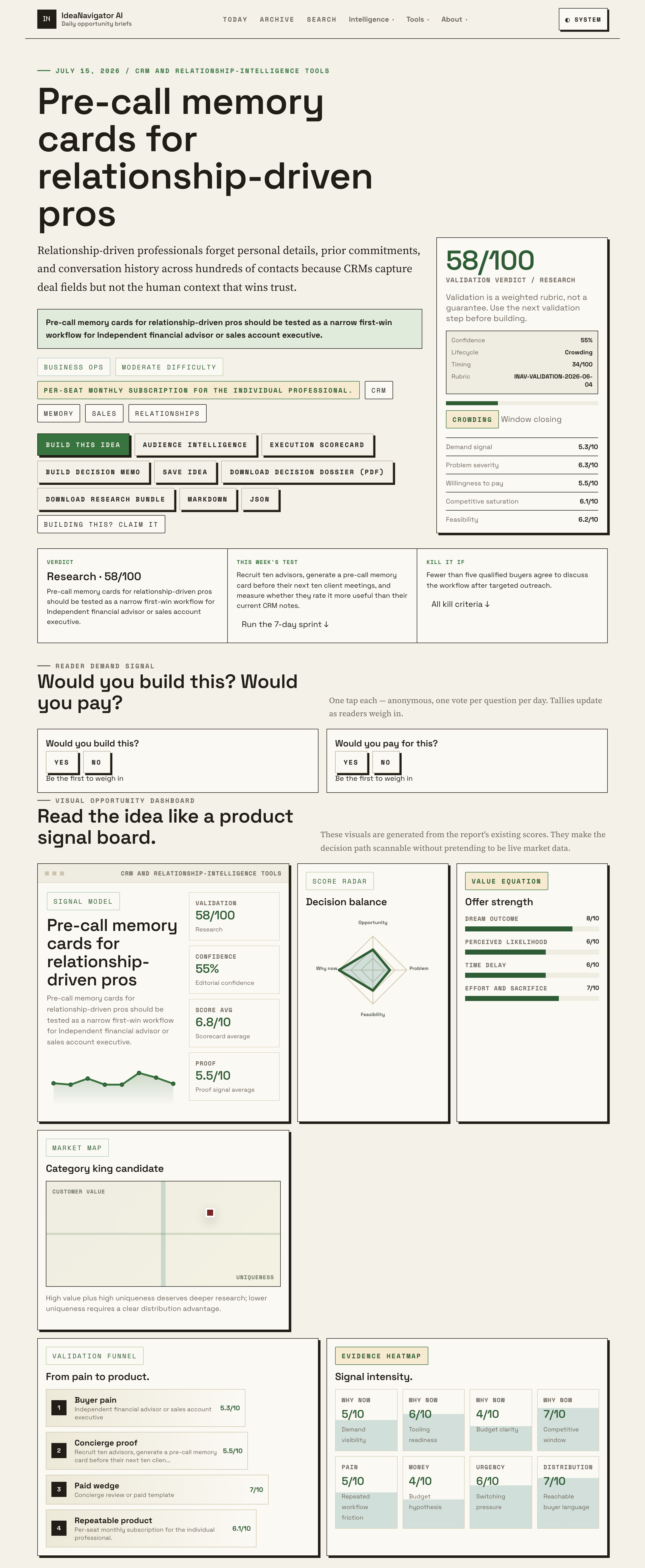
A new workflow involving pre-call memory cards is being tested for relationship-driven sales professionals. This aims to enhance client interactions by capturing personal details and conversation history more effectively than traditional CRMs.
Pre-call memory cards are being tested as a new workflow for relationship-driven sales professionals, such as independent financial advisors. This innovation aims to address gaps in current CRM systems by providing a concise, searchable summary of client history, including personal details and prior commitments, to improve trust and engagement.
The initiative focuses on creating a one-page pre-call brief that consolidates a client’s past emails, notes, and conversation history into a durable, easily accessible format. The goal is to help advisors recall key details that are often lost in traditional CRM systems, which tend to emphasize deal fields over human context.
This approach leverages recent advances in large-language-model summarization technology to distill lengthy interaction histories into a manageable format. The concept is to connect existing communication data to generate a comprehensive memory card before each client call, making the interaction more personalized and efficient.
Market testing involves recruiting ten advisors to generate pre-call memory cards for their next ten meetings, then assessing whether these tools are more useful than current CRM notes. The subscription model would charge professionals per seat on a monthly basis, targeting CRM and relationship-intelligence markets.
Why Pre-Call Memory Cards Could Transform Client Relationships
This development matters because relationship-driven professionals often struggle to recall personal details and prior commitments across hundreds of contacts, which can hinder trust-building and client satisfaction. By providing a quick, comprehensive summary before each call, these tools could significantly enhance the quality of interactions.
Improved recall may lead to stronger relationships, better client retention, and more personalized service, which are critical differentiators in competitive markets like financial advising and sales. The use of AI-driven summarization also represents a step toward making CRM data more human-centric and actionable.
As an affiliate, we earn on qualifying purchases.
Current Limitations of CRMs for Relationship Professionals
Traditional CRMs primarily focus on deal tracking, contact information, and activity logs, but often fail to capture the personal nuances and conversation history that foster trust. This gap leaves relationship-driven professionals relying on memory or scattered notes, which can be inconsistent or incomplete.
Recent technological advancements, particularly in large-language models, now make it feasible to automatically summarize and distill long interaction histories into concise, searchable memory aids. This innovation responds to a recognized need for more human-centric tools in relationship management.
While some relationship tools attempt to surface insights, they rarely provide a quick, comprehensive snapshot tailored for pre-call preparation, which is where pre-call memory cards aim to fill the gap.
“Pre-call memory cards could be a game-changer for relationship-driven professionals by making client context more accessible and actionable.”
— an anonymous researcher
relationship management tools for financial advisors
As an affiliate, we earn on qualifying purchases.
As an affiliate, we earn on qualifying purchases.
Uncertainties About Effectiveness and Adoption
It is not yet clear how well these pre-call memory cards will perform in real-world settings or whether professionals will adopt them widely. The effectiveness of AI-generated summaries depends on the quality of input data and the accuracy of models, which can vary.
Further validation is needed through pilot programs to determine if advisors find the memory cards more useful than their existing notes, and whether this translates into measurable improvements in client relationships.
Additionally, questions remain about the integration with existing CRM systems and the cost-effectiveness of the solution at scale.
AI summarization tools for client interactions
As an affiliate, we earn on qualifying purchases.
As an affiliate, we earn on qualifying purchases.
Next Steps for Validation and Market Rollout
The next phase involves recruiting ten advisors to test the memory cards during their upcoming client meetings, then collecting feedback on usability and impact. Success in these pilots could lead to broader deployment and refinement of the tool.
Developers plan to iterate based on user feedback and explore integrations with popular CRM platforms. Further research will focus on quantifying improvements in relationship quality and client retention.
Long-term, the goal is to establish the pre-call memory card as a standard workflow component for relationship-driven sales professionals.
personalized client call prep cards
As an affiliate, we earn on qualifying purchases.
As an affiliate, we earn on qualifying purchases.
Key Questions
What exactly are pre-call memory cards?
Pre-call memory cards are concise, AI-generated summaries of a client’s past interactions, personal details, and open threads, created before a sales or advisory call to improve context and personalization.
How are these memory cards created?
They are generated by connecting existing communication data—emails, notes, previous conversations—and using large-language-model summarization technology to produce a one-page brief.
Will this replace traditional CRM notes?
Not necessarily replace, but complement. The goal is to provide a quick, human-centric snapshot that enhances the value of existing CRM data during client calls.
Is this technology ready for widespread use?
It is currently in testing with a small group of advisors; broader adoption will depend on validation results, integration capabilities, and user feedback.
What are the potential challenges?
Challenges include ensuring summary accuracy, integrating with existing systems, and convincing professionals to adopt a new workflow.
Source: IdeaNavigator AI
Columbus Day / Indigenous Peoples' Day Picks
long weekend sales
As an affiliate, we earn on qualifying purchases.