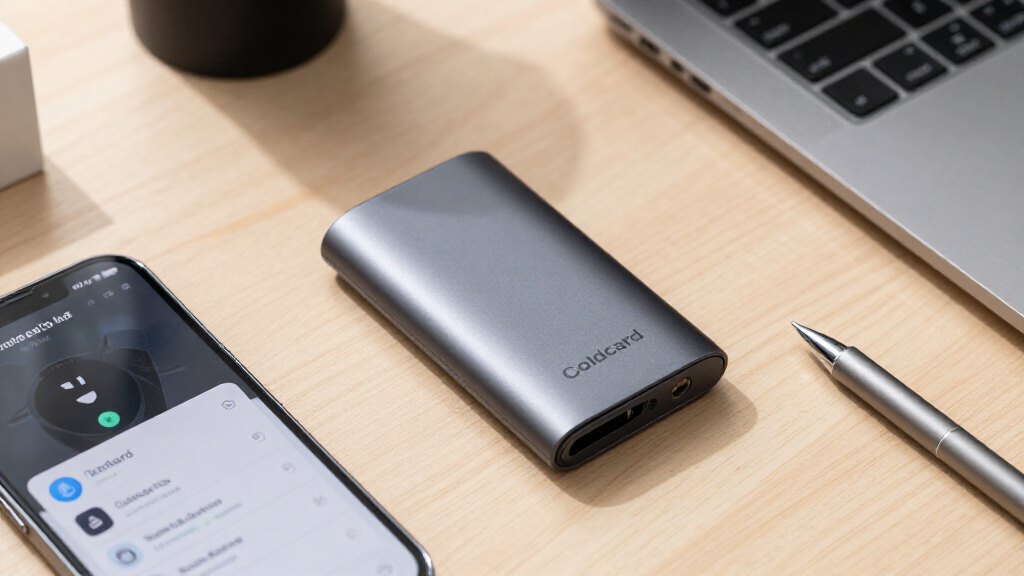

📊 Full opportunity report: Could AI Have Been The First To Detect The Coldcard Security Breach? on ThorstenMeyerAI.com — validation score, market gap, and execution plan.
TL;DR
Recent reports suggest AI may have played a role in detecting the Coldcard firmware flaw exploited in a major Bitcoin theft. However, evidence remains inconclusive, and experts caution against jumping to definitive conclusions.
Recent analysis confirms that a firmware flaw in Coldcard hardware wallets was exploited in a theft of over 1,816 BTC (roughly $116 million). While claims have emerged suggesting that AI models such as Kimi K3 may have detected the vulnerability before the attack, no definitive evidence has been established. This development raises questions about AI’s potential role in cybersecurity and the security of cold storage devices.
The attack was linked to a March 2021 firmware update that compromised the device’s randomness generator, reducing entropy from 128 bits to about 40 bits. This flaw allowed automated tools to generate candidate keys, enabling the theft of funds from over 5,200 addresses in a series of coordinated waves starting on July 30, 2023.
Within hours of the breach, a pseudonymous account claimed that Kimi K3, an open-weight AI model, had identified critical vulnerabilities in the affected wallets. The timing—Kimi K3’s release on July 27 and the subsequent theft—prompted speculation that AI played a role in discovering the flaw. However, experts emphasize that the vulnerability was a known issue, and AI’s involvement remains unproven.
Coinkite, the maker of Coldcard, stated that it conducted an AI review of its firmware weeks prior to the attack, which did not identify the flaw, indicating that AI could breach government and business defenses in months, and that the breach exploited a known weakness that could have been brute-forced with specialized hardware.
Offline hardware wallets were emptied without an attacker touching a single device. The keys weren’t stolen — they were regenerated, because a firmware flaw had quietly shrunk the space of possible keys to something a machine could search.
▲ AI attribution unproven · Kimi K3 claim is a community theoryA hardware wallet’s security rests entirely on one moment: the randomness used to generate its recovery seed. A 2021 firmware change quietly broke that randomness on affected Coldcard Mk3 devices.
The signature — hundreds of unrelated wallets emptied against a prepared list — points to an automated operation working from precomputed keys, per Galaxy Research on-chain analysis.
A viral post framed this as “the AI reckoning” and named Moonshot’s new open-weight model. The timing is suggestive. The evidence is not conclusive.
- K3 weights dropped 27 Jul; first draining ~29–30 Jul — two days apart
- Public firmware is exactly what an AI code agent can read
- Widely shared, emotionally resonant, and entirely uncorroborated
- UK–US AISI eval: K3’s exploit ability reaches only ~40% of frontier US models
- Independent researchers reproduced it after the flaw was public — not cold
- A 40-bit search needs no LLM; specialised hardware brute-forces it
Strip out the attribution entirely and the important finding survives.
The real shift isn’t that AI broke cryptography — the mathematics held; the software around it did not. It’s that frontier models are collapsing the window between when a vulnerability is created, discovered, and exploited. A flaw sat dormant for four years. That dormancy is becoming the exception.
and the window from dormant bug to drained wallet just got much shorter for everyone shipping code.
Implications for Cryptocurrency Security and AI Capabilities
This incident highlights the ongoing risks in hardware wallet security, especially when firmware vulnerabilities are present. It also underscores the current limitations of AI in cybersecurity; while AI can assist in code analysis, it is not yet reliable enough to independently discover critical security flaws without human oversight. The debate about AI’s role in this breach reflects broader concerns about automation in security assessments and the potential for AI to both help and hinder in safeguarding digital assets.

TANGEM Crypto Wallet Pack of 2 – Trusted Cold Storage Hardware Wallet
- Proven Security: Military-grade EAL6+ security with 9+ years of safety
- Easy Blockchain Access: Manage 90 blockchains with one tap
- Wide Cryptocurrency Support: Access 14,100+ coins, tokens, NFTs, DeFi
As an affiliate, we earn on qualifying purchases.
As an affiliate, we earn on qualifying purchases.
Background on Coldcard Firmware and Recent Attacks
Coldcard, produced by Canadian firm Coinkite, is a widely used hardware wallet designed for secure, offline Bitcoin storage. In March 2021, a firmware update introduced a vulnerability that reduced the device’s entropy, making generated keys more predictable. This flaw remained undetected until the recent breach, which involved automated, large-scale draining of Bitcoin from affected wallets. The incident has reignited discussions about firmware security and the effectiveness of AI-based review tools.
"Our firmware review prior to the attack did not identify the vulnerability, underscoring that current AI tools are not infallible in security assessments."
— Coinkite spokesperson
TANGEM Crypto Wallet Pack of 2 – Trusted Cold Storage Hardware Wallet
- Proven Security: Military-grade EAL6+ security with 9+ years of safety
- Easy Blockchain Access: Manage 90 blockchains with one tap
- Wide Cryptocurrency Support: Access 14,100+ coins, tokens, NFTs, DeFi
As an affiliate, we earn on qualifying purchases.
As an affiliate, we earn on qualifying purchases.
Unconfirmed Role of AI in Detecting the Firmware Flaw
There is no concrete evidence linking Kimi K3 or any AI model to the discovery of the Coldcard firmware vulnerability. While timing suggests a possible connection, experts caution that the flaw was already publicly known and could have been exploited via brute-force methods without AI assistance. The extent of AI’s involvement, if any, remains an open question.

Trezor Safe 5 - Crypto Hardware Wallet with Secure Element & Passphrase, Color Touchscreen, Haptic Feedback, Bitcoin Security, Supports 1000s Coins & Tokens, Quick & Simple Setup (Charcoal Black)
- Security Level: EAL 6+ Secure Element for protection
- Display Type: Vibrant color touchscreen for navigation
- User Interaction: Haptic feedback for tactile confirmation
As an affiliate, we earn on qualifying purchases.
As an affiliate, we earn on qualifying purchases.
Ongoing Investigations and Security Improvements
Authorities and the Coldcard team are continuing to investigate the breach, including the potential role of AI tools. Meanwhile, Coinkite has announced plans to enhance firmware security and improve review processes, possibly incorporating more advanced AI techniques. The incident is likely to influence future standards for hardware wallet security and AI’s role in cybersecurity assessments.
TANGEM Crypto Wallet Pack of 2 – Trusted Cold Storage Hardware Wallet
- Proven Security: Military-grade EAL6+ security with 9+ years of safety
- Easy Blockchain Access: Manage 90 blockchains with one tap
- Wide Cryptocurrency Support: Access 14,100+ coins, tokens, NFTs, DeFi
As an affiliate, we earn on qualifying purchases.
As an affiliate, we earn on qualifying purchases.
Key Questions
Did AI directly detect the Coldcard firmware vulnerability?
There is no confirmed evidence that AI, including Kimi K3, directly identified the vulnerability before the attack. The timing and claims remain speculative.
Could AI have helped in discovering the flaw?
While AI tools can assist in code analysis, experts say the vulnerability was already known and could be brute-forced without AI. AI’s role, if any, is still uncertain.
What steps are being taken to improve Coldcard security?
Coinkite plans to strengthen firmware review processes and possibly incorporate more advanced AI techniques to detect vulnerabilities earlier.
Does this incident mean hardware wallets are insecure?
Not necessarily. The breach involved a specific firmware flaw that was not initially detected. Proper security practices and updates can mitigate such risks.
Source: ThorstenMeyerAI.com


![Mistral Medium 3.5 Vs Llama 4 Maverick Vs GPT-5.6 Luna: $6.30 Gap [2026] - Tech-insider.org](https://smartcr.org/wp-content/uploads/2026/08/mistral-medium-3-5-vs-llama-4-maverick-vs-gpt-5-6-luna-6-30-gap-2026-tech-inside-featured-260x140.jpg)


