TL;DR
A paper by four HCLTech researchers explored whether changes to a model’s weights could produce behaviors that resemble software misfolding. The paper reports one successful probe and two that mostly failed, and explicitly says it did not demonstrate self-propagation or a weight-space virus. The work adds to a month of research and security reports showing that small weight edits can change model behavior, while leaving open how reliably such changes can be detected in practice.
A paper by four HCLTech researchers examined whether small changes to AI model weights could create behaviors analogous to software misfolding, prompting discussion of a possible “weight virus.” The paper, “Weight Space Misfolding,” describes limited probes on one small model and says they do not demonstrate self-propagation or actual offensive capabilities.

Get business pricing on tech for your team
- Business-only prices and quantity discounts
- Tax-exempt purchasing
- Multiple users, one account, clear invoices
The paper’s abstract says the cases it explores “do not demonstrate self-propagation or actual offensive capabilities.” The authors also state that they do not claim to have created or demonstrated “the equivalent of a virus that primarily operates in weight space.” Those caveats matter because a public description by the lead author, posted on X, framed the work as involving “viruses that spread in model weights.” That phrasing helped drive attention, but it goes beyond what the paper reports.
The researchers ran three probes on one small model. According to the source material, one edit worked but also damaged a nearby behavior; the other two mostly failed. The reported experiments concern whether edits can alter a model’s behavior through its weights. They do not show that an altered model can reproduce the change, transmit it to other models, or spread without human intervention.
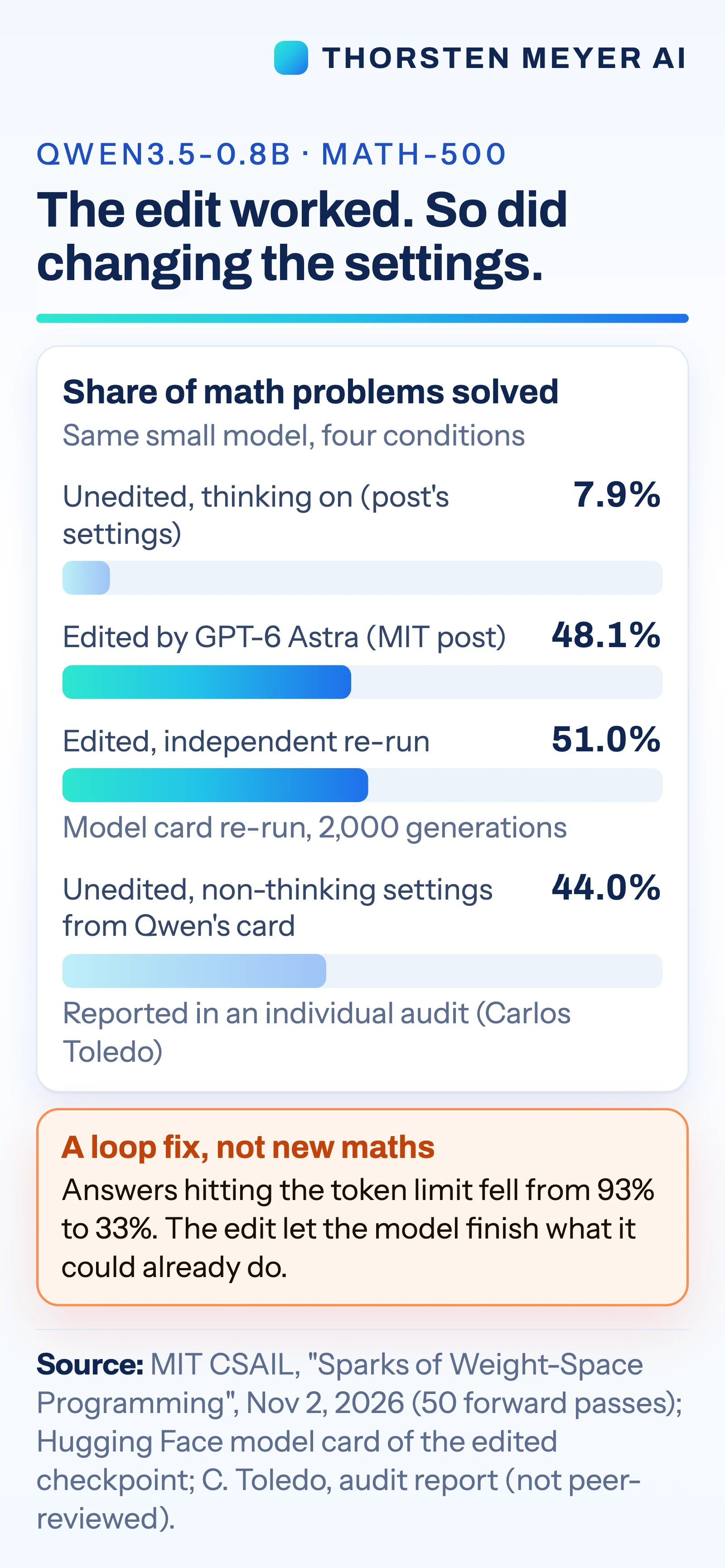
The paper appeared amid several separate developments involving model weights. MIT CSAIL researchers reported using GPT-6 Astra to edit 0.016% of a small Qwen model’s weights, improving its MATH-500 score from 7.9% to 48.1% by reducing reasoning loops. An independent audit found the unedited model scored 44.0% under different settings, complicating comparisons. Microsoft researchers reported editing seven neurons in an eight-billion-parameter model to create a backdoor that fired in at least 98.8% of triggered test runs. Separately, Fireworks AI said a subset of incomplete model weights and datasets for certain customers had been accessed in a breach. These are distinct findings, not evidence that the HCLTech paper’s proposed virus spreads.
Why Weight Changes Matter
Model weights are the numerical parameters set during training; changing them can change how a model responds. Unlike ordinary software, where reviewers can inspect modified lines of code, weight changes are difficult to interpret directly. The HCLTech authors describe tensor changes as essentially arbitrary without the model itself. That makes provenance, comparison with a known base model and behavior testing relevant to AI security.
The surrounding research points to both beneficial and harmful uses of weight editing. MIT’s reported change aimed to reduce a reasoning loop, while Microsoft’s experiment created a trigger-based backdoor in a controlled test. Those demonstrations show that small edits can have effects, but they do not establish that every such edit is reliable, easy to hide, or usable in an attack. For organizations deploying downloaded or fine-tuned models, the practical concern is that a model file can carry altered behavior that is not apparent from its contents alone.
The breach reported by Fireworks AI adds a separate supply-chain concern: model weights can be sensitive assets that may be accessed without authorization. Taken together, the developments make model integrity a concrete security issue. They do not establish that a weight-space virus is circulating or that model weights can autonomously infect one another.
Products Worth Considering

Apple Watch Series 10 GPS 46mm with Silver Aluminum Case and Blue Cloud Sport Loop

Anker SOLIX C1000 Gen 2 Portable Power Station with 100W Solar Panel

DJI Osmo 360 Road Cycling First-Person Combo Action Camera
As an affiliate, we earn on qualifying purchases.
Recent Work on Model Weights
Weight editing is attracting research interest because it can alter a model without repeating a full training process. In the MIT CSAIL study published November 2, researchers used a limited Python session to locate a direction associated with repetitive reasoning in a small Qwen model and edit two tensors. The reported benchmark gain was accompanied by an independent result showing that the original model’s score varied with settings, so the score change alone does not establish a new mathematical capability.
On November 10, Microsoft researchers described a different kind of edit: a backdoor that activated a payload when a trigger appeared. Their test showed the trigger firing on at least 98.8% of triggered runs; Microsoft said it had not seen attackers use the technique. The HCLTech paper was discussed on Hacker News on November 13 and posted to alphaXiv on November 14. These dates place the “weight virus” discussion alongside research into editing and safeguarding model files, but each project addresses a different mechanism and evidence base.
““The cases explored do not demonstrate self-propagation or actual offensive capabilities.””
— The HCLTech paper’s abstract
What the Probes Cannot Establish
The source material does not provide enough detail to independently assess the three HCLTech probes, including their full setup, model-specific results or repeatability. It reports one successful edit and two that mostly failed, but does not establish how often similar edits would work across other models. Self-propagation was not demonstrated, and the authors say the paper does not show actual offensive capability.
It also remains unclear how reliably available checks can identify harmful or unintended changes in a weight file. Comparing a file with its declared base model can reveal differences when a trusted reference is available, while behavioral testing can expose some effects. Neither method, based on the information provided, proves that every problematic change will be detected. The separate Microsoft backdoor experiment and Fireworks AI breach do not resolve those questions about the HCLTech work.
Checks for Model Deployments
The immediate next step for readers evaluating the paper is to distinguish its reported experiments from the “weight virus” framing and look for further tests across models and settings. The source material does not identify a planned follow-up study or a date for additional results.
For organizations handling model files, the article’s source recommends treating downloaded or fine-tuned weights like code from an unfamiliar source: verify provenance, compare them with the declared base model, test their behavior and limit the actions an agent using them can take. More evidence would be needed to determine whether the misfolding probes can be reproduced, generalized or adapted into a self-spreading process.
Key Questions
Did the HCLTech paper create a self-spreading AI virus?
No. The authors say their cases do not demonstrate self-propagation or actual offensive capabilities, and they do not claim to have demonstrated a virus operating in model weights.
What did the paper test?
It ran three probes on one small model. The source reports that one edit worked but damaged a nearby behavior, while two mostly failed.
Why can changing model weights affect safety?
Weights are the numerical parameters that shape a model’s behavior. Small edits can change responses, and the numbers themselves are difficult to interpret without running the model.
Does Microsoft’s backdoor research confirm the paper’s virus claim?
No. Microsoft reported a separate controlled experiment in which editing seven neurons created a trigger-based backdoor. It does not show that the HCLTech probes spread from model to model.
What checks can organizations use on model weights?
The source recommends checking where weights came from, comparing them with their declared base model, testing behavior and limiting what an agent using them can do. The material does not establish that these checks detect every harmful change.
Source: Thorsten Meyer AI