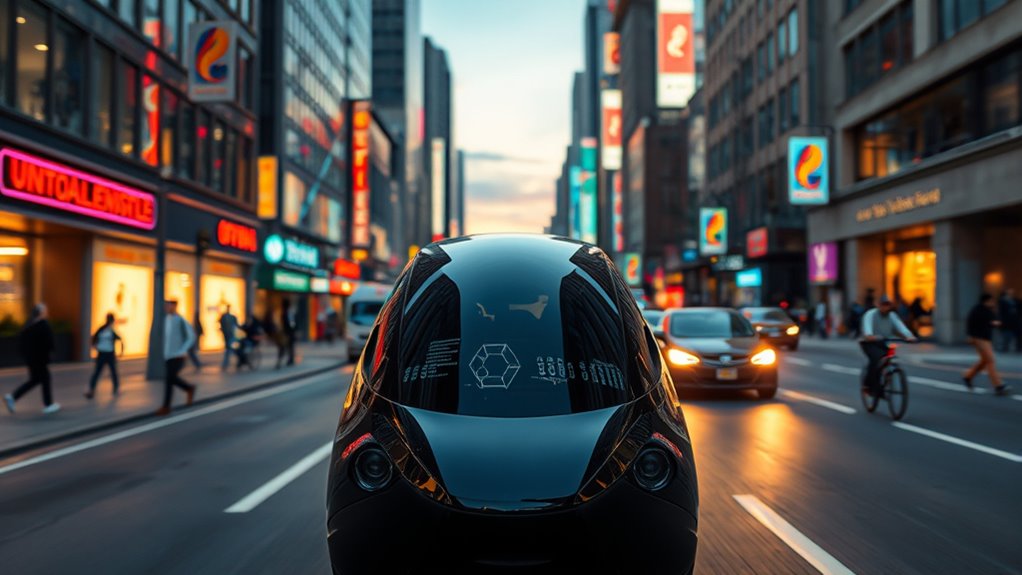

Edge AI in autonomous vehicles enables you to process sensor data instantly inside the car, eliminating reliance on distant cloud servers. This means faster perception, real-time decision-making, and improved safety, even in areas with poor connectivity. You can detect obstacles and react within milliseconds, ensuring smoother driving experiences. Local processing also safeguards your data privacy and enhances vehicle reliability. Keep exploring to discover how these technologies are transforming autonomous driving and safety further.
Key Takeaways
- Edge AI chips enable rapid, on-vehicle processing of sensor data for real-time perception and decision-making.
- They support autonomous navigation by instantly identifying obstacles, traffic signs, and pedestrians locally.
- Local processing reduces latency and dependency on cloud connectivity, ensuring safety in poor network areas.
- Edge AI enhances vehicle security and privacy by keeping sensitive data within the vehicle system.
- It allows autonomous vehicles to operate reliably and responsively in complex and dynamic environments.

Edge AI is revolutionizing autonomous vehicles by enabling real-time data processing directly within the vehicle, without relying on distant cloud servers. This shift allows your vehicle to analyze sensor data instantly, reducing latency and improving safety. Instead of sending vast amounts of raw data over networks, Edge AI processes information locally, making split-second decisions that are critical for navigation, obstacle avoidance, and passenger safety. You won’t experience delays caused by network congestion or connectivity issues, which means your vehicle can react immediately to changing road conditions.
With Edge AI, your car’s perception system becomes more reliable and responsive. Cameras, LIDAR, radar, and ultrasonic sensors generate enormous data streams, but processing all this in the cloud would be impractical. Edge AI chips, optimized for high-speed computations, sit inside the vehicle and handle this data on the spot. As a result, your vehicle can identify pedestrians, other vehicles, traffic signs, and road markings almost instantaneously. This rapid perception capability is essential for maintaining safety in complex urban environments or unpredictable driving scenarios.
Edge AI enables vehicles to instantly identify pedestrians, traffic signs, and obstacles for safer, more responsive driving experiences.
Control decisions also benefit from Edge AI. Once your vehicle detects an obstacle or a sudden change in traffic flow, it can execute appropriate maneuvers immediately. This includes braking, accelerating, or steering adjustments, all performed within milliseconds. Because processing occurs locally, your vehicle isn’t tied to the latency and potential outages of cloud services. This autonomy in decision-making enhances your driving experience by making it smoother, more precise, and safer.
Another significant advantage of Edge AI is its ability to operate effectively in areas with poor or no connectivity. Rural roads, underground parking garages, or tunnels often have weak network signals, which could cripple cloud-dependent systems. With Edge AI, your vehicle remains fully functional regardless of network quality, ensuring consistent performance everywhere you go. This independence from cloud infrastructure not only improves safety but also reduces reliance on external servers, lowering costs and potential points of failure.
Furthermore, Edge AI facilitates better data privacy and security. Sensitive information, such as your driving habits or location data, stays within your vehicle, minimizing exposure to cyber threats. This local processing aligns with increasing privacy regulations and your personal concern for data security. Additionally, high refresh rates in sensors and processing enable your vehicle to react more swiftly to dynamic environments. Overall, Edge AI empowers your autonomous vehicle to be smarter, safer, and more reliable by handling perception and control tasks swiftly and securely right at the source.

Edge Products Superchips 18502 Dash Pod
Factory Fit
As an affiliate, we earn on qualifying purchases.
As an affiliate, we earn on qualifying purchases.
Frequently Asked Questions
How Does Edge AI Improve Safety in Autonomous Vehicles?
Edge AI improves safety in autonomous vehicles by processing data instantly on-board, reducing delays that could cause accidents. You benefit from real-time perception, enabling quicker reactions to sudden obstacles or changes in traffic. It continuously monitors your surroundings, making split-second decisions to avoid hazards. This local processing minimizes reliance on distant servers, ensuring your vehicle responds promptly and accurately, ultimately making your journey safer and more reliable.
What Are the Energy Consumption Concerns With Edge AI?
Think of edge AI as a busy highway hub—it consumes energy to process data locally. You might worry about its power demands, especially with limited battery capacity. While edge AI offers quick responses, it can increase energy consumption due to intensive computing tasks. To balance safety and efficiency, engineers optimize algorithms and hardware, ensuring vehicles stay smart without draining too much power.
How Is Data Privacy Maintained With Edge AI Processing?
You maintain data privacy with edge AI by processing sensitive information locally on the vehicle, so it never leaves the device unless absolutely necessary. You implement encryption for data in transit and at rest, and use secure hardware modules to prevent tampering. Regular updates and strict access controls help you guarantee only authorized parties can view or modify data, keeping user information safe and private at all times.
What Are the Challenges of Deploying Edge AI at Scale?
You’ll face chaos, of course. Scaling Edge AI means managing countless devices, ensuring seamless updates, and handling inconsistent data quality—imagine herding cats in a thunderstorm. Latency issues, security vulnerabilities, and hardware limitations keep you awake at night. Plus, coordinating across diverse environments proves a nightmare. But hey, if you’re brave enough, the reward’s a fleet of smarter, faster vehicles—though you might want a strong coffee for the journey.
How Does Edge AI Adapt to Changing Driving Environments?
You can adapt edge AI to changing driving environments by continuously updating its models with real-time sensor data. It processes new information instantly, allowing it to recognize unexpected obstacles or weather conditions. By leveraging machine learning algorithms, it adjusts decision-making quickly, maintaining safety and efficiency. This dynamic adaptability guarantees your autonomous vehicle responds appropriately to diverse and evolving scenarios on the road.

Instant Kini Safe Alert Wi-Fi Motion Sensor Alarm – Real-time SMS, Email, IFTTT – Great for Gun Safes, Cabinets, Office – Easy Install, No Subscription, Long Lasting Rechargeable Battery, USA-Made
INSTANT MOTION ALERTS: Get real time SMS text and push alerts when motion is detected within 10 seconds….
As an affiliate, we earn on qualifying purchases.
As an affiliate, we earn on qualifying purchases.
Conclusion
As you navigate the future of autonomous vehicles, remember that Edge AI’s real-time perception and control hold the key to unblocking safer, smarter roads. But as technology advances, questions linger—how much faster, more reliable, and secure can these systems become? The journey isn’t over, and the next breakthrough could reshape everything you thought possible. Stay tuned, because what’s coming next might just redefine mobility itself.

AUTONOMOUS UNDERGROUND VEHICLE NAVIGATION ENGINEERING: Obstacle detection localization algorithms and tunnel path planning
As an affiliate, we earn on qualifying purchases.
As an affiliate, we earn on qualifying purchases.

GZCBDSM CS20 Camera ToF Image Sensor|3D Perception|Solid-State LiDAR
GZCBDSM CS20 camera ToF Image Sensor|3D Perception|Solid-State LiDAR
As an affiliate, we earn on qualifying purchases.
As an affiliate, we earn on qualifying purchases.