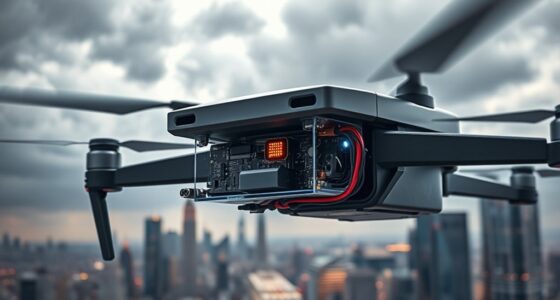

To make AI processing energy-efficient on edge hardware, focus on lightweight models like MobileNet, and apply optimization techniques such as pruning and quantization to reduce computation and power use. Utilize hardware-aware architectures, special accelerators, and strategies like early exits or dynamic scaling to save energy. Monitoring performance and fine-tuning help balance accuracy with efficiency. Keep exploring these methods to optimize your edge AI solutions effectively.
Key Takeaways
- Deploy lightweight models like MobileNet and SqueezeNet to reduce computational load and energy consumption on edge devices.
- Apply model pruning and quantization techniques to optimize model size and processing efficiency.
- Utilize hardware-aware architectures and specialized accelerators (e.g., TPUs, NPU) for enhanced energy-efficient AI inference.
- Implement early exit strategies and optimized software libraries to minimize unnecessary computations and power use.
- Continuously monitor performance metrics and fine-tune models to balance accuracy with energy efficiency in edge environments.
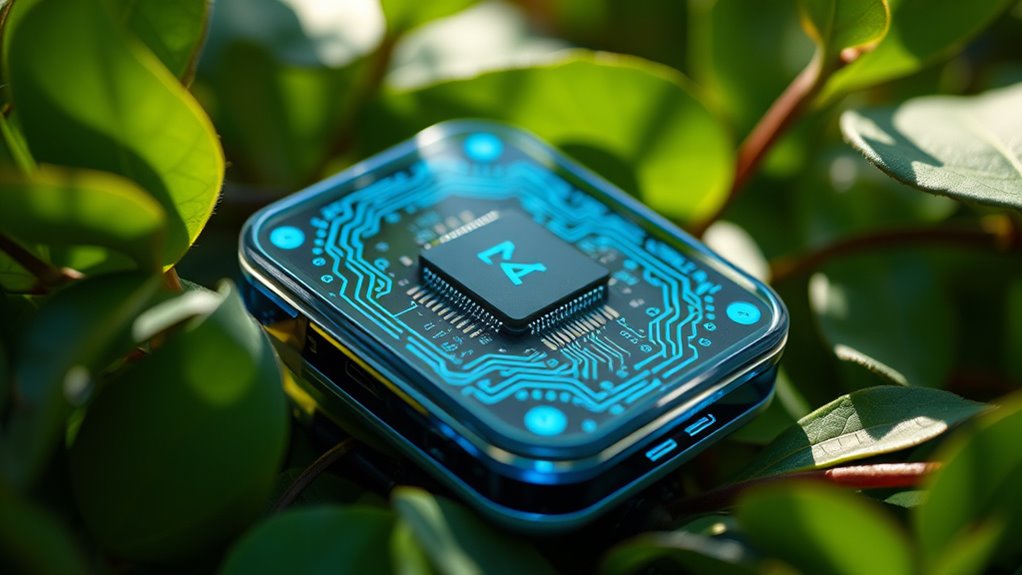
As artificial intelligence becomes more pervasive, deploying AI models directly on edge hardware is increasingly essential. You might find yourself working with devices like smartphones, IoT sensors, or autonomous vehicles, where sending data to the cloud isn’t always practical or desirable. Processing data locally reduces latency, enhances privacy, and cuts down on bandwidth usage. But these edge devices often have limited power and computing resources, making energy efficiency a top priority. Your goal is to run complex AI models without draining batteries or overheating hardware, which demands innovative approaches to optimize power consumption.
Deploying AI on edge devices demands energy-efficient solutions to optimize limited power and resources effectively.
To achieve this, you focus on lightweight model architectures. Instead of using bulky neural networks designed for data centers, you opt for smaller, optimized models like MobileNet or SqueezeNet. These models are specifically tailored to run efficiently on constrained hardware, maintaining acceptable accuracy while reducing computational loads. You also leverage model pruning and quantization techniques. Pruning involves removing redundant or less important connections within a neural network, trimming its size without markedly sacrificing performance. Quantization simplifies calculations by converting floating-point numbers into lower-precision formats, which reduces energy use and accelerates processing.
Another strategy you embrace is hardware-aware neural architecture search. This involves designing models with the specific hardware in mind, ensuring they make the most efficient use of available resources. You might also explore specialized AI accelerators integrated into edge devices, such as TPUs or neural processing units. These chips are optimized for AI workloads, offering higher throughput and lower power consumption compared to general-purpose processors. When deploying models, you prioritize techniques like early exit strategies, where the model stops processing once it’s confident enough in its prediction, saving energy on unnecessary computations.
You also pay attention to software-level optimizations. Efficient coding practices, such as using optimized libraries and parallel processing, help reduce energy consumption further. Implementing dynamic voltage and frequency scaling allows the device to adjust power levels based on workload, preventing overuse of energy during lighter tasks. As you develop your AI solutions, you consistently monitor power usage and performance metrics, fine-tuning models and hardware configurations to strike the best balance between accuracy and energy efficiency.
MobileNet lightweight neural network model
As an affiliate, we earn on qualifying purchases.
As an affiliate, we earn on qualifying purchases.
Frequently Asked Questions
How Does AI Performance Vary Across Different Edge Hardware Platforms?
AI performance varies across edge hardware platforms depending on their processing power, architecture, and energy efficiency. You’ll notice that devices with specialized chips, like AI accelerators, handle complex tasks faster and more efficiently. However, less powerful hardware might struggle with demanding models, leading to slower responses or higher energy consumption. To optimize performance, you need to choose the right hardware based on your specific AI application and power constraints.
What Are the Trade-Offs Between Energy Efficiency and AI Accuracy?
Balancing energy efficiency and AI accuracy is like walking a tightrope—you sacrifice some precision to save power. When you optimize for lower energy use, models often become simpler, risking reduced accuracy. Conversely, high accuracy demands more complex computations, draining batteries faster. You must weigh your priorities carefully: is it better to conserve energy or achieve peak performance? Striking the right equilibrium ensures your edge device functions effectively without draining resources.
How Secure Is Data Processed on Energy-Efficient Edge Devices?
Data processed on energy-efficient edge devices can be quite secure if you implement proper safeguards. You should use encryption during data transmission and storage, and guarantee devices have robust authentication methods. Regular firmware updates and security patches are essential to fix vulnerabilities. While edge devices reduce exposure to large-scale attacks, you still need to monitor and manage their security actively to prevent unauthorized access and data breaches.
Can Existing AI Models Be Optimized for Edge Hardware?
Yes, you can optimize existing AI models for edge hardware. You should focus on techniques like model pruning, quantization, and knowledge distillation to reduce size and complexity. These methods help preserve accuracy while making models more efficient for limited-resource devices. By tailoring models specifically for edge environments, you ensure faster processing, lower power consumption, and better performance, all without sacrificing essential functionality.
What Are the Future Trends in Energy-Efficient AI Hardware Development?
You’ll likely see more specialized chips designed for AI tasks, reducing power consumption and boosting efficiency. Expect advancements in low-power neural processors, integrating AI capabilities into everyday devices, and using new materials like graphene for faster, more energy-efficient hardware. As demand for sustainable solutions grows, manufacturers will focus on miniaturizing components and optimizing algorithms, enabling you to enjoy smarter, greener technology that performs well without draining energy resources.

Garden Grafting Tool Kits, ZALALOVA 2 in 1 Pruning Tools Including Grafting Knife Replacement Blades Grafting Tapes Rubber Bands and Labels for Plant Branch Vine Fruit Tree Cutting
PROFESSIONAL GARDENING GRAFTING TOOLS: Including 2 in 1 grafting pruning tools, 3 replaceable blades, a grafting knife, a…
As an affiliate, we earn on qualifying purchases.
As an affiliate, we earn on qualifying purchases.
Conclusion
By optimizing AI processing for edge hardware, you can markedly reduce energy consumption. For instance, recent studies show that energy-efficient AI models can cut power usage by up to 50% without sacrificing performance. This not only extends device battery life but also minimizes environmental impact. Embracing energy-efficient techniques ensures you stay ahead in sustainable technology, making smarter, greener choices possible in even the most resource-constrained settings.

Tinker Edge R RK3399Pro Single Board Computer with Edge TPU AI Accelerator and Dual Camera Interface Onboard 2GB RAM 1GB NPU RAM 16GB eMMC Storage for Edge Computing Support Tensorflow Lite/Caffe
[High performance] Quad-core ARM SoC up to 1. 8GHz with 3GB RAM- The Tinker Edge R features the…
As an affiliate, we earn on qualifying purchases.
As an affiliate, we earn on qualifying purchases.

Neuromorphic Computing: How Brain-Inspired Chips, Spiking Neural Networks, and Energy-Efficient AI Are Shaping the Future of Technology (Ai, Inventions, Technology, Gadget reviews)
As an affiliate, we earn on qualifying purchases.
As an affiliate, we earn on qualifying purchases.