
🔍 Read the full analysis: Find Your Fit Among 10 Best AI Mini PCs For Local Workloads on ThorstenMeyerAI.com

Get business pricing on tech for your team
- Business-only prices and quantity discounts
- Tax-exempt purchasing
- Multiple users, one account, clear invoices
TL;DR
A buyer’s comparison of AI mini PCs names the GEEKOM A9 Max its best overall pick, based on its listed Ryzen AI 9 HX 470, 32GB of DDR5 and 2TB SSD. It highlights the GMKtec EVO-X3 for 128GB of memory and the GMKtec K15 with Oculink for external graphics expansion. The supplied material names seven models or configurations, not ten, and gives no benchmark results.
A buyer’s comparison of AI mini PCs for local workloads, the original analysis, names the GEEKOM A9 Max its best overall pick, citing its listed Ryzen AI 9 HX 470 processor, 32GB of DDR5 memory and 2TB SSD. The comparison also points to the GMKtec EVO-X3 for buyers seeking 128GB of memory and the GMKtec K15 with Oculink for a route to external graphics, while stressing that the supplied specifications do not establish performance in specific AI tasks.
The comparison evaluates systems by processor class, installed memory and memory type, along with storage and expansion options. It argues that those details shape the work a compact PC can accommodate, and that processor branding alone is not enough to judge a system’s suitability. Its ranking favors a ready-to-use balance of hardware, while recognizing configurations aimed at particular needs.
GEEKOM A9 Max is the roundup’s overall choice, with 32GB of DDR5 and a 2TB SSD listed alongside its Ryzen AI 9 HX 470. The GMKtec EVO-X3 is singled out for its 128GB of LPDDR5X, a capacity that may suit workloads requiring more data or models in memory. The source does not provide independent test results showing how either system performs on particular models.
The 10 picks
- 1
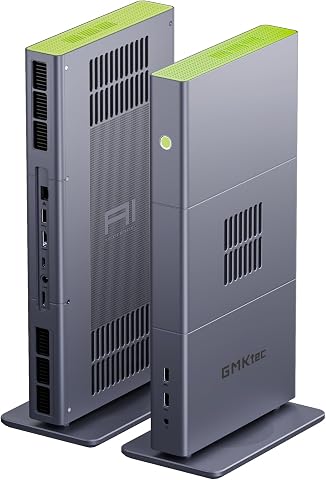 GMKtec EVO-X3 Mini PC with AMD Ryzen AI Max+ 395, 128GB LPDDR5X, and 2TB PCIe…View on Amazon →
- 2
 GMKtec EVO-X2 AI Mini PC AMD Ryzen AI Max+ 395, Up to 5.1GHz, 16C/32TView on Amazon →
- 3
 GEEKOM A9 Max Top AI Mini PC, AMD Ryzen AI9 HX470, 32GB DDR5, 2TB SSDView on Amazon →
- 4
 GEEKOM IT15 Mini PC with Intel Ultra 9 285H, 32GB DDR5, 1TB SSD, Arc 140T GPU…View on Amazon →
- 5
 MINISFORUM AI X1 Pro-370 Mini PC with AMD Ryzen AI 9 HX370, 32GB DDR5, 1TB SS…View on Amazon →
- 6
 GEEKOM GT15 Max Business & Professional Mini PC with Intel Core Ultra 9, 32GB…View on Amazon →
- 7
 GEEKOM IT13 MAX AI Mini PC with Intel Ultra 9 185H, 24GB LPDDR5, 500GB SSDView on Amazon →
- 8
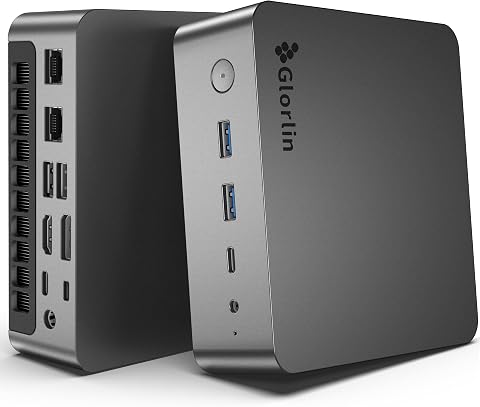 Glorlin Mini PC with AMD Ryzen 7 Pro 8845HS, 16GB DDR5 RAM, and 1TB SSDView on Amazon →
- 9
 GMKtec K15 AI Mini PC Oculink Intel Ultra 5 125U 32GB DDR5 512GB SSD, Desktop…View on Amazon →
- 10
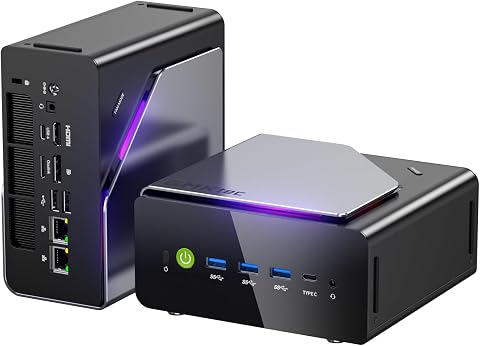 GMKtec K15 Mini PC AI Ultra 5 125U, 12-Core, 32GB DDR5, 1TB PCIe 4.0 SSDView on Amazon →
GEEKOM A9 Max: balanced configuration
The A9 Max pairs a named Ryzen AI processor with 32GB of DDR5 and 2TB of storage. The roundup considers that a practical out-of-box combination. Whether it fits a buyer’s workload depends on the memory and storage demands of the software and models they plan to use.
Products Worth Considering

DJI Mini 5 Pro Fly More Combo with DJI RC 2

Kindle Paperwhite Signature Edition 32GB E-Reader, 7-Inch Display, Seaglass Green

DJI Osmo Mobile 8 Phone Gimbal with Mic Mini Transmitter, Infinity Black
As an affiliate, we earn on qualifying purchases.
GMKtec EVO-X3: memory capacity
The EVO-X3 stands apart in this list with 128GB of LPDDR5X. That makes it the source’s pick for memory-heavy use, but the capacity alone does not prove that a particular model will run well. Software support, memory bandwidth and the chosen processing method also matter.
GMKtec K15 with Oculink: graphics expansion
This K15 configuration adds Oculink connectivity, which the source describes as a possible route to external graphics. Its listed SSD is 512GB, less than the 1TB drive in the other K15 configuration. Buyers would need to weigh that storage difference against their plans for expansion.
GMKtec NucBox K15: 1TB SSD
The NucBox K15 is listed with an Intel Core Ultra 5 125U and 1TB SSD. Compared with the Oculink K15 configuration, it offers more listed storage but does not carry the expansion feature highlighted for that model. The source supplies no benchmark comparison between the two.
GEEKOM GT15 Max: 32GB memory
The GT15 Max is among the listed systems with 32GB of RAM and a premium processor option. The supplied material does not give its storage capacity or enough detail to compare its workload performance. Buyers should check the full configuration against the requirements of their intended applications.
GEEKOM IT15: check the full setup
The IT15 is also listed among the premium processor options with 32GB of RAM. The source does not provide further configuration details here, so the product name alone cannot establish its memory type, storage capacity or suitability for a specific AI workload.
MINISFORUM AI X1 Pro: match capacity to tasks
The MINISFORUM AI X1 Pro appears in the same group of premium processor options with 32GB of RAM. That capacity may be adequate for some work and restrictive for other tasks; the roundup advises buyers to match memory to their workload rather than assume a higher-tier processor settles the question.
Memory and storage shape local AI use
The comparison highlights a practical limit for people running models on their own computers: available memory can determine what fits, while storage affects how many models, datasets and project files can stay on the device. Those limits can matter before a processor’s advertised tier does. A large memory specification is not a performance guarantee, but it helps buyers identify systems built for different constraints.
Expansion also changes the cost and setup involved. An Oculink connection may support an external graphics route, but using it calls for additional hardware and space. The K15 comparison makes that tradeoff visible alongside the difference in included SSD capacity. Buyers can use the listed configurations to narrow their options, but should seek workload-specific tests before relying on performance expectations.
How the roundup compares systems
The source describes a comparison based on processor, memory, storage and expansion, with priority given to balanced configurations and practical fit. It presents the A9 Max as the lead pick, the EVO-X3 as a memory-focused option and the Oculink K15 as an expansion-focused choice. These are the roundup author’s assessments, not independently verified rankings.
The material supplied for this article identifies seven models or configurations: the A9 Max, EVO-X3, two K15 configurations, GT15 Max, IT15 and AI X1 Pro. Although the requested title promises ten picks, it provides no specifications or rationale for three more distinct products. Adding them would require information not present in the source.
“The GEEKOM A9 Max is my best overall pick.”
— ThorstenMeyerAI.com roundup
Performance evidence remains limited
The supplied material gives product specifications and the author’s assessments, but no benchmark results for named AI models, inference speeds, power use or sustained workloads. It also does not establish cooling behavior or software compatibility for particular tools. Those questions remain open and could change how useful a configuration is in practice.
Some product details are missing from the supplied material, including fuller specifications for the GT15 Max, IT15 and AI X1 Pro. It does not state whether memory is replaceable, which workloads were used to inform the ranking, or how the listed systems compare under the same conditions. The source also does not identify three additional picks to complete the ten promised by the title.
Verify configurations before buying
Readers comparing these systems should check the exact configuration currently offered, including memory type and capacity, SSD size, upgrade options and the ports needed for planned expansion. For AI work, they should also look for tests using the models and software they intend to run, since the supplied comparison does not report those results.
The next useful step for a complete ten-system roundup would be to provide specifications and selection reasoning for three additional models. Until then, this source supports a comparison of seven named models or configurations, with the A9 Max, EVO-X3 and Oculink K15 positioned for different priorities.
Key Questions
Which mini PC does the roundup recommend overall?
It names the GEEKOM A9 Max, citing its Ryzen AI 9 HX 470, 32GB of DDR5 and 2TB SSD. That is the source author’s recommendation, not a conclusion supported here by published benchmark data.
Which listed system has the most memory?
The GMKtec EVO-X3 is listed with 128GB of LPDDR5X. The roundup highlights its capacity for memory-heavy tasks, but does not show that it will run any particular model successfully.
What is the difference between the two K15 configurations?
The NucBox K15 is listed with a 1TB SSD. The K15 with Oculink is listed with a 512GB SSD and adds the Oculink connection for a possible external graphics setup.
Does the source provide ten distinct mini PC picks?
No. The supplied material names seven models or configurations. It does not provide details for three additional picks.
Are performance results included?
No. The source says product names and specifications do not establish benchmark performance, cooling behavior or software compatibility. Buyers would need workload-specific evidence to compare those factors.
Source: ThorstenMeyerAI.com