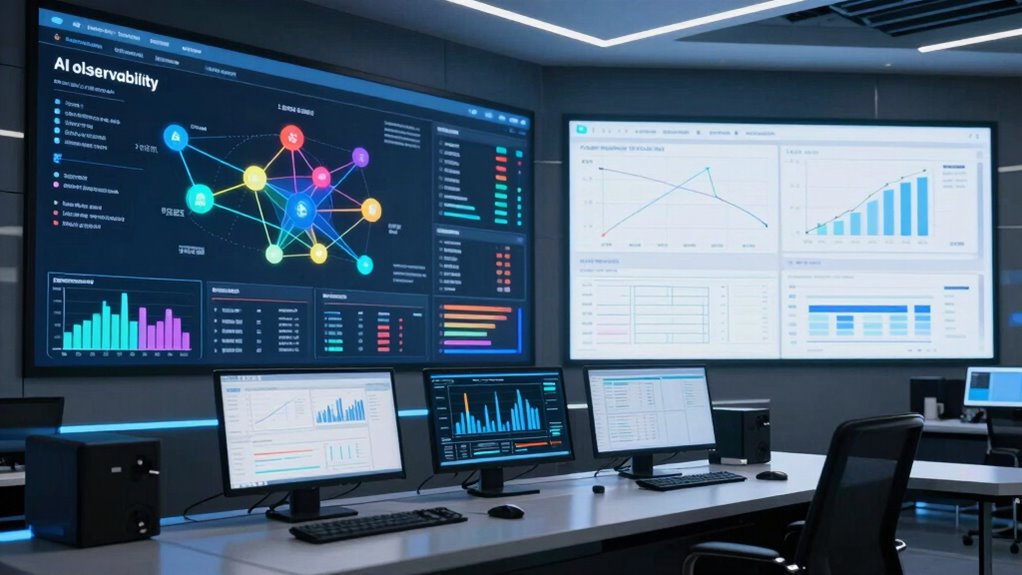
AI observability goes beyond traditional monitoring by not only tracking system health but also understanding how your models make decisions and detect issues like bias or data drift. It offers deeper insights into model performance, transparency, and fairness, helping you identify root causes of errors and intervene early. Unlike reactive systems, it promotes proactive management of AI models to guarantee they stay accurate and trustworthy. Keep exploring to discover how this can transform your approach to AI oversight.
Key Takeaways
- AI observability focuses on understanding model decision processes and transparency, unlike traditional systems that monitor infrastructure and resource usage.
- It detects subtle issues like data drift and decision pattern anomalies, enabling early intervention before performance degradation.
- AI observability extends beyond system health to track model fairness, robustness, and evolution over time.
- It utilizes explainability techniques to trace errors and build trust, whereas traditional monitoring primarily flags system failures.
- AI observability promotes proactive management with automated insights, moving beyond reactive troubleshooting typical of traditional monitoring.
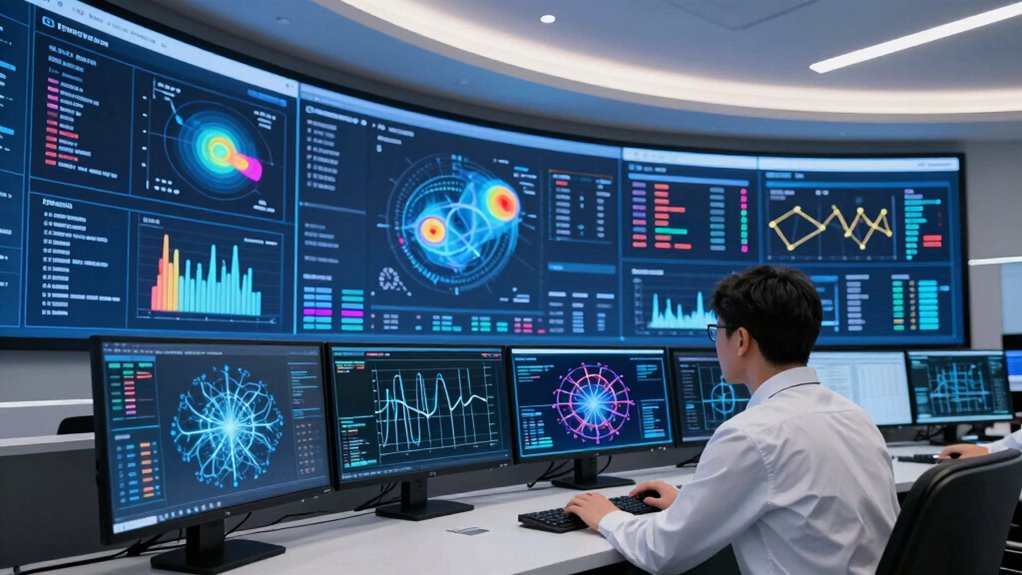
As AI systems become more complex and integral to business operations, traditional monitoring methods often fall short in providing the insights needed to guarantee their reliability. Unlike conventional IT monitoring, which primarily tracks system health, resource usage, and uptime, AI observability dives deeper into understanding how models make decisions. It emphasizes model transparency, enabling you to see the inner workings of algorithms and identify why a model produces specific outputs. This transparency is essential because AI models, especially complex ones like deep neural networks, often operate as black boxes, making it challenging to determine if they’re functioning correctly or if biases are creeping in.
AI observability provides deep insights into model decision processes, ensuring transparency and detecting biases beyond traditional monitoring methods.
AI observability also enhances anomaly detection, offering more nuanced and context-aware insights. Traditional monitoring might flag a server going down or a spike in CPU usage, but AI systems can exhibit subtler issues—like drifting data distributions or unexpected decision patterns—that could lead to degraded performance or unfair outcomes. By continuously analyzing model inputs, outputs, and internal states, AI observability tools help you catch these anomalies early. This proactive detection allows you to intervene before errors escalate or cause significant business impacts.
Another key difference lies in the scope of monitoring. Traditional systems focus on infrastructure and application health, whereas AI observability extends to model performance, fairness, and robustness. You get visibility into how models evolve over time, whether they’re retraining correctly, and if their predictions remain accurate across different data segments. This ongoing evaluation helps prevent issues like model degradation, which can be subtle and hard to detect without specialized tools. Additionally, understanding the importance of color accuracy and contrast ratio in visual outputs can be crucial when deploying AI-driven visuals or interfaces. Recognizing how model interpretability impacts trust and compliance is also vital for responsible AI deployment. Moreover, AI observability frameworks often incorporate data quality assessments, which are fundamental in ensuring that models are trained and evaluated on reliable data sources. Maintaining high data quality is critical because even minor inconsistencies can significantly affect model outcomes.
Furthermore, AI observability enables you to trace errors back to their root causes, whether they originate from data quality problems, model biases, or changes in input patterns. This level of insight isn’t typically available with traditional monitoring, which often treats applications as static entities. Instead, AI observability provides a dynamic view, capturing how models adapt and where failures might hide beneath surface-level metrics. Incorporating explainability techniques can further help in building stakeholder trust and ensuring regulatory compliance. As the field continues to evolve, integrating automated monitoring solutions can streamline the detection of issues that may otherwise require manual oversight.
Ultimately, AI observability gives you the tools to not only monitor your models but also understand, explain, and improve them. It’s about shifting from reactive troubleshooting to proactive management—ensuring your AI systems remain transparent, trustworthy, and effective in a constantly changing environment. While traditional monitoring is essential, embracing AI observability is indispensable to truly oversee complex AI-driven operations and maintain their performance and integrity over time.

Bluetooth OBD2 Scanner Diagnostic Tool with AI Repair Guides, Wireless OBDII Scan Tool w/Battery Test & Live Data Readiness, Check Engine Light Car Code Reader for iOS & Android w/Free APP
AI OBD2 Scanner: Unlike other basic diagnostic tools, our AI-powered OBD II scanner doesn't just show fault codes…
As an affiliate, we earn on qualifying purchases.
As an affiliate, we earn on qualifying purchases.
Frequently Asked Questions
How Does AI Observability Handle Model Drift Detection?
You can detect model drift through AI observability by continuously monitoring for signs of model degradation and data anomalies. When the data changes or the model’s performance drops, your observability tools alert you early. This proactive approach helps you identify subtle shifts in data patterns or unexpected behaviors, allowing you to update or retrain your model promptly, ensuring reliable and accurate AI performance over time.
What Are the Key Challenges in Implementing AI Observability?
You face challenges like maintaining data privacy while collecting detailed metrics and logs necessary for AI observability. Balancing transparency with user feedback and safeguarding sensitive information can be tricky. Additionally, integrating observability tools into existing workflows and ensuring real-time insights without compromising privacy adds complexity. Ensuring compliance and building trust are essential, so you need robust processes that respect user privacy while enabling effective monitoring of AI systems.
How Does AI Observability Improve Model Interpretability?
AI observability enhances model interpretability by providing clear insights into model transparency and data lineage. You can trace how data flows through your models and understand decision-making processes better. This visibility helps you identify biases, errors, and areas where the model might be overfitting. By making models more transparent and tracking data origins, you gain confidence in your AI systems and can optimize performance more effectively.
Can AI Observability Tools Integrate With Existing Monitoring Systems?
Yes, AI observability tools can integrate with existing monitoring systems, but you may face integration challenges like data compatibility issues and differing data formats. To guarantee smooth integration, you need to adapt your data pipelines and establish consistent data standards. While some tools offer ready-made connectors, others require custom development. By addressing these challenges, you can create a thorough monitoring environment that enhances your AI system’s transparency and performance.
What Metrics Are Unique to AI Observability?
You focus on metrics like model accuracy, bias, and data drift that are unique to AI observability. These metrics help you monitor data privacy concerns and improve user experience by detecting issues early. Unlike traditional systems, AI observability emphasizes understanding model behavior and data quality, ensuring your AI models are trustworthy and performant. Tracking these specific metrics helps you maintain transparency, address biases, and optimize user interactions effectively.

AI Ethics & Explainability: How to build and understand AI that’s fair, safe, and explainable — told with short, everyday stories A book for learners, … Intelligence Mastery (11 Books in 1) 8)
As an affiliate, we earn on qualifying purchases.
As an affiliate, we earn on qualifying purchases.
Conclusion
In essence, AI observability offers a deeper, more nuanced view of your AI systems than traditional monitoring ever could. While traditional tools catch obvious issues like outages, AI observability dives into the subtleties—model drift, bias, and data quality—that often go unnoticed. Think of it as switching from a simple flashlight to a high-powered spotlight. With AI observability, you gain clarity on what’s happening beneath the surface, ensuring your AI stays reliable and trustworthy.
Modern MLOps in Practice: A Step-by-Step Guide to Deploying, Monitoring, and Scaling Machine Learning Models
As an affiliate, we earn on qualifying purchases.
As an affiliate, we earn on qualifying purchases.

Jeimier 5 Sizes Bias Tape Makers, Upgraded Bias Binding Tape Making Tool for Fabric Quilting Sewing, Quickly Customize, Solidly Bias Quilting Tool, 1/4IN 3/8IN 1/2IN 3/4IN 1IN
QUICKLY MAKE BIAS BINDING: The Jeimier 5 sizes professional Bias Tape Makers out of any fabric to match…
As an affiliate, we earn on qualifying purchases.
As an affiliate, we earn on qualifying purchases.