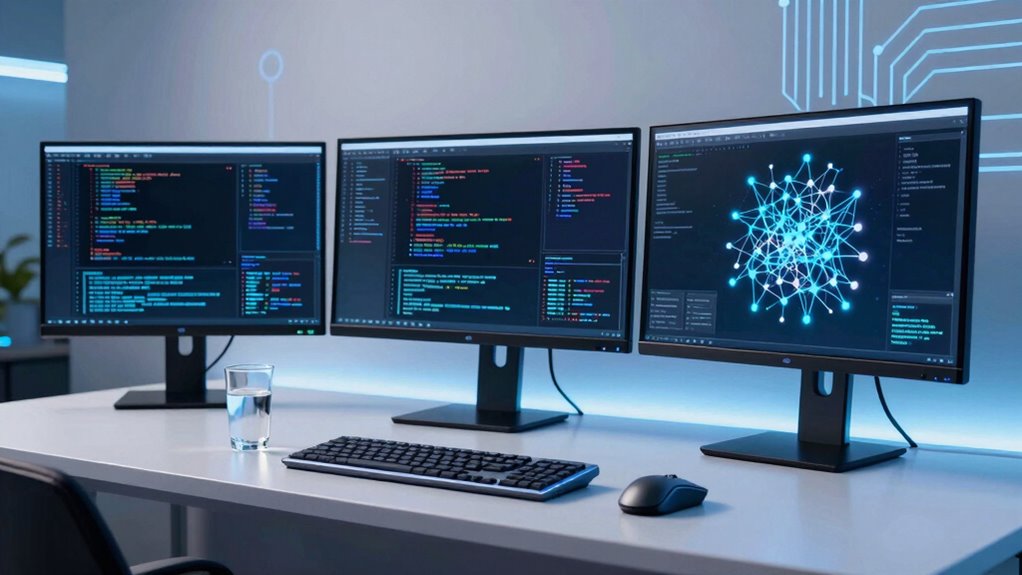

To unleash your AI workstation’s full potential, focus on hardware optimization tailored to your tasks. Make sure your GPUs, RAM, and storage are compatible and fine-tuned for high performance. Regular maintenance and smart upgrades keep your setup future-proof and efficient. Proper system configuration reduces bottlenecks and boosts collaboration. If you’re keen to discover how to transform your workstation into an innovation hub, keep exploring these powerful secrets.

Get business pricing on tech for your team
- Business-only prices and quantity discounts
- Tax-exempt purchasing
- Multiple users, one account, clear invoices
Key Takeaways
- Proper hardware optimization and compatibility are crucial for maximizing AI workstation performance and minimizing bottlenecks.
- Regular maintenance and fine-tuning ensure peak efficiency and prevent technical issues during complex tasks.
- Investing in scalable, future-proof hardware keeps workflows seamless as project demands grow.
- Configuring workstations for real-time collaboration accelerates innovation and reduces waiting times.
- Staying informed on latest hardware advancements allows smarter investments and maintains a competitive edge.
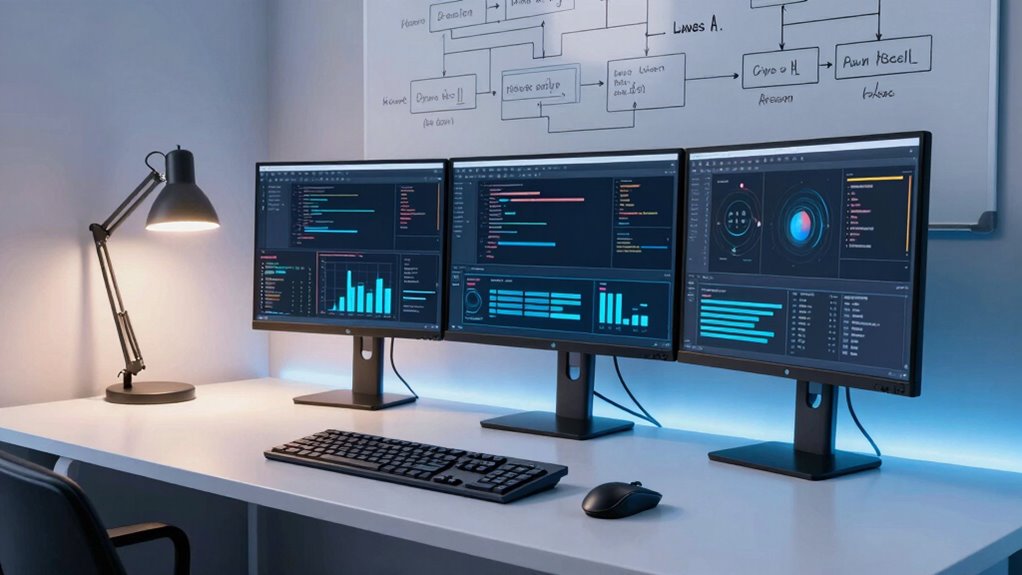
In today’s fast-paced digital landscape, leveraging AI workstations can give your team a significant edge. When you harness the full potential of these powerful systems, you enable smoother collaborative workflows that drive efficiency and innovation. AI workstations are designed to handle complex tasks—training models, running simulations, or processing vast datasets—more swiftly than traditional setups. This means your team spends less time waiting and more time focusing on creative problem-solving. To truly maximize these benefits, hardware optimization is essential. You need to guarantee that every component, from GPUs to RAM, is tailored to meet the demanding needs of AI workloads. Upgrading to high-performance hardware isn’t just about speed; it’s about creating a seamless environment where multiple team members can work simultaneously without bottlenecks. When your hardware is optimized, collaborative workflows become more fluid. Multiple users can share resources efficiently, running different parts of a project concurrently, reducing downtime and fostering a more integrated team dynamic. This setup encourages real-time collaboration, where team members can experiment, iterate, and troubleshoot without waiting for lengthy processing times. Beyond raw power, consider the importance of flexible storage solutions and fast data transfer rates. These elements ensure that large datasets are accessible instantly, preventing workflow interruptions. Investing in robust hardware also means future-proofing your setup, so it adapts as your projects grow more complex. When you’re aware of the importance of hardware optimization, you can choose components that not only meet current demands but also accommodate upcoming technological advancements. The secret isn’t just in having a high-end workstation but in configuring it intelligently for your specific tasks. This involves fine-tuning your system settings, selecting compatible hardware, and maintaining it regularly for peak performance. By doing so, you enable your team to operate at maximum efficiency, with fewer technical hiccups and more focus on innovative outputs. Recognizing hardware compatibility is crucial to ensuring all components work harmoniously and deliver optimal performance. Additionally, understanding the importance of component integration can significantly enhance overall system stability and performance. Incorporating optimized hardware configurations can further elevate your AI workstation’s capabilities and ensure that your team remains ahead in a competitive environment. A well-integrated system also minimizes potential bottlenecks, allowing for smoother multitasking and better resource allocation. Moreover, staying informed about the latest advancements in hardware technology can help you make smarter investments and maintain a cutting-edge setup. Ultimately, understanding how to leverage AI workstations through optimized hardware and streamlined collaborative workflows transforms your team’s productivity. It’s about working smarter, not harder, and turning your AI setup into a strategic asset that accelerates project timelines and enhances creative potential. The key is realizing that the right hardware, combined with a collaborative approach, creates a foundation where your team can truly excel in the rapidly evolving world of AI.
high performance GPU for AI workstation
As an affiliate, we earn on qualifying purchases.
As an affiliate, we earn on qualifying purchases.
Frequently Asked Questions
What Budget Is Required to Set up an AI Workstation?
You should budget around $2,000 to $4,000 for a solid AI workstation. Focus on hardware compatibility, ensuring your GPU, CPU, and RAM work seamlessly together. Prioritize software optimization by choosing components that support AI frameworks efficiently. Keep in mind, investing in a powerful graphics card like an NVIDIA RTX series can greatly boost performance. Adjust your budget based on your specific AI project needs and future expansion plans.
How Long Does It Take to Train the AI Workstation?
Training an AI workstation typically takes anywhere from a few hours to several weeks, depending on your AI model complexity and data preprocessing. If your data is clean and well-preprocessed, training speeds up markedly. Smaller models may finish quickly, but larger, more advanced AI models require longer training times. You’ll want to allocate sufficient time for data preprocessing first, as it’s essential for efficient training and better results.
Can Existing Hardware Be Upgraded for AI Workstations?
Did you know that over 60% of AI teams upgrade existing hardware to boost performance? Yes, existing hardware can often be upgraded for AI workstations, but hardware compatibility is key. Check your current components—GPU, RAM, and storage—and explore upgrade options like adding more RAM or installing a more powerful GPU. This approach can save you money and time while enhancing your AI capabilities without starting from scratch.
What Security Measures Are Necessary for AI Workstations?
You need strong security measures for AI workstations, like data encryption and strict user access controls. Encrypt sensitive data both at rest and in transit to prevent breaches. Limit user access to only essential functions, and implement multi-factor authentication to enhance security. Regularly update software and security patches, and monitor system activity to quickly identify suspicious behavior. These steps help protect your AI environment from potential threats.
How to Troubleshoot Common AI Workstation Issues?
When troubleshooting common AI workstation issues, start by checking hardware compatibility, ensuring your GPU, CPU, and RAM meet the system requirements. Next, verify software optimization, updating drivers and AI frameworks like TensorFlow or PyTorch. Restart your workstation to clear temporary issues, monitor resource usage, and look for error logs. These steps help identify bottlenecks or conflicts, keeping your AI environment running smoothly and efficiently.
large capacity SSD for data storage
As an affiliate, we earn on qualifying purchases.
As an affiliate, we earn on qualifying purchases.
Conclusion
By revealing these AI workstation secrets, you can boost your team’s productivity and innovation. Embrace the right tools, streamline workflows, and stay ahead of the curve. Trust that a well-optimized AI environment isn’t just a trend—it’s a game-changer. When you implement these strategies, you’ll discover that smarter, faster teamwork becomes second nature. So, don’t wait—start applying these secrets today and watch your team thrive in the AI-driven future.
high RAM capacity for AI workloads
As an affiliate, we earn on qualifying purchases.
As an affiliate, we earn on qualifying purchases.
professional workstation cooling system
As an affiliate, we earn on qualifying purchases.
As an affiliate, we earn on qualifying purchases.
Fall Picks
fall essentials
As an affiliate, we earn on qualifying purchases.