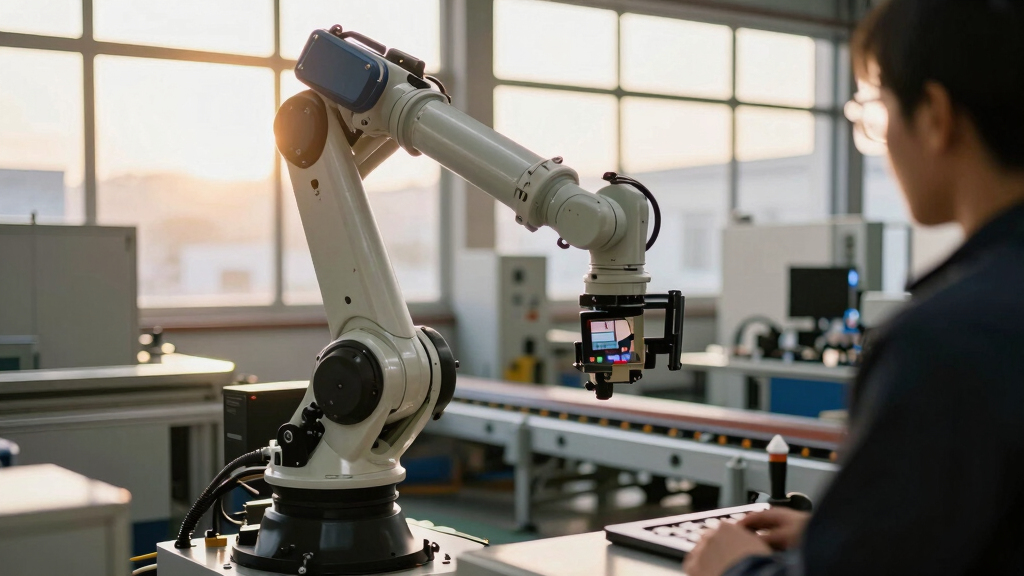

📊 Full opportunity report: China: The Visible Hand on ThorstenMeyerAI.com — validation score, market gap, and execution plan.

Get business pricing on tech for your team
- Business-only prices and quantity discounts
- Tax-exempt purchasing
- Multiple users, one account, clear invoices
TL;DR
China is employing a centralized, state-led approach to economic and technological development, prioritizing strategic sectors like AI and robotics. The government owns significant capital and directs innovation, but social safety nets remain limited. The development highlights China’s distinct model of economic management.
China is actively implementing a state-led approach to its economic and technological development, with the government directing investments, innovation, and industrial policy through its Five-Year Plans and mobilization campaigns like “AI+” and “Robot+.” This strategy emphasizes direct state ownership and control, contrasting with market-driven models, and aims to position China as a global leader in artificial intelligence and robotics.
The Chinese government owns a large share of capital through state-owned enterprises and state banks, enabling it to allocate resources directly toward strategic priorities. The “AI+” and “Robot+” campaigns are designed to accelerate innovation in AI, humanoid robots, and smart manufacturing, leveraging China’s existing industrial strengths. While private companies such as DeepSeek and Alibaba play significant roles in technological breakthroughs, the state’s role primarily involves funding, regulation, and ownership, rather than invention.
China’s approach is characterized by a high degree of central planning, with the Five-Year Plan serving as the core document guiding provincial and municipal targets. The regulatory framework emphasizes control and social stability, with AI and algorithm regulation focused on governance rather than worker protections. Despite these efforts, the private sector remains a key driver of frontier breakthroughs, with most innovations originating from private startups and firms.
However, the model also reveals significant inequalities. The social safety net is limited, with the hukou household registration system excluding millions of rural migrants from urban welfare benefits. The “common prosperity” rhetoric has been de-emphasized in recent plans, with resources increasingly directed toward technology, supply chains, and security, often at the expense of social welfare programs.
The Visible Hand
Where the US bets on the market’s invisible hand, China bets on the visible one: the party-state directs the transition by plan — owns the capital, names the strategic tracks — strong where the state acts, thin where the individual stands.
Independent commentary, produced with AI assistance under human editorial oversight. The views are the author’s own and may change. This is analysis, not policy, economic, investment, or legal advice. Descriptions of “common prosperity,” dibao, the hukou system, the 15th Five-Year Plan, “AI+”/”Robot+,” DeepSeek, and China’s robotics and state-ownership landscape reflect publicly reported information as of mid-2026 and may change; figures are indicative and several are contested estimates. This phase maps differing approaches and endorses none; characterizations of contested political, economic, and labor arrangements are factual and analytical, present competing views, not a verdict, and are not partisan. Country, program, and company names are referenced for analysis and imply no affiliation.
Implications of China’s State-Directed Strategy
This approach demonstrates China’s capacity for rapid, coordinated development in key sectors, giving it a strategic advantage in AI and robotics. However, it also raises concerns about social inequality, limited individual rights, and the sustainability of an economic model that prioritizes state control over social welfare. The reliance on state ownership and top-down planning contrasts sharply with market-driven democracies, potentially shaping global technological competition and geopolitical influence.
AI development kits for developers
As an affiliate, we earn on qualifying purchases.
As an affiliate, we earn on qualifying purchases.
Background of China’s Strategic Economic Model
Over recent decades, China has shifted from a primarily market-oriented economy to a model where the state plays a central role in directing growth. The 15th Five-Year Plan (2026-2030) emphasizes technological self-reliance, with campaigns like “AI+” and “Robot+” accelerating innovation. Historically, China has used top-down planning to achieve rapid development, lifting hundreds of millions out of poverty and establishing global manufacturing dominance. The current focus on AI and robotics builds on this legacy, aiming to secure leadership in future industries.
While private companies have driven breakthroughs in AI, the government’s role in funding and regulation remains critical. The strategy reflects a belief that a determined party-state can mobilize resources more efficiently than market democracies, especially in sectors deemed vital for national security and global influence.
“China’s approach is characterized by direct state ownership and control, mobilizing capital and policy to accelerate strategic sectors like AI and robotics.”
— Thorsten Meyer
As an affiliate, we earn on qualifying purchases.
Unclear Aspects of China’s Long-Term Strategy
It remains uncertain how sustainable this state-led model is, especially regarding social stability and inequality. The limited social safety nets and the exclusion of millions of rural migrants could pose risks to social cohesion. Additionally, the balance between private innovation and state control continues to evolve, with questions about whether private firms can sustain breakthroughs without greater state support or whether the model can adapt to future global shifts.
As an affiliate, we earn on qualifying purchases.
Future Developments in China’s Strategic Planning
China is expected to continue emphasizing AI and robotics in its upcoming Five-Year Plans, with increased investment in innovation and infrastructure. Monitoring the evolution of regulation, private sector participation, and social policies will be key to understanding whether the current model maintains its effectiveness or faces new challenges. International responses to China’s technological advancements will also influence its strategic trajectory.
As an affiliate, we earn on qualifying purchases.
Key Questions
How does China’s state-led approach differ from Western market models?
China’s approach involves direct government ownership, planning, and regulation to steer development, contrasting with Western models that rely more on market forces and private enterprise.
What are the main sectors prioritized by China’s Five-Year Plan?
Artificial intelligence, robotics, supply chains, and security are the primary focus areas, with significant government funding and regulation.
The model has limited social safety nets and excludes many rural migrants, raising concerns about inequality and social stability.
Will private companies continue to lead innovation under this model?
Yes, private companies currently drive many breakthroughs, but the state’s role in funding and regulation remains central to the overall strategy.
Source: ThorstenMeyerAI.com
Halloween Picks
halloween
As an affiliate, we earn on qualifying purchases.