

TL;DR
Diffusion models generate images by starting with random noise and repeatedly estimating and removing it, guided by a text prompt. The method is described in published research, but models can struggle with lettering, object relationships and reproducing training images; a 2025 UK court ruling addressed one legal question about Stable Diffusion while leaving others unresolved.
A November 23, 2026 explainer from Thorsten Meyer AI describes how diffusion models create images by starting with random noise and gradually removing it, with a text prompt steering the process. The method, documented in research papers, helps explain both how image generators work and why they can produce errors such as misspelled words or misplaced objects.

Get business pricing on tech for your team
- Business-only prices and quantity discounts
- Tax-exempt purchasing
- Multiple users, one account, clear invoices
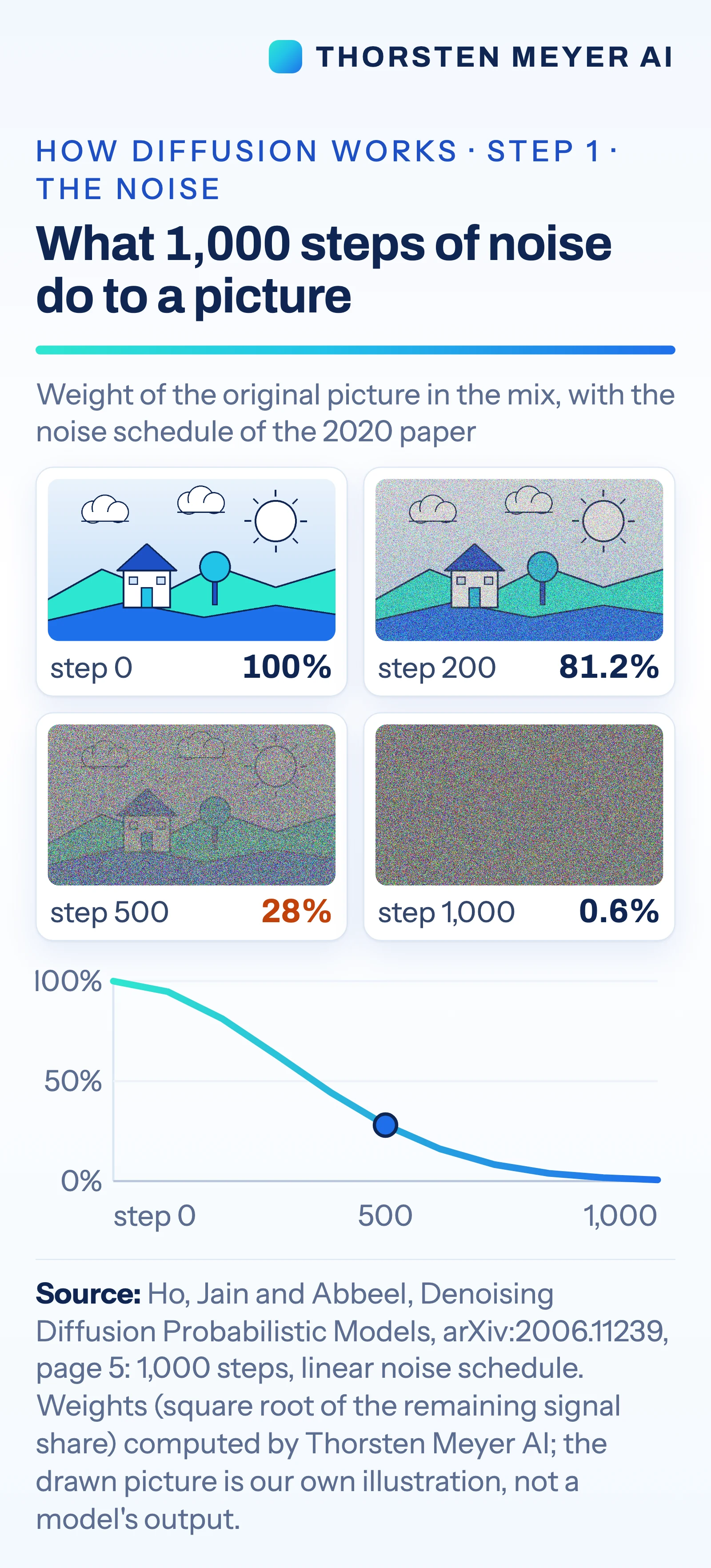
During training, a model is shown real images that have been progressively mixed with noise. A neural network learns to estimate the noise at each stage. The 2020 paper Denoising Diffusion Probabilistic Models, by Jonathan Ho, Ajay Jain and Pieter Abbeel, used 1,000 steps in its experiments. At the end of the sequence, the image signal is effectively lost in noise.
Image generation runs the process in reverse. The model begins with random noise and estimates what to remove at each step, gradually forming broad shapes before finer detail. The explainer says a widely used open-source pipeline commonly runs 50 steps by default; the exact settings can vary by model and software.
Many systems do this work in a compressed representation called latent space. The article says that in Stable Diffusion v1, a 512-by-512 image is represented using 48 times fewer numbers than its full-resolution form. A text encoder converts the prompt into numerical information, and guidance steers the denoising steps toward that description. Stronger guidance can bring the output closer to the prompt, though the explainer says this may come at a cost to image quality.
Why Image Generators Miss Details
The process helps explain why generated images can look convincing while getting specific details wrong. A model predicts and removes noise across an image representation; it does not follow a human-like plan that guarantees each object, count, word or spatial relationship will be correct. The explainer identifies lettering, counting and object placement as persistent challenges.
There is also a question of resemblance to training material. Researchers have extracted near-copies of some training images from models, according to the source. That finding makes memorization and copyright relevant concerns, but it does not establish that every generated image copies a source image. The distinction matters to artists, users and companies assessing how such systems are trained and deployed.
Products Worth Considering

Bose QuietComfort Headphones (2nd Gen), Wireless Over-Ear Noise-Cancelling Headphones, Black

DJI Mini 5 Pro Bundle with RC-N3 Controller, 1 50MP CMOS Camera Drone, 4K/120fps HDR, LiDAR Obstacle Sensing, Under 249g, ND Filter Kit (ND8

Sonos Era 300 Wireless Smart Speaker with Dolby Atmos, Black
As an affiliate, we earn on qualifying purchases.
From Noise Research to Image Tools
The general approach predates today’s image generators. In 2015, Jascha Sohl-Dickstein and colleagues described gradually destroying structure in data and learning a reverse process to restore it. The idea gained a practical demonstration in Ho, Jain and Abbeel’s 2020 paper, which set out a denoising method using a sequence of noise levels.
Modern image systems add components that make the method more efficient and responsive to text. Latent diffusion reduces the amount of data processed at each step, while a text encoder and guidance method connect the prompt to the image-generation process. These are parts of a larger pipeline; the article distinguishes image generation from language-model text generation, while noting that both systems can use text encoders and attention mechanisms.
The explainer also cites a 2025 UK court ruling that found Stable Diffusion itself was not an “infringing copy.” That finding concerns a specific legal question. It does not settle every issue about training data, copyright or the status of particular generated images.
““systematically and slowly destroy structure in a data distribution through an iterative forward diffusion process””
— Jascha Sohl-Dickstein and colleagues, 2015 paper
Open Questions on Copying and Control
The explainer does not establish how often models reproduce training images, or how likely a particular model is to do so. The reported extraction of near-copies shows a possibility researchers have demonstrated, but it does not quantify the risk across systems or prompts.
Legal questions also remain broader than the cited UK ruling. The source says the court found Stable Diffusion itself was not an “infringing copy,” while other questions are open. It does not provide details here about the scope of those unresolved issues or how other courts may rule. The article also describes typical step counts and compression for named systems; those figures should not be assumed to apply to every image model.
What Future Evaluations Need to Show
The next developments to watch are technical evaluations of how well image models handle text, object counts and spatial relationships, alongside research into whether outputs reproduce material in training data. Results will need to be tied to specific models and testing methods, since settings and pipelines differ.
On copyright, further court decisions and evidence about training practices may clarify questions left open by the 2025 UK ruling. For now, the explainer provides a technical account of the denoising process and a limited snapshot of the legal position; it does not establish how those unresolved issues will be decided.
Key Questions
How does a diffusion model make an image?
It starts with random noise and repeatedly estimates and removes some of it. The image gradually takes shape, with the prompt guiding the process.
Why do AI images often get words or object positions wrong?
The model predicts image patterns while removing noise; it does not guarantee that each requested word, object count or spatial relationship will be represented correctly. The explainer identifies lettering, counting and placement as common difficulties.
What does latent diffusion mean?
It means the model performs the denoising process on a compressed representation of the image. The source says Stable Diffusion v1 represents a 512-by-512 image with 48 times fewer numbers than the full-resolution form.
Did a UK court settle whether Stable Diffusion violates copyright?
No. The cited 2025 ruling found Stable Diffusion itself was not an “infringing copy,” according to the explainer. The source says other questions remain open.
Source: Thorsten Meyer AI