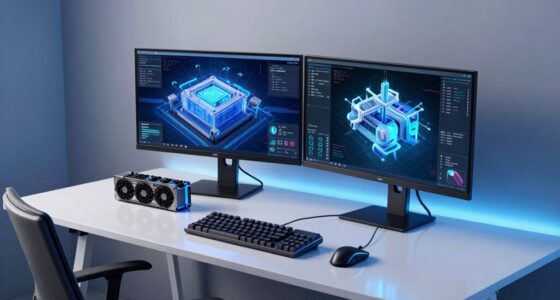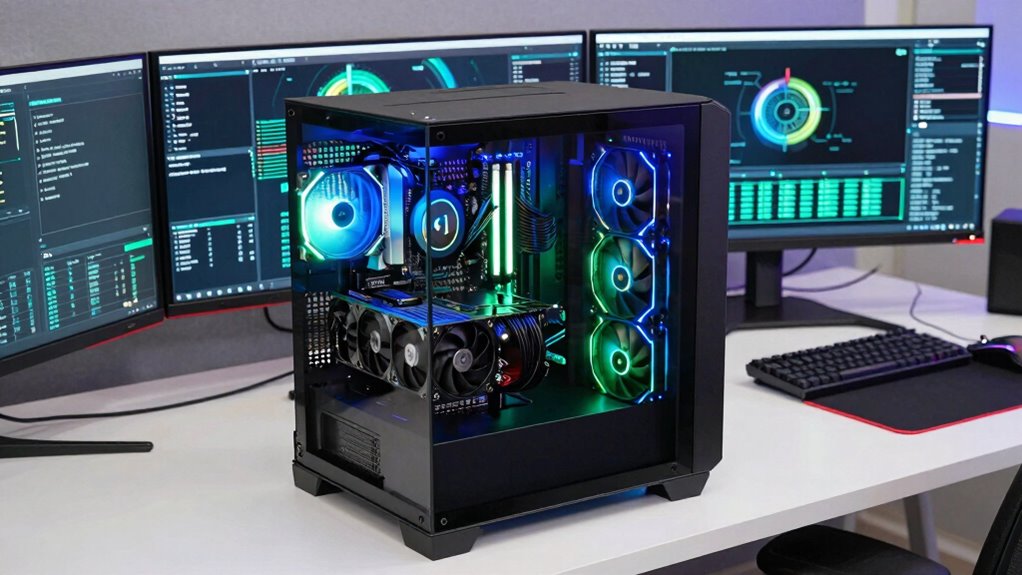

A machine learning workstation beats a high-end PC because it’s built specifically for complex training tasks. It offers multiple high-performance GPUs, customization options, and better cooling and power stability to handle heavy workloads. Unlike a generic PC, it can be upgraded easily and supports scalability through cloud options. This tailored design helps improve efficiency and reduces training times. Keep exploring to discover more about how these features make a difference.

Get business pricing on tech for your team
- Business-only prices and quantity discounts
- Tax-exempt purchasing
- Multiple users, one account, clear invoices
Key Takeaways
- Machine learning workstations feature multiple high-performance GPUs optimized for intensive training tasks.
- They allow hardware customization and upgrades tailored to specific models and datasets.
- Workstations include advanced cooling and power systems designed for sustained, heavy workloads.
- They offer flexibility to accommodate evolving algorithms and larger data sizes through upgrades and cloud integration.
- High-end PCs have fixed specifications, limiting their ability to handle demanding, large-scale machine learning tasks.
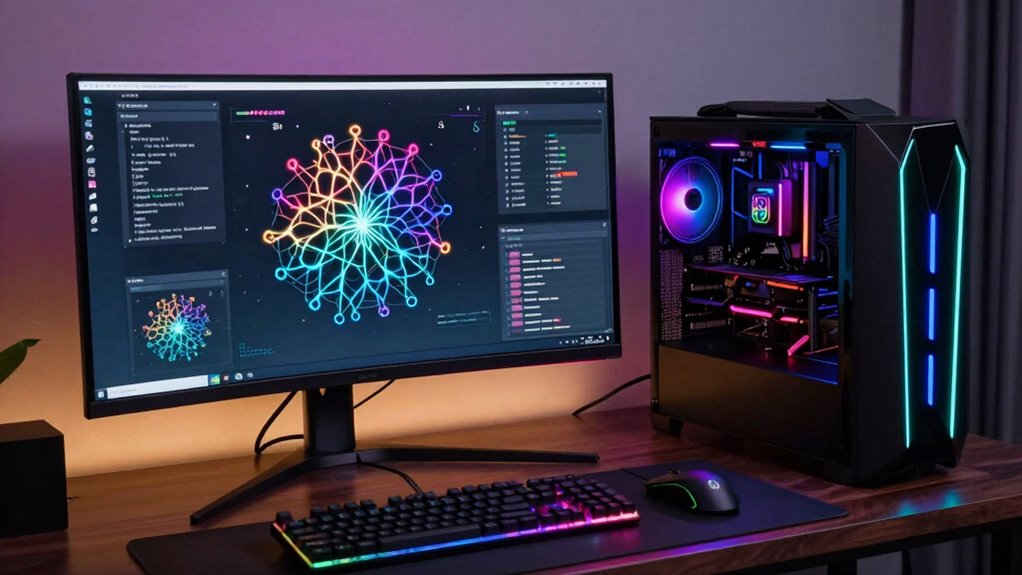
When choosing between a machine learning workstation and a high-end PC, understanding their distinct capabilities can help you make an informed decision. A machine learning workstation is specifically designed to handle the intense computational demands of training complex models. Unlike a typical high-end PC, which may excel at gaming or general tasks, a workstation offers specialized hardware tailored for machine learning workloads. These systems often incorporate multiple high-performance GPUs, ample RAM, and fast storage options that markedly reduce training times. Cloud computing options are also integrated into many workstations, allowing you to offload some processing to remote servers when needed, which enhances flexibility and scalability. This integration means you can scale up your resources without constantly upgrading your hardware.
One of the biggest advantages of a machine learning workstation is hardware customization. You can select and upgrade components based on your precise needs, whether that’s adding more GPUs, increasing memory, or optimizing storage solutions for faster data access. This level of customization guarantees that your system is not just powerful but tailored for the specific models and datasets you’re working with. In contrast, a high-end PC, while capable of handling some machine learning tasks, typically comes with fixed specifications that might not be optimized for large-scale training or complex algorithms. The hardware in a high-end PC is often more generalized, aiming to balance performance across various uses rather than specializing in machine learning.
Customizable hardware for tailored machine learning performance, unlike fixed-spec high-end PCs optimized for general use.
Additionally, a machine learning workstation often features enhanced cooling systems and robust power supplies to support continuous, heavy workloads. This reliability is essential when training models over long periods. Hardware flexibility also plays a crucial role in allowing users to adapt to evolving machine learning techniques and data sizes. The ability to customize hardware also means you can future-proof your investment, gradually upgrading components as your project scales or as new technology becomes available. Moreover, customizable hardware allows for better adaptation to evolving machine learning techniques and data sizes. Another benefit is that these systems often include professional-grade components, ensuring longevity and consistent performance under demanding conditions. On the other hand, a high-end PC, although powerful, may hit limitations sooner because it lacks the same level of hardware flexibility. It’s designed more for versatility than for the specific needs of machine learning, making it less ideal for intensive, ongoing training tasks.
In essence, if your focus is on pushing the boundaries of machine learning, a dedicated workstation provides the durability, scalability, and customization you need. While a high-end PC might suffice for casual or beginner projects, a machine learning workstation offers the specialized features and adaptability that can make all the difference in achieving faster results and smoother workflows.
high performance GPU workstation
As an affiliate, we earn on qualifying purchases.
As an affiliate, we earn on qualifying purchases.
Frequently Asked Questions
Can a High-End PC Handle Large Machine Learning Models Effectively?
A high-end PC can handle large machine learning models, but it might struggle with scalability and efficiency. You’ll find that cloud integration allows you to access powerful resources when needed, while hardware upgradeability lets you improve components over time. This flexibility guarantees smoother training of big models, whereas a dedicated workstation is optimized for performance, minimizing bottlenecks and offering a more reliable, long-term solution for intensive machine learning tasks.
What Specific Hardware Features Distinguish a ML Workstation From a Gaming PC?
You might think a gaming PC suffices, but a machine learning workstation has dedicated hardware features like superior GPU optimization and advanced storage configurations. These aren’t just bells and whistles—they’re essential for handling massive datasets and complex models efficiently. While gaming PCs focus on graphics for entertainment, a workstation’s hardware is purpose-built for relentless computation, making your machine learning tasks faster and more reliable—who knew that gaming hardware just isn’t enough?
Is a Workstation More Cost-Effective Than a High-End PC for ML Tasks?
A workstation often proves more cost-effective than a high-end PC for ML tasks because it offers better hardware durability and upgrade flexibility. You can invest in high-quality components designed for intensive workloads, reducing replacement costs over time. Plus, you can easily upgrade parts like GPUs or memory as needed, extending its lifespan and optimizing performance, ultimately providing long-term savings despite a higher initial investment.
How Does Thermal Management Differ Between ML Workstations and High-End PCS?
Think of thermal management like a well-oiled machine—your ML workstation is designed for ideal thermal efficiency, with advanced cooling systems that keep components from overheating. Unlike generic high-end PCs, which often rely on standard fans, workstations feature custom liquid cooling or larger heatsinks, ensuring consistent performance during intense workloads. This superior cooling helps extend hardware lifespan and maintains peak performance, making your workstation a powerhouse for machine learning tasks.
Are There Software Compatibility Advantages With ML Workstations?
You benefit from software compatibility advantages on an ML workstation because it’s designed with optimized drivers and software support tailored for machine learning tasks. This guarantees better software optimization, reducing bugs and improving performance. Unlike generic high-end PCs, ML workstations often come with pre-installed or easily integrable drivers for GPUs and AI frameworks, making your setup smoother and more reliable for complex machine learning workloads.
machine learning workstation with multiple GPUs
As an affiliate, we earn on qualifying purchases.
As an affiliate, we earn on qualifying purchases.
Conclusion
When you choose a dedicated machine learning workstation over a generic high-end PC, you’re unleashing a superpower that makes even the most advanced consumer rigs look like toys. With optimized hardware, massive memory, and dedicated GPUs, your productivity skyrockets — transforming complex data into insights faster than you ever imagined. Don’t settle for less; upgrade to a machine learning workstation and watch your projects soar beyond the limits of ordinary machines, turning your dreams into reality at lightning speed.
As an affiliate, we earn on qualifying purchases.
professional deep learning workstation
As an affiliate, we earn on qualifying purchases.
As an affiliate, we earn on qualifying purchases.
Evergreen bestsellers Picks
bestsellers
As an affiliate, we earn on qualifying purchases.