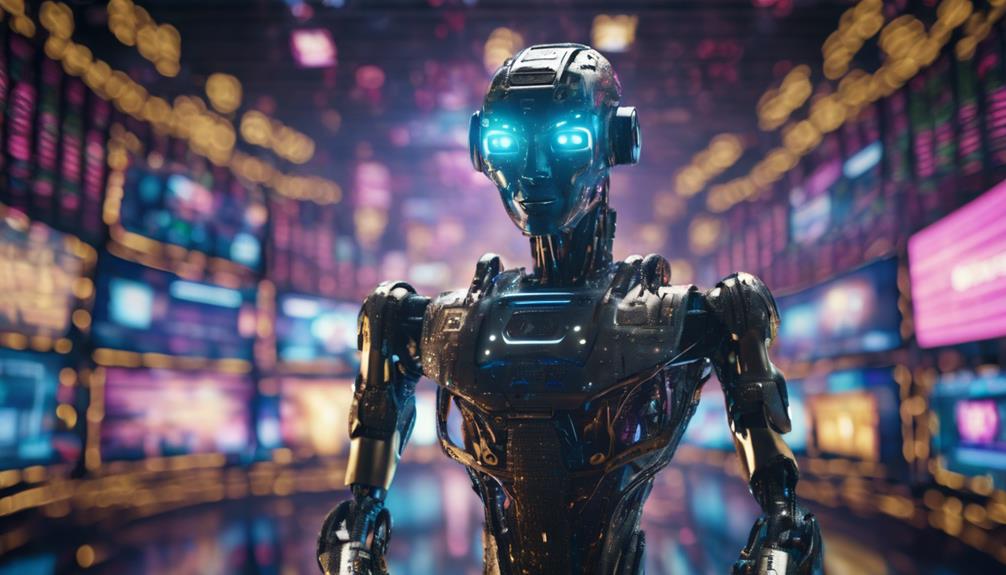
Multi-agent reinforcement learning involves multiple AI agents learning to interact through cooperation, competition, or both within shared environments. You’ll see agents working together to achieve common goals, like robotic teams coordinating tasks, or competing to outperform rivals in games. These strategies require balancing communication, strategic thinking, and adaptability. As you explore further, you’ll discover how these dynamics enable AI systems to handle complex, real-world problems with advanced collaboration and rivalry skills.
Key Takeaways
- MARL involves multiple agents learning to collaborate or compete within shared environments, mirroring real-world scenarios.
- Cooperative MARL focuses on joint goals, communication, and shared rewards to achieve synchronized actions.
- Competitive MARL emphasizes individual strategies, predicting opponents, and tactics to outperform rivals.
- Many real-world situations require handling mixed scenarios involving both cooperation and competition simultaneously.
- Challenges in MARL include managing complex, dynamic interactions and enabling agents to adapt to changing motives.
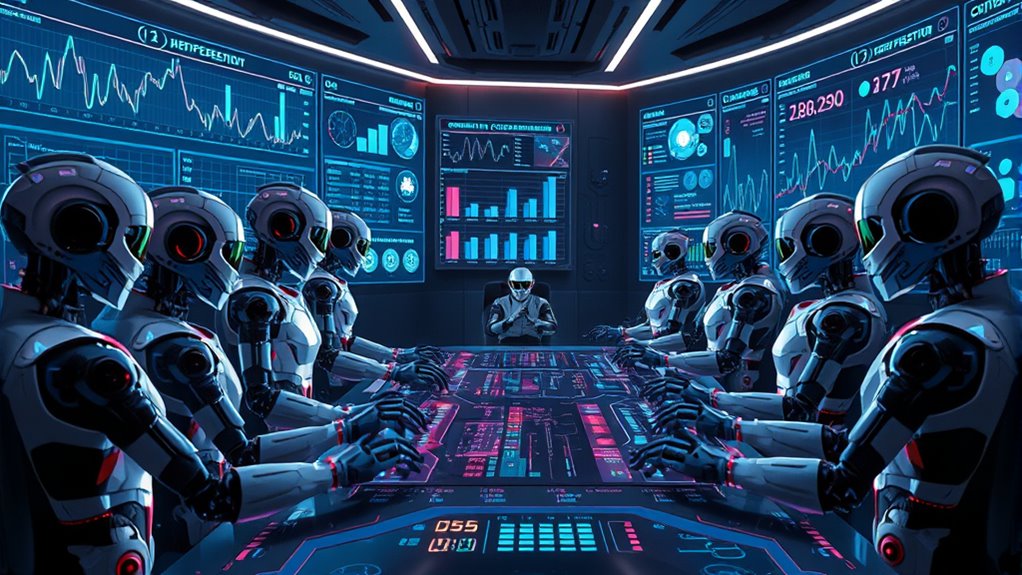
Have you ever wondered how multiple AI agents can learn to work together in complex environments? This is the core idea behind multi-agent reinforcement learning (MARL), a fascinating area where AI systems interact within shared spaces, learning strategies that involve cooperation, competition, or a mix of both. In MARL, each agent perceives its environment and makes decisions based on its own observations while considering the actions of others. This setup mimics real-world scenarios like autonomous vehicles charting traffic, robotic teams assembling products, or virtual players competing in a game. The challenge lies in enabling these agents to adapt and learn effectively amidst dynamic, often unpredictable, interactions.
When multiple agents share an environment, their goals can either align or conflict. In cooperative settings, agents work together to achieve a common objective, like collaborating to clean a room or coordinate defense strategies in a game. They learn to communicate, share information, and synchronize their actions to maximize a joint reward. For example, in robotic soccer, each robot must understand its role and coordinate with teammates to score goals while defending their net. Achieving such harmony requires sophisticated algorithms that allow agents to balance individual learning with group goals, often through shared reward signals or centralized training with decentralized execution.
On the flip side, competition introduces a different dynamic where agents pursue individual interests. Here, learning involves predicting opponents’ actions and adapting strategies accordingly. Think of a multiplayer game where each player aims to outsmart others; agents must develop tactics that counter their rivals while maximizing their own gains. This setting fosters strategic thinking, where agents anticipate moves, bluff, or form temporary alliances. Reinforcement learning algorithms in competitive environments often incorporate elements like game theory, enabling agents to analyze potential outcomes and choose actions that maximize their chances of winning.
MARL systems must also handle the tension between cooperation and competition, which often coexist in real-world scenarios. For instance, autonomous vehicles might collaborate to maintain traffic flow but compete when choosing routes or overtaking. Developing algorithms that adapt to such mixed motives requires a nuanced understanding of the environment and the ability to switch strategies as circumstances change. Additionally, incorporating high fidelity simulation can help train agents more effectively in realistic settings. This complexity makes MARL a rich, challenging field, pushing the boundaries of how AI systems can learn, adapt, and interact in multifaceted settings. By mastering cooperation and competition, you access the potential for AI to tackle more intricate problems that mirror the complexities of human social and strategic behavior.

Multi-Agent Reinforcement Learning for Developers and Researchers: From Fundamentals to Advanced Applications
As an affiliate, we earn on qualifying purchases.
As an affiliate, we earn on qualifying purchases.
Frequently Asked Questions
How Does Multi-Agent RL Differ From Single-Agent RL?
You’ll find that multi-agent reinforcement learning involves multiple agents learning and interacting within the same environment, unlike single-agent RL where only one agent makes decisions. In multi-agent settings, agents must consider others’ actions, leading to complex dynamics like cooperation or competition. This makes the learning process more challenging, as agents need to adapt to changing strategies, whereas single-agent RL focuses solely on optimizing one agent’s behavior.
What Are Common Challenges in Multi-Agent Reinforcement Learning?
You might think multi-agent reinforcement learning is straightforward, but it faces unique challenges. You’ll struggle with non-stationarity, where agents change behaviors, making learning unstable. Coordination becomes tough when agents have conflicting goals, leading to difficulties in cooperation. Additionally, the environment’s complexity grows exponentially with more agents, increasing computational demands. Overcoming these issues necessitates innovative algorithms and careful design to guarantee effective learning and interaction among agents.
How Is Cooperation Incentivized Among Competing Agents?
You incentivize cooperation among competing agents by designing shared rewards, encouraging collaboration to achieve common goals. Implementing mechanisms like communication protocols and negotiation strategies can foster trust and coordination. Additionally, structuring environments with mutual dependencies motivates agents to work together, as their success depends on collective effort. By aligning individual incentives with group outcomes, you promote cooperation even amid competition, leading to more effective and harmonious multi-agent systems.
What Are Real-World Applications of Multi-Agent RL?
You might find multi-agent reinforcement learning useful in areas like traffic management, where it helps optimize flow and reduce congestion, or in robotics, enabling teams of robots to work harmoniously on complex tasks. It also finds a home in finance for trading strategies, in gaming for creating realistic opponents, and in smart grids for balancing energy distribution. These applications streamline operations and foster efficiency across diverse sectors.
How Do Communication Protocols Impact Multi-Agent Strategies?
Communication protocols directly influence your multi-agent strategies by enabling better coordination and information sharing. When protocols are clear and efficient, you can adapt quickly, avoid conflicts, and optimize collective goals. Conversely, poor communication leads to misunderstandings and suboptimal decisions. You need dependable protocols to ensure agents work together seamlessly, whether in competitive or cooperative settings, ultimately improving your system’s performance and robustness in complex environments.
![Arduino Engineering Kit REV2 [AKX00022] - Advanced Hands-On Learning Kit for Engineering, Robotics, and Automation with Full Curriculum and Real-World Projects](https://m.media-amazon.com/images/I/41Z1Qwv73ML._SL500_.jpg)
Arduino Engineering Kit REV2 [AKX00022] – Advanced Hands-On Learning Kit for Engineering, Robotics, and Automation with Full Curriculum and Real-World Projects
Complete Engineering Learning Experience: The Arduino Engineering Kit REV2 is an advanced, hands-on learning package designed to teach…
As an affiliate, we earn on qualifying purchases.
As an affiliate, we earn on qualifying purchases.
Conclusion
In summary, multi-agent reinforcement learning opens exciting possibilities for cooperation and competition. Did you know that in complex environments, agents can learn strategies that outperform humans in certain tasks? This highlights the potential for AI to tackle real-world challenges collaboratively or competitively. By understanding these dynamics, you can harness multi-agent systems’ power, pushing the boundaries of what’s achievable in fields like robotics, gaming, and autonomous systems. The future of AI truly depends on mastering these interactions.

Introduction to Autonomous Driving
As an affiliate, we earn on qualifying purchases.
As an affiliate, we earn on qualifying purchases.

AI Game Strategy, Video Analysis & Opponent Scouting: How Artificial Intelligence Wins Before the Game Starts (AI Sports Peak Performance)
As an affiliate, we earn on qualifying purchases.
As an affiliate, we earn on qualifying purchases.