
Integrating reinforcement learning with high-fidelity simulations allows you to develop and test control strategies safely and cost-effectively before deploying them in real industrial processes. This approach reduces risks, minimizes costs, and accelerates development by enabling rapid iteration in virtual environments. You can explore diverse scenarios, improve system robustness, and refine policies with real-world data feedback. Continuing this exploration will reveal how this integration can truly optimize your industrial automation efforts.
Key Takeaways
- Utilizing high-fidelity simulations enables safe and cost-effective training of RL agents before deployment in real industrial systems.
- Continuous simulation updates with real data improve model accuracy and facilitate smooth transfer of learned policies to actual processes.
- Simulations allow testing of diverse control strategies and extreme scenarios, enhancing policy robustness and system resilience.
- Integrating RL with simulations accelerates development cycles, reducing time and costs associated with physical experimentation.
- Feedback from real-world operations refines simulation models, creating a loop that improves both system understanding and policy performance.
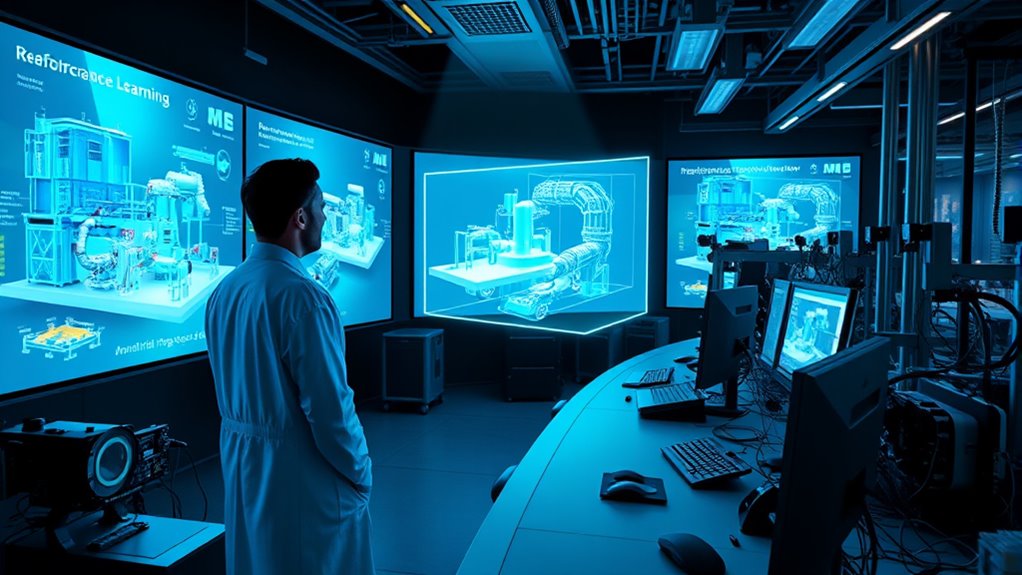
Reinforcement learning (RL) has become a powerful tool for developing intelligent systems, but training these models in real-world environments can be costly and risky. You might find that experimenting directly on complex industrial equipment or production lines could lead to costly errors, safety hazards, or system downtime. To overcome these challenges, integrating RL with simulations offers a practical and efficient alternative. By creating accurate digital replicas of your industrial processes, you can train and refine RL agents in a controlled, risk-free environment before deploying them in the real world.
Training RL models in real environments is costly and risky; simulations provide a safe, efficient alternative.
When you use simulations, you gain the ability to model complex dynamics, incorporate variability, and test a wide array of scenarios that would be difficult or impossible to replicate physically. This allows you to explore the effects of different control strategies, operational parameters, and environmental conditions without interrupting your actual process. The key is to develop simulations that closely match real-world behavior, guaranteeing that the policies learned transfer effectively when implemented in real systems.
One of the main advantages of this approach is the significant reduction in costs. Instead of wasting resources on trial-and-error experiments that could damage equipment or cause production delays, you can conduct extensive training within the virtual environment. This accelerates the development cycle, enabling you to iterate rapidly, optimize control policies, and identify the most effective strategies before risking anything on the plant floor. As a result, your team can save both time and money while improving system performance.
Another benefit is safety. Training RL agents directly on live machinery poses safety risks to operators and the environment. Simulations mitigate these concerns, allowing you to test aggressive or unconventional control strategies without endangering personnel or risking safety violations. Once you’re confident in the simulation results, you can gradually transfer the learned policies to real-world systems with a higher degree of certainty that they will perform as intended.
Furthermore, integrating RL with simulations enables continuous improvement. As your system operates, you can update the simulation models with real data, refining their accuracy. This creates a feedback loop where the RL agent continually learns and adapts, improving performance over time. You can also simulate rare or extreme events to ensure your control policies are robust and resilient under unexpected conditions. Additionally, understanding system dynamics is crucial for creating high-fidelity simulations that accurately reflect real-world behavior.
In essence, using simulations as a training ground for RL in industrial processes empowers you to develop smarter, safer, and more cost-effective control strategies. It bridges the gap between theoretical models and practical application, making advanced automation achievable without exposing your operations to unnecessary risks.
Frequently Asked Questions
How Does RL Handle Real-Time Data Variability in Industrial Simulations?
You can handle real-time data variability in industrial simulations by designing your RL system to adapt quickly. It updates its policies based on new data, using techniques like online learning or continual training. This allows the agent to respond to changing conditions effectively. Additionally, incorporating noise models helps the system distinguish between normal fluctuations and significant changes, ensuring more robust decision-making in dynamic environments.
What Are the Main Challenges in Scaling RL for Large Industrial Systems?
Scaling RL for large industrial systems is like trying to tame a wildfire; the complexity grows exponentially. You’ll face challenges in computational resources, as training requires massive data and processing power. Ensuring stability becomes harder, and designing scalable algorithms is tricky. Plus, real-world unpredictability makes it tough to maintain performance across diverse, interconnected components. Overcoming these hurdles demands innovative methods and robust infrastructure to keep the flame of efficiency burning bright.
How Can Simulation Accuracy Impact RL Policy Effectiveness?
Simulation accuracy directly influences your RL policy’s success; if the simulation’s imprecise, your learned strategies may not perform well in real systems. When the model doesn’t reflect actual conditions accurately, your policy might optimize for scenarios that never occur or overlook critical factors. To maximize effectiveness, you should guarantee your simulations are detailed and validated, so your RL agent learns robust, real-world-relevant policies.
What Safety Measures Are Necessary During RL Training in Industrial Settings?
Think of safety measures as your shield during RL training in industrial settings. You should implement robust monitoring systems, set clear operational boundaries, and use virtual environments to test policies before real-world deployment. Regular safety audits and emergency shutdown protocols are essential. These steps make certain your team stays protected, and the process remains secure—turning potential hazards into manageable challenges, so your training proceeds smoothly without risking safety.
How Do Transfer Learning Techniques Improve RL Deployment Across Industries?
Transfer learning helps you deploy RL across industries by allowing you to leverage pre-trained models from one domain to another. This accelerates training, reduces data requirements, and improves initial performance in new environments. You can adapt existing policies to different settings, saving time and resources. By fine-tuning models with industry-specific data, you guarantee the RL system quickly becomes effective, making deployment smoother and more efficient across various industrial applications.
Conclusion
By blending reinforcement learning with simulations, you open a powerful tool akin to Da Vinci’s ingenuity—creating masterpieces through experimentation. This integration lets you optimize industrial processes with agility and precision, transforming theoretical ideas into real-world excellence. Just as Icarus aspired to touch the sun, you can push boundaries and reach new heights in efficiency and innovation. Embrace this fusion, and let your journey toward smarter industries soar beyond the horizon.