
📊 Full opportunity report: Understanding The AI Compression Pipeline Before Releasing Local LLMs on ThorstenMeyerAI.com — validation score, market gap, and execution plan.

Get business pricing on tech for your team
- Business-only prices and quantity discounts
- Tax-exempt purchasing
- Multiple users, one account, clear invoices
TL;DR
AI developers are increasingly adopting trained-in quantization, like MXFP4, for large language models, fundamentally changing how models are compressed and deployed locally. This shift affects hardware requirements, model accuracy, and deployment strategies.
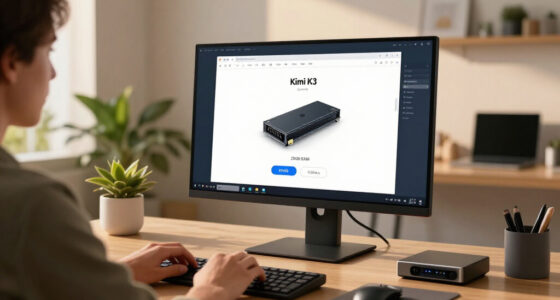
Recent advancements in AI model training and compression have led to a fundamental shift in how large language models (LLMs) are prepared for local deployment. Trained-in quantization, exemplified by models like Kimi K3, is now being integrated during training rather than applied afterward, drastically reducing model size and altering hardware requirements. This development matters because it impacts the feasibility of running frontier-scale models on consumer hardware, especially in the context of the growing popularity of local inference.
Historically, AI models such as Kimi K3 were trained at full precision (FP16) and then compressed through post-training quantization (PTQ), which involves reducing the model’s numerical precision after training. This approach allowed for smaller, faster models that could be deployed on consumer hardware, but it introduced accuracy trade-offs. However, recent models like Kimi K3 are trained with quantization-aware training (QAT), embedding low-precision formats such as MXFP4 directly into the training process. As a result, these models are already optimized at 4-bit precision, making further uniform quantization less effective and sometimes damaging to accuracy.
For example, Kimi K3’s native size at MXFP4 is approximately 1.4TB, significantly smaller than the 5.6TB of the original FP16 weights, yet it cannot be simply downscaled further without risking performance loss. This shift means that compression is no longer a post hoc step but an integral part of the training process, requiring new workflows and hardware considerations.
Quantization is the lever that turns a model needing a datacenter into one needing a workstation. In 2026 it stopped being a simple after-the-fact shrink — and Kimi K3 is the clearest example of why.
Quantization stores the same weights at coarser precision. Fewer bits per weight means less memory and bandwidth, and slightly less accuracy. The size scales almost linearly with bit-depth.
bytes ≈ parameters × bits ÷ 8. K3 figures are Unsloth-reported for the 2.8T model.“Quantized” isn’t one thing. The format decides which hardware, which loader, and which trade-offs you get.
For years, labs shipped at FP16 and the community shrank the model afterward. Kimi K3 inverts that — and it changes the advice.
- Precision reduced after the model is trained
- Exploits the slack between FP16 and 4-bit
- “Just download a smaller quant” — the old default
- K3 ships natively at MXFP4, MXFP8 activations
- The compression was spent before release
- Can’t be squeezed further uniformly — the slack is gone
If K3 can’t be squeezed uniformly, how does a 594GB 1-bit build exist? Mixed precision — most weights at 1–2 bits, the load-bearing layers upcast to 8-bit, the whole thing measured against a lossless reference.
Both distort the simple bytes-equals-params-times-bits math, and both bite hardest on the frontier models people most want to run.
The abstractions resolve into a hard boundary. Drawn on a 512GB M3 Ultra:
Choosing a quant is choosing a point on a curve — steep at the ends, flat in the middle.
Now the frontier labs are spending the compression before you download it.
Implications of Trained-In Quantization for Local AI Deployment
This shift to trained-in quantization fundamentally changes how developers approach deploying large models locally. It reduces the need for extensive post-training compression, but also demands hardware capable of native low-precision computation, such as Blackwell-class GPUs. It raises questions about model flexibility, compatibility, and the future ecosystem of model formats. For users, it means that deploying frontier models on consumer hardware will increasingly depend on training techniques rather than simple post-processing steps, potentially limiting the universality of traditional quantization workflows.
As an affiliate, we earn on qualifying purchases.
Evolution of Model Compression Techniques and Hardware Compatibility
Until recently, the standard practice was to train models at high precision (FP16 or BF16) and apply quantization afterward, often using formats like GGUF or MLX suited for different hardware architectures. Post-training quantization techniques like GPTQ and AWQ aimed to balance accuracy and compression, primarily targeting GPU inference. However, the advent of models like Kimi K3, trained with quantization-aware methods, marks a significant departure. These models are designed from the ground up to operate efficiently at low precision, leveraging hardware-native formats like MXFP4 that are accelerated directly on specialized GPUs such as Blackwell-class units.
This transition reflects a broader industry trend toward integrating low-precision formats into the training process itself, rather than relying solely on post hoc compression, which has been the dominant paradigm for years.
"Models trained with quantization-aware techniques like MXFP4 are already optimized for low-precision deployment, making traditional post-training compression less effective and often damaging to accuracy."
— Thorsten Meyer, AI researcher
As an affiliate, we earn on qualifying purchases.
Unresolved Questions About Compatibility and Ecosystem Support
It is still unclear how widely adopted trained-in quantization will become across different model architectures and hardware platforms. Compatibility with existing tools, formats, and inference engines remains a challenge, especially outside specialized GPU environments. Additionally, the long-term impact on model accuracy and flexibility, particularly for fine-tuning and transfer learning, is still being evaluated. The industry is actively testing these approaches, but definitive standards and best practices are yet to emerge.
As an affiliate, we earn on qualifying purchases.
Future Developments in Hardware and Model Training Techniques
Expect ongoing research into hardware-native low-precision formats like MXFP4, with increased support from GPU manufacturers. Model developers will likely continue integrating quantization-aware training into their workflows, leading to more compact, efficient models optimized for local inference. Industry collaborations may produce standardized formats and tools, easing adoption. Additionally, the community will monitor how these models perform in real-world applications, influencing the next generation of AI deployment strategies.
As an affiliate, we earn on qualifying purchases.
Key Questions
What is trained-in quantization and how does it differ from traditional methods?
Trained-in quantization involves integrating low-precision formats like MXFP4 directly into the training process, making models inherently optimized for low-precision deployment. Traditional methods train at full precision and apply quantization afterward, which can lead to accuracy loss.
How does this shift affect the hardware requirements for local AI inference?
Models trained with native low-precision formats require hardware capable of native low-precision computation, such as Blackwell-class GPUs. This may limit compatibility with older hardware but enables more efficient inference on specialized accelerators.
Will all future models adopt trained-in quantization?
While many new models are moving toward this approach, adoption depends on hardware support, ecosystem development, and research validation. It is likely to become standard for frontier-scale models but may not be universal immediately.
Can models trained with quantization-aware techniques be fine-tuned later?
Yes, but fine-tuning may require adjustments, as the models are optimized for low-precision formats from the start. Compatibility with existing fine-tuning workflows is an active area of research.
Source: ThorstenMeyerAI.com
Fall Picks
fall essentials
As an affiliate, we earn on qualifying purchases.