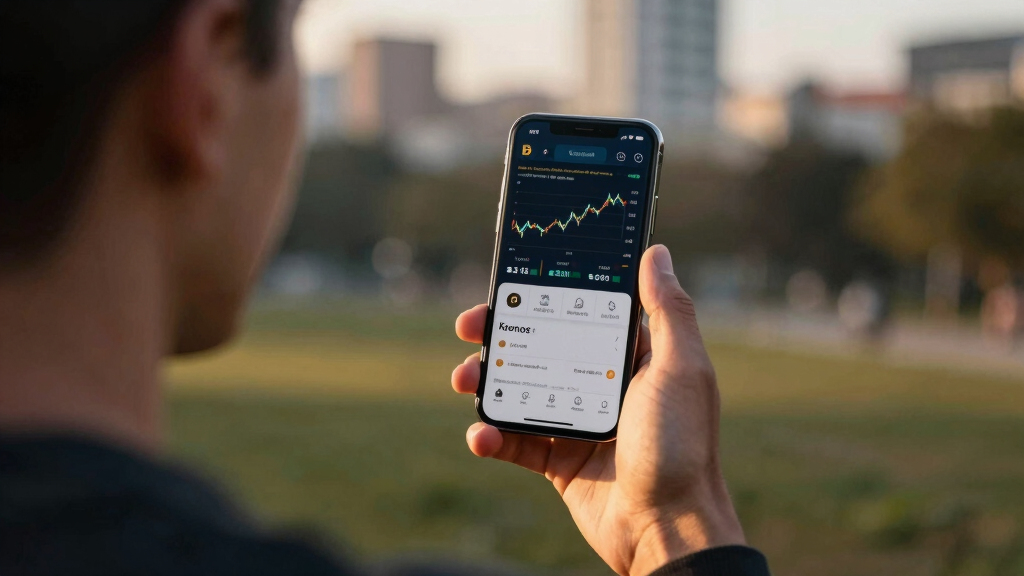

📊 Full opportunity report: Week Three — Foundation model vs Brownian motion. Kronos on five-minute BTC. on ThorstenMeyerAI.com — validation score, market gap, and execution plan.

Get tech for your team delivered free — and shop member deals
- Fast, free delivery on millions of items
- Access to Prime Big Deal Days deals on October 6–7
- Prime Video, Amazon Music and more included
TL;DR
A recent test compared Kronos, a foundation model, to Brownian motion for predicting 5-minute Bitcoin price movements. The results show Kronos does not outperform the traditional Brownian baseline in out-of-sample tests, raising questions about the value of modern learned models in short-term crypto forecasting.
Recent testing shows that Kronos, an open-source foundation model trained on global exchange data, does not outperform a traditional Brownian motion model in predicting 5-minute Bitcoin price movements in out-of-sample conditions.
Over a sample of 497 historical trades, Kronos’s predictive accuracy, measured by Brier score and log-loss, was statistically indistinguishable from the Brownian baseline, which is based on a 100-year-old mathematical assumption of independent, normally-distributed log-returns. In the out-of-sample test, involving 249 trades never seen by the model during training, Kronos’s performance remained nearly identical to Brownian motion, with a negligible difference of 0.0011 in Brier score, well within the margin of noise.
This testing was conducted using a custom Python tool that reconstructed market context, applied both models, and evaluated hypothetical trading outcomes based on their predicted probabilities. The results suggest that, at least for short-term 5-minute horizon predictions, modern foundation models like Kronos do not yet provide a measurable edge over traditional stochastic models.
Implications for AI in Short-Term Crypto Trading
The findings challenge assumptions that large, learned models automatically outperform classical statistical models in high-frequency trading contexts. While Kronos represents a significant advance in financial AI research, its current predictive power in this specific setting is comparable to the simplest models, raising questions about the practical utility of such models for real-time trading strategies. This result underscores the importance of rigorous out-of-sample testing and suggests that, for now, traditional models remain competitive in short-term crypto prediction.
As an affiliate, we earn on qualifying purchases.
Background on Model Testing and Market Expectations
Over the past two weeks, a paper-trading bot called Polybot has been tested against Polymarket’s 5-minute Up/Down markets, revealing that most “edges” identified by the bot are mechanical artifacts that do not persist in new samples. The bot’s baseline is a geometric Brownian motion model, a mathematical approximation dating back to the early 20th century. Given the limitations of this model, researchers explored whether a modern foundation model trained on extensive global exchange data could do better. Kronos, an open-source model with over 25,000 GitHub stars, was selected for this purpose. It is explicitly designed for research, not live trading, and trained on millions of candles from multiple exchanges.
“Our tests show that Kronos does not outperform the traditional Brownian baseline in out-of-sample conditions for 5-minute BTC predictions.”
— Thorsten Meyer, lead researcher
As an affiliate, we earn on qualifying purchases.
Uncertainty About Long-Term and Different Market Conditions
It remains unclear whether Kronos or similar models could outperform traditional models in different market conditions, longer prediction horizons, or with alternative training data. The current tests are limited to 5-minute horizons and specific market environments, so broader applicability is still unproven. Additionally, future model improvements or different training approaches might yield different results.
high-frequency trading analytics software
As an affiliate, we earn on qualifying purchases.
As an affiliate, we earn on qualifying purchases.
Next Steps for AI-Based Crypto Prediction Research
Further research is needed to evaluate whether larger or differently trained foundation models can provide an edge in short-term crypto prediction. Researchers may also explore hybrid models combining classical stochastic methods with learned features. Additionally, testing in live trading environments, with real funds and risk management, will be essential to assess practical utility. The current results suggest caution in assuming that modern AI models automatically translate into trading advantage.
cryptocurrency market analysis software
As an affiliate, we earn on qualifying purchases.
As an affiliate, we earn on qualifying purchases.
Key Questions
Does this mean foundation models are useless for crypto trading?
Not necessarily. The current tests show they do not outperform simple models in short-term, out-of-sample predictions for Bitcoin at five-minute intervals. Further research and different settings may reveal other advantages.
Could larger or more advanced models do better?
It’s possible. The current study used a specific version of Kronos. Future versions with more parameters or different training data might yield improved results.
What does this mean for traders using AI models?
It suggests caution. Relying solely on current foundation models for short-term trading may not provide a consistent edge. Rigorous testing and validation are essential before deploying such models in live trading.
Are longer-term predictions different?
The current study focused on 5-minute horizons. Performance over longer periods remains an open question and requires separate investigation.
What is the significance of the Brownian model in this context?
The Brownian motion model is a classical, mathematically simple baseline used to estimate short-term price movements. Its comparable performance to Kronos in this test underscores its robustness and the challenge for modern models to surpass it in this specific setting.
Source: ThorstenMeyerAI.com
Halloween Picks
halloween
As an affiliate, we earn on qualifying purchases.