
📊 Full opportunity report: When One Agent Isn’t Enough: Claude Now Builds Its Own Team Of Agents On The Fly on ThorstenMeyerAI.com — validation score, market gap, and execution plan.

Get business pricing on tech for your team
- Business-only prices and quantity discounts
- Tax-exempt purchasing
- Multiple users, one account, clear invoices
TL;DR
Anthropic’s Claude now dynamically creates and orchestrates teams of subagents for complex tasks, addressing limitations of single-agent workflows. This innovation aims to improve performance on high-value, multi-faceted projects.
Anthropic’s Claude has introduced a new capability called dynamic workflows, enabling the AI to build and manage its own team of subagents on the fly. This development addresses longstanding limitations of single-agent workflows in handling complex, high-value tasks, and marks a significant step toward more autonomous and scalable AI orchestration.
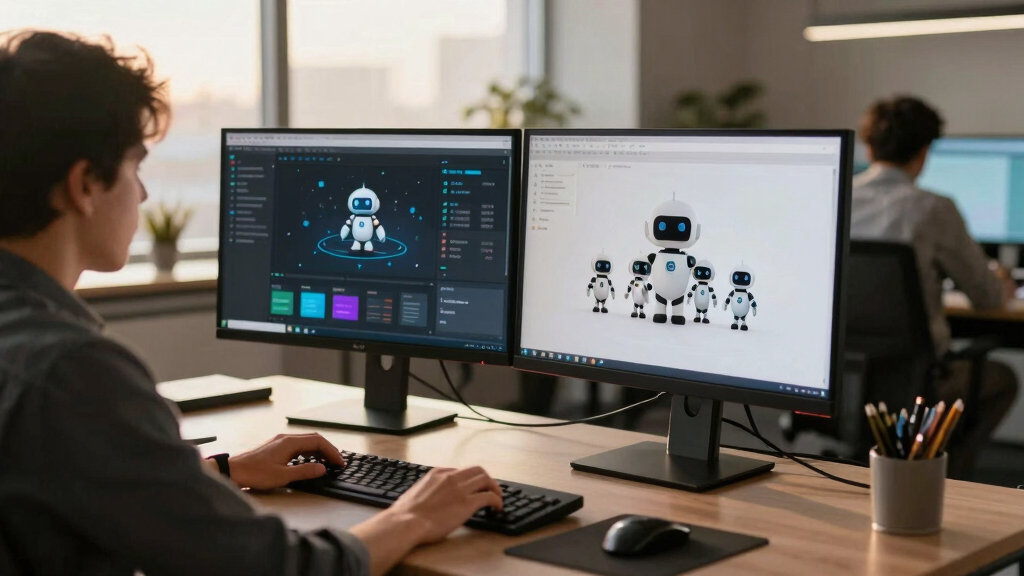
The new feature allows Claude to write and execute small JavaScript programs that orchestrate multiple subagents, each with dedicated roles, contexts, and model configurations. This approach emulates a human team lead, assigning focused tasks to specialized agents, overseeing their coordination, and synthesizing their outputs into a comprehensive result.
According to Anthropic, this capability is especially beneficial for tasks requiring parallel processing, adversarial verification, or iterative refinement, where a single agent might underperform due to issues like goal drift, self-bias, or laziness. The system can decide which model to deploy for each subtask and whether to run agents in isolated worktrees, ensuring parallel execution without interference.
Anthropic emphasizes that this feature is resource-intensive, using more tokens and computational power, and is intended for complex, high-value tasks rather than simple corrections or straightforward queries.
When one agent isn’t enough: Claude now builds its own team on the fly
Skills package what you know; loops decide how far you delegate over time. Dynamic workflows are the third axis — within a single task, Claude writes its own harness and assembles a temporary team of subagents. Think of it as Claude drawing an org chart for one job.
The shift is from prompting a worker to commissioning a team — more output, more cost, and a manager’s judgment required. Reach for a workflow when a task is big, parallel, adversarial, or judgment-heavy — and when you can feel a single agent getting lazy, grading its own homework, or losing the plot. Bound it (token budgets, pilot first) — workflows can spawn hundreds of agents and burn far more tokens. For everything else, don’t hire five people to change a lightbulb.
Implications for AI Workflow Automation
This innovation represents a major advancement in AI orchestration, enabling models like Claude to perform multi-agent coordination autonomously. It could significantly improve the quality and reliability of AI outputs in domains such as research, software development, and complex decision-making, reducing the need for human oversight in multi-step projects.
By mimicking team management strategies, this approach could lead to more scalable and robust AI systems, capable of handling tasks previously considered too complex for single-agent execution. However, it also raises questions about resource consumption and control, as more sophisticated orchestration requires careful management.
As an affiliate, we earn on qualifying purchases.
Evolution of Multi-Agent AI Systems
Anthropic’s earlier work focused on improving individual agent capabilities, but limitations persisted when addressing large, complex tasks. Previous methods involved static workflows or manually wired multi-agent systems, which lacked flexibility and scalability.
The recent release of Claude’s dynamic workflows builds on this foundation, introducing the ability for the AI to generate and adapt its own orchestration scripts in real time. This development aligns with broader trends toward autonomous AI management and self-organization, seen in other research initiatives and industry applications.
“Claude’s ability to dynamically assemble its own team of agents marks a significant leap toward autonomous AI workflows, especially for complex, multi-faceted projects.”
— Thorsten Meyer, AI researcher at Anthropic
multi-agent AI orchestration tools
As an affiliate, we earn on qualifying purchases.
As an affiliate, we earn on qualifying purchases.
Unanswered Questions About Resource Use and Control
It remains unclear how widely available this feature will be, what specific resource costs are involved, and how users will manage or restrict agent orchestration in practice. Additionally, the long-term reliability and safety implications of autonomous team management by AI are still under evaluation.
JavaScript automation tools for AI workflows
As an affiliate, we earn on qualifying purchases.
As an affiliate, we earn on qualifying purchases.
Next Steps for Deployment and Evaluation
Anthropic plans to roll out the dynamic workflows feature to a broader user base in the coming months, accompanied by ongoing testing and refinement. Future updates may include user controls for managing agent teams, performance benchmarks, and safety protocols to ensure responsible use.
As an affiliate, we earn on qualifying purchases.
Key Questions
How does Claude build its own team of agents?
Claude writes and runs small JavaScript programs called workflows that instantiate and coordinate multiple subagents, each with specific roles and model configurations, to complete complex tasks.
What types of tasks benefit most from dynamic workflows?
High-complexity projects such as research synthesis, code refactoring, multi-step verification, and large-scale data analysis are prime candidates, especially where parallel processing and independent review improve outcomes.
Does this increase resource consumption?
Yes, dynamic workflows use more tokens and computational power, making them suitable mainly for high-value, complex tasks rather than simple queries.
Will users be able to control or limit the agent teams?
Details about user controls and safety measures are still under development, with future plans likely including management features to govern autonomous agent orchestration.
Source: ThorstenMeyerAI.com
Columbus Day / Indigenous Peoples' Day Picks
long weekend sales
As an affiliate, we earn on qualifying purchases.