
📊 Full opportunity report: An Automation Readiness Audit For Small And Midsize Businesses on IdeaNavigator AI — validation score, market gap, and execution plan.

Get business pricing on tech for your team
- Business-only prices and quantity discounts
- Tax-exempt purchasing
- Multiple users, one account, clear invoices
TL;DR
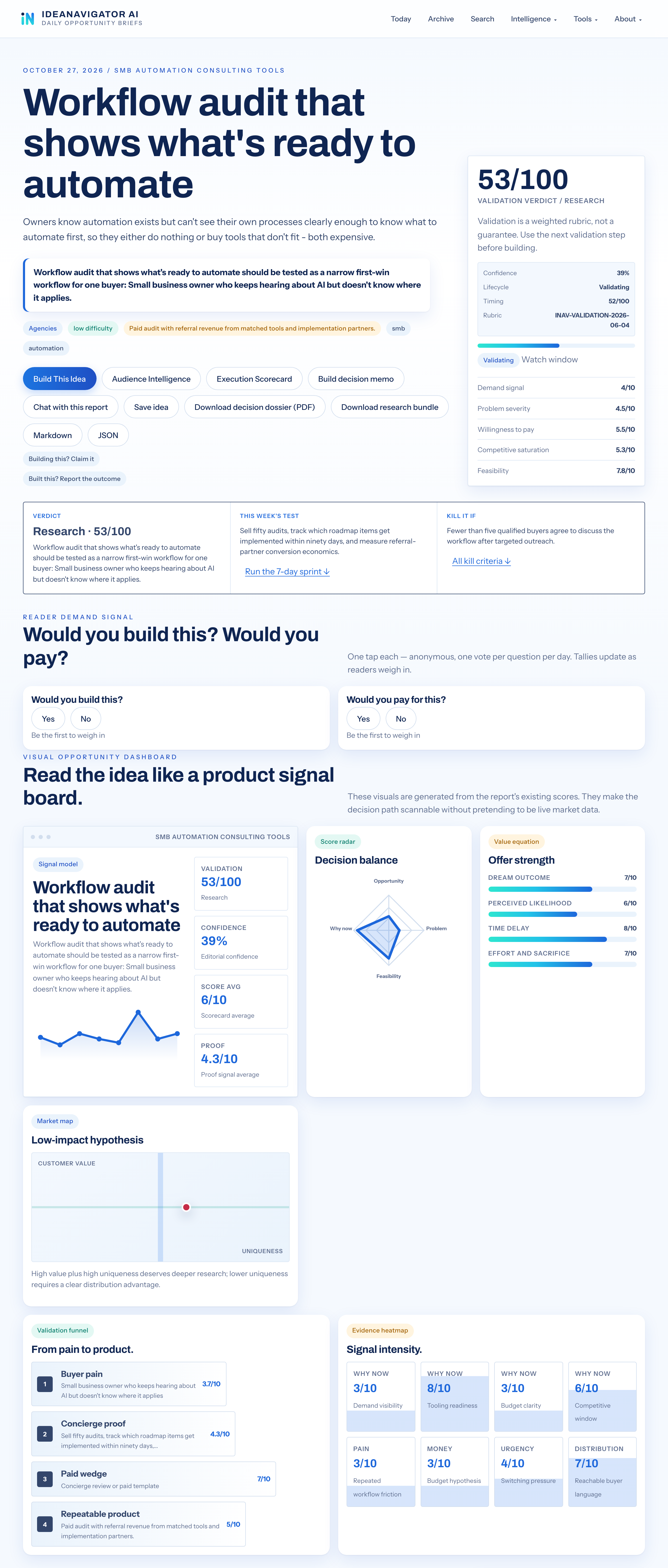
IdeaNavigator AI has outlined a proposed paid workflow audit for small and midsize businesses unsure where automation could help. According to the company’s idea brief, the concept would interview owners, rank processes by readiness, expected return and difficulty, and recommend tools and a sequenced 90-day roadmap; it is a proposal, not a reported launch or validated product.
IdeaNavigator AI has outlined a proposed workflow audit for small and midsize businesses that want to use automation but are unsure which processes to tackle first. In its idea brief, the company says the suggested product would interview an owner about business operations, score workflows for automation readiness, potential return and difficulty, then provide tool suggestions and a sequenced 90-day plan; the brief reports no product launch or customer results.
IdeaNavigator AI’s brief positions the concept for small-business owners facing uncertainty about AI and automation. It argues that owners may know such tools are available without having a clear view of their own processes or a reliable way to judge which ones are suitable. The brief says this can lead either to inaction or to buying tools that do not fit, both of which can carry costs.
According to the proposed minimum viable product described in the brief, a guided interview would gather information about a company’s operations. The product would turn that information into a process map, assign scores for readiness, expected return on investment and implementation difficulty, and lay out a 90-day roadmap. Each recommended step could include matched software tools, with implementation partners also suggested.
The brief proposes a business model combining a paid audit with referral revenue when customers choose recommended tools or implementation services. It suggests testing demand by selling 50 audits, then tracking which roadmap items customers implement within 90 days and measuring conversion economics for referral partners. These are proposed validation targets, not reported sales or outcomes.
IDEANAVIGATOR AI · CONCEPT BRIEF
An Automation Readiness Audit For Small And Midsize Businesses
A proposed paid workflow audit would help owners identify where automation might fit, rank opportunities and plan a first 90 days. The concept has not been reported as launched or validated.
Start with the work, then choose the tool
IdeaNavigator AI’s brief describes small-business owners who know automation tools exist but may not know which of their own processes are suitable. That uncertainty can lead to inaction or spending on software that does not fit.
The proposed audit would make the decision more concrete by documenting workflows, estimating the effort and potential return, then sequencing possible projects before a business commits to implementation.
Map how the business operates before recommending products. The brief presents this as a way to address decision paralysis; it does not show that the approach improves results.
Four steps from interview to action
Interview
Gather information from an owner about business operations and recurring work.
Map processes
Turn answers into a view of workflows and how tasks connect.
Score opportunities
Assess readiness, expected return on investment and implementation difficulty.
Sequence a plan
Suggest tools and organize next steps into a proposed 90-day roadmap.
What each workflow would be judged on
Can this workflow be automated?
The concept proposes assessing whether a process is suitable for automation. The brief does not explain the scoring method or how incomplete answers would be handled.
Could the change be worthwhile?
Potential return would help compare opportunities. No ROI formula, pricing assumptions or measured returns are provided.
How hard might implementation be?
Estimated effort would help owners sequence projects. The brief does not describe how difficulty would be calculated or verified.
Use the assessment to identify an initial workflow to investigate.
Match a workflow with software or implementation support, if appropriate.
Observe which recommendations customers put into practice.
Referral income raises a question of trust
The idea brief proposes combining revenue from paid audits with referral income when customers select recommended software or implementation services. It gives no pricing or partner arrangements.
Referral income could support the service, while also creating a potential incentive to favor partner products. Transparent criteria and clear disclosures would matter, but the brief does not describe safeguards.
How would recommendations distinguish a workflow’s needs from a partner’s commercial interests? How would customer information be stored and protected? The proposal does not yet say.
Test willingness to pay and follow-through
The brief suggests selling 50 paid audits, then tracking which roadmap items customers implement over the following 90 days. It also proposes measuring conversion economics for referral partners.
Those measures could help separate interest in a report from willingness to pay for guidance and act on it. The brief gives no test timetable, sales figures, implementation rates or results.
Demand, recommendation accuracy, customer outcomes and referral economics remain unverified. The 50-audit target is a proposed experiment, not a reported achievement.
What the brief does—and does not—establish
Has the audit launched?
No launch is reported. The brief describes a proposed product and a plan to validate it through paid audits.
What would customers receive?
A guided interview, process map, workflow scores, tool suggestions and a sequenced 90-day roadmap, according to the concept.
How would it make money?
The proposal combines paid audit revenue with referral income from software vendors or implementation partners. No pricing is stated.
How would the idea be tested?
Sell 50 audits, track implementation within 90 days and measure referral conversion economics. No results are available in the brief.
Source: IdeaNavigator AI · Proposal summarized from its idea brief
A Structured Route to Automation
For smaller firms without dedicated operations or technology teams, deciding where automation fits can be as difficult as choosing a tool. As IdeaNavigator AI’s brief frames it, a workflow-by-workflow assessment could make the decision more concrete by setting out the process, the likely difficulty of changing it and the estimated return before a business commits to software or implementation work.
The proposed audit also reflects a practical tension in the market: more available AI tools do not automatically make adoption easier. The brief argues that recommendations poorly matched to a company’s workflows could add expense without solving the underlying problem. A staged roadmap could help owners compare potential projects and begin with a manageable first step, although the brief does not establish that this approach improves results.
The commercial model described in the brief creates a question about incentives. Referral income could help fund the service, but it may also influence which products are recommended. A useful audit would need transparent criteria and a clear distinction between a workflow’s needs and a partner’s commercial interests. IdeaNavigator AI’s proposal does not describe how such safeguards would work.
Products Worth Considering

Samsung Galaxy Tab A11+ Kids Edition, 128GB, Royal Blue

Kindle Paperwhite Signature Edition 32GB (2024 Model) – Metallic Black

Bose Home Speaker 500 Smart Speaker with Alexa, Black
As an affiliate, we earn on qualifying purchases.
From Tool Choice to Workflow Mapping
IdeaNavigator AI’s idea brief frames the opportunity around two developments: the growing range of AI tools and the possibility of using large language models to support structured process-mapping through guided interviews. The company argues that owners can face decision paralysis when asked to choose among tools before identifying the work that might benefit from them.
Rather than begin with a particular software product, the proposed audit would start by documenting how a business operates. It would then rank possible automation projects and connect recommendations to tools or implementation support. As described in the brief, this is a product concept in the SMB automation consulting-tools market, not evidence that a specific solution is already available or that businesses have adopted it.
Validation and Recommendation Safeguards
IdeaNavigator AI’s brief provides no evidence that the audit has been built, launched or tested, and reports no customer interviews, sales figures, implementation rates or measured returns. The proposed target of selling 50 audits and monitoring implementation over 90 days is a validation plan, not a result. The brief also does not explain how the product would calculate ROI, assess workflow readiness, or handle incomplete or inaccurate answers during an interview.
The brief does not specify pricing, the range of businesses or industries it would serve, or whether the assessment would be delivered automatically, reviewed by a consultant, or combine both approaches. It also gives no details on how customer information would be stored or protected. Referral relationships, tool-selection criteria and disclosures are not described, leaving open how the service would manage potential conflicts when it recommends paid products or implementation partners.
Testing Demand Through Paid Audits
IdeaNavigator AI’s brief proposes offering 50 paid audits and observing whether customers act on the recommendations. The suggested test would track which roadmap items are implemented during the following 90 days and examine whether referrals to software vendors or implementation partners generate viable economics.
Those measures could help distinguish interest in a report from willingness to pay for guidance and carry it through to implementation. Until results are published, the concept’s demand, accuracy, customer outcomes and referral economics remain unverified. The brief does not give a timetable for the test or say when findings might be available.
Source: IdeaNavigator AI
Key Questions
Has the automation audit launched?
No launch is reported. IdeaNavigator AI’s idea brief describes a proposed product and a plan to validate it through paid audits.
What would the audit provide?
As described in the brief, it would interview a business owner about operations, create a process map, score workflows by automation readiness, expected ROI and difficulty, and suggest tools alongside a sequenced 90-day roadmap.
How would the proposed service make money?
The brief suggests combining revenue from paid audits with referral income from matched software tools and implementation partners. No pricing or partner arrangements are provided.
How would the idea be tested?
IdeaNavigator AI’s brief proposes selling 50 audits, tracking which recommendations are implemented within 90 days and measuring referral-partner conversion economics. No test results are available in the brief.
Source: IdeaNavigator AI