TL;DR
The shift from handling individual cargo items to moving sealed containers reduced the cost of loading ships and reshaped port employment. Historical figures show steep declines in dockworker numbers, while labor disputes over automation continue; a 2024 U.S. government report found mixed results at automated terminals.
A November 23, 2026, article traces how container shipping cut the cost of loading cargo and reduced the need for dockworkers, while describing how unions negotiated over the effects. The history is relevant to current disputes over port automation, including a 2024 strike by East and Gulf Coast dockworkers; the available source does not establish how those disputes have since developed.

Get business pricing on tech for your team
- Business-only prices and quantity discounts
- Tax-exempt purchasing
- Multiple users, one account, clear invoices
Before containers, ports moved goods as break-bulk cargo: workers handled each sack, barrel, crate or carton individually, transferring it between trucks or trains, warehouses and ships. A 1954 voyage from Brooklyn to Bremerhaven involved 194,582 separate items, according to the article. Loading and unloading added time and expense at both ends of a sea journey.
The article cites figures from Marc Levinson’s book The Box: loading loose cargo onto an average break-bulk ship cost $5.83 per ton in 1956, while Malcom McLean’s accountants calculated a cost of 15.8 cents per ton for his container ship, the Ideal X. The article calculates that as roughly 36 times cheaper. In an estimate for shipping a truckload of medicine from Chicago to Nancy, France, around 1960, port costs were $1,163 of a $2,386 total, or 48.7 percent.
The change also sharply reduced port employment. The article cites Waterfront Commission figures showing that the Port of New York and New Jersey had more than 35,000 longshoremen in the early 1960s and about 3,500 in 2013. Britain’s registered dock workforce fell from 82,000 at its peak to 9,400 in 1989. Those figures describe long-term changes; they do not by themselves establish how much of each decline was caused by containerization or other factors.
What AI means for ports and dockworkers
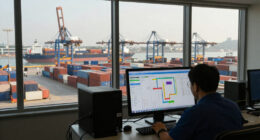
Container shipping cut cargo handling costs and reshaped port jobs. Today, automation brings a similar debate over efficiency, reliability and workers.
How Ports and Jobs Changed
Containerization changed shipping by making a sealed box transferable between truck, ship and truck without opening it at each stage. That system reduced the amount of manual handling and the time cargo spent moving through ports. The cited cost figures show why shipping companies had a strong financial reason to adopt it: port handling had been a major part of transport costs.
For dockworkers, the efficiency gain meant fewer jobs tied to moving individual pieces of freight. The numbers cited for New York and Britain show the scale of the employment decline, but the source does not separate containerization’s role from other economic and industry changes. The distribution of savings and losses was contested: workers faced job insecurity, while shippers gained from lower handling costs. That tension remains relevant when ports consider automation.
Automation does not automatically resolve the trade-off by making terminals faster. A 2024 U.S. government report, as summarized in the article, found denser stacking at some automated terminals, alongside slower moves and more breakdowns at some sites. The results matter to port operators, shipping customers and workers weighing the effects of further investment in machines.
Products Worth Considering

DJI Mic 3 Wireless Microphone (2 Transmitters, 1 Receiver, Charging Case)

EcoFlow DELTA 3 Portable Power Station, 1024Wh, 1800W

Anker SOLIX S2000 Portable Power Station, 2,010Wh, 1,500W
As an affiliate, we earn on qualifying purchases.
From Break-Bulk to Boxes
Malcom McLean was a trucking company owner, and the article identifies April 26, 1956, as the date a crane in Newark, New Jersey, loaded 58 aluminium truck bodies onto the Ideal X, an old tanker fitted with a steel frame on deck. The ship arrived in Houston five days later, where trucks were ready to collect the containers.
McLean did not invent cargo containers, the article says; metal boxes had been used before. The innovation was a system that allowed a box to move through multiple forms of transport without the cargo being unpacked. That change displaced the old practice of loading each item by hand. The article also notes that New York dockworkers were often hired through a daily “shape-up,” a system the Waterfront Commission described as vulnerable to corruption and kickbacks.
Labor negotiations accompanied the transition. The article says West Coast dockers agreed in 1960 to changes in work practices in return for a $29 million fund and a no-layoff promise. It also reports that they struck for 134 days in 1971. In 2024, East and Gulf Coast dockworkers struck over wages and automation, linking current labor concerns to the longer history of technology changing port work.
“The commission described how a surplus of labor let corrupt union officials and hiring bosses decide who got a job, and who had to pay a kickback for it.”
— Waterfront Commission of New York Harbor, as described in the article
What the Numbers Cannot Show
The employment figures show large declines in dockworker numbers, but the source does not quantify how much containerization alone caused them or account for other changes in the shipping industry. The figures also come from different places and years, so they should not be treated as a single measure of a global trend.
The article calls the story that McLean conceived the container while waiting at a pier a legend: it says no record from the time was found to verify it. It also gives no detail on the outcome or later effects of the 2024 East and Gulf Coast strike. The summary of the government report does not name the terminals studied or provide the full data behind its findings of denser stacking, slower moves and more breakdowns at some locations.
Automation’s Next Labor Talks
The article points to the ongoing debate over how ports will adopt automation and how workers will be affected. The 2024 strike shows that wages and technology have been subjects of labor negotiations, while the government report’s mixed findings leave practical questions about terminal performance.
The source provides no date for a next negotiation or policy milestone. Further developments to watch include the terms unions and port operators reach over automation, and whether later operational data show changes in speed, reliability or jobs.
Key Questions
What changed when container shipping began?
Sealed cargo boxes could move between trucks and ships without workers unpacking and reloading each item at every stage. That replaced much of the individual handling required by break-bulk cargo.
How much cheaper was loading with containers?
The article cites a cost of $5.83 per ton for loose cargo in 1956 and 15.8 cents per ton for the Ideal X. It calculates the latter was roughly 36 times cheaper to load.
Did containerization reduce the number of dockworkers?
Dockworker numbers fell sharply in the historical figures cited: New York and New Jersey had more than 35,000 longshoremen in the early 1960s and about 3,500 in 2013. The figures alone do not show what share of the decline containerization caused.
Do automated terminals work faster?
The article’s summary of a 2024 U.S. government report is mixed. Some automated terminals stacked cargo more densely, but some also had slower moves and more breakdowns.
What did dockworkers do in response to the changes?
The article describes labor agreements and strikes across several decades. West Coast dockers reached an agreement in 1960 that included a $29 million fund and a no-layoff promise, and East and Gulf Coast dockworkers struck in 2024 over wages and automation.
Source: Thorsten Meyer AI