

Workload placement has become a bigger AI architecture issue because of the increasing complexity of models, hardware diversity, and demand for real-time results. You must carefully decide where tasks run—whether on edge devices or centralized servers—to guarantee performance, reduce latency, and manage resources efficiently. Poor placement can cause bottlenecks and higher costs, risking system failure. If you want to understand how to master this challenge, keep exploring this essential topic.

Get tech for your team delivered free — and shop member deals
- Fast, free delivery on millions of items
- Access to Prime Big Deal Days deals on October 6–7
- Prime Video, Amazon Music and more included
Key Takeaways
- Increasingly complex hardware landscapes demand strategic workload placement for optimal performance and system stability.
- Edge computing’s growth raises new challenges in balancing local and cloud processing for low latency.
- Data sharding requires intelligent workload allocation to ensure scalability and prevent bottlenecks.
- Resource management and cost efficiency hinge on effective workload distribution across diverse hardware.
- Evolving AI models and infrastructure make workload placement critical for responsiveness and competitive advantage.
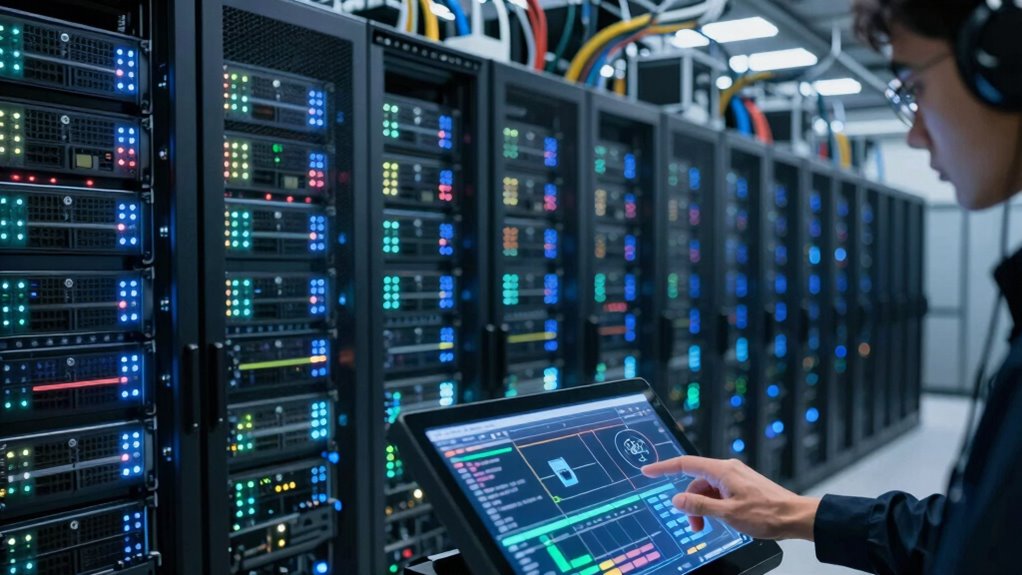
Have you ever wondered how AI systems efficiently manage their tasks across different hardware components? It’s a complex dance that involves not just powerful algorithms but also strategic workload placement. In today’s landscape, this issue has become more critical than ever, especially with the rise of edge computing and data sharding. These technologies are transforming how data is processed and where tasks are executed, making workload placement a pivotal concern for AI architecture.
Edge computing pushes processing closer to the data source—think IoT devices, sensors, or mobile gadgets—reducing latency and bandwidth usage. But this shift introduces new challenges. You need to determine which tasks should run locally on edge devices and which should be sent to centralized data centers or cloud servers. The decision isn’t simple; it must account for hardware limitations, network conditions, and the urgency of real-time responses. If you misplace workloads, you risk bottlenecks, increased latency, or even system failures. Proper workload placement ensures that edge devices handle lightweight, latency-sensitive tasks, while heavier processing is offloaded to more capable nodes, optimizing overall performance.
Strategic workload placement balances local edge tasks and centralized processing, boosting performance and reducing latency.
Data sharding further complicates workload distribution. By splitting data into smaller, manageable pieces, you can process large datasets more efficiently and in parallel. However, this requires smart data allocation to ensure that the workload is evenly distributed across shards. The AI system must intelligently assign tasks to different shards, balancing the load while maintaining data consistency. You can’t just shard data haphazardly; you need algorithms that consider the nature of the data, the computational capacity of each node, and the interdependencies between shards. Effective data sharding enhances scalability but demands precise workload placement strategies to prevent uneven load distribution, which could slow down processing or cause resource contention.
The importance of workload placement also extends to resource management and cost efficiency. In an era where AI models grow exponentially in size and complexity, placing workloads optimally helps you maximize hardware utilization without over-provisioning. This isn’t just about speed; it’s about making sure your AI infrastructure is sustainable and cost-effective. As models become more sophisticated, the stakes get higher. Poor placement can lead to wasted compute power, increased energy consumption, and higher operational costs.
Ultimately, the bigger issue isn’t just about deploying AI models but about smartly orchestrating their execution across a multifaceted hardware landscape. With edge computing and data sharding shaping the future of AI processing, mastering workload placement will determine whether your systems run smoothly, respond swiftly, and scale effectively. Staying aware of hardware limitations and designing strategies accordingly is crucial for optimal performance. If you want to stay ahead, understanding and optimizing this aspect of AI architecture isn’t optional—it’s essential.
As an affiliate, we earn on qualifying purchases.
Frequently Asked Questions
How Does Workload Placement Impact AI Model Training Speed?
Workload placement directly impacts your AI model training speed by influencing model efficiency and training scalability. When workloads are carefully distributed across suitable hardware, your training runs faster and more smoothly. Poor placement causes bottlenecks, underutilized resources, and longer training times. By strategically managing workload placement, you guarantee better resource utilization, enabling your models to train more quickly and scale efficiently as your data and complexity grow.
What Role Does Hardware Diversity Play in Workload Distribution?
Hardware diversity plays a vital role in workload distribution by offering varied processing capabilities, but it also introduces compatibility challenges. You need to carefully match workloads to hardware heterogeneity to maximize efficiency and avoid bottlenecks. If you don’t address these compatibility issues, tasks may run slower, underutilize resources, or cause system instability. Proper workload placement guarantees you leverage diverse hardware effectively, optimizing AI training and inference performance.
Can Workload Placement Influence AI System Security?
Workload placement can substantially influence AI system security by affecting data privacy and regulatory compliance. Imagine placing sensitive data processing tasks on less secure hardware, risking breaches. Proper workload placement ensures critical data stays on compliant, secure infrastructure, safeguarding privacy and meeting regulations. By consciously distributing workloads, you reduce vulnerabilities, prevent data leaks, and uphold trust, making security a proactive part of your AI architecture rather than an afterthought.
How Do Emerging Cloud Technologies Affect Workload Management?
Emerging cloud technologies, like edge computing, revolutionize workload management by enabling data processing closer to users, reducing latency, and improving efficiency. You can now manage workloads dynamically across distributed locations, which enhances performance and flexibility. However, as data sovereignty becomes vital, you must guarantee compliance with regional regulations. Proper workload placement helps balance security, performance, and legal requirements, making cloud technology a powerful tool for modern AI architecture.
What Metrics Are Best for Evaluating Workload Placement Effectiveness?
You should focus on metrics like resource utilization, latency, and throughput to evaluate workload placement effectiveness. These help you assess how well resources are allocated and identify bottlenecks. Monitoring performance optimization indicators, such as response times and error rates, guarantees workloads are efficiently distributed. By tracking these metrics, you can make data-driven adjustments, improving overall system efficiency and guaranteeing ideal resource allocation across your AI architecture.
As an affiliate, we earn on qualifying purchases.
Conclusion
So, next time you’re marveling at your AI’s speed, remember—choosing the right workload placement isn’t just a tech detail, it’s the real secret sauce. Who knew that something so seemingly mundane could be the ultimate game-changer? Ironically, the smarter your workload placement, the less you have to worry about your AI’s “brain.” So, while everyone’s chasing flashy algorithms, don’t forget: a well-placed workload might just be the unsung hero in your AI masterpiece.
As an affiliate, we earn on qualifying purchases.
As an affiliate, we earn on qualifying purchases.
Halloween Picks
halloween
As an affiliate, we earn on qualifying purchases.