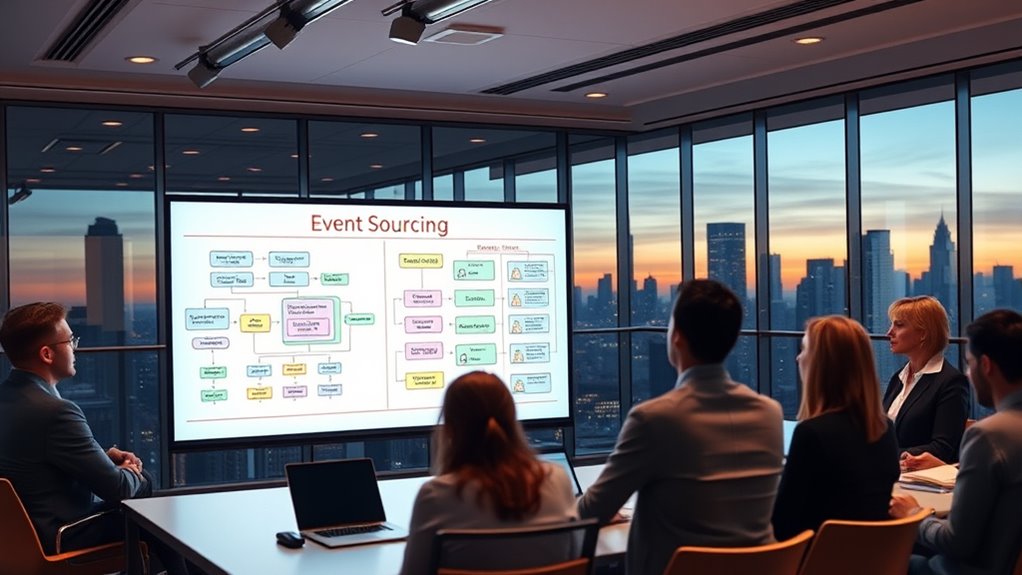

Building event-sourced systems with CQRS and Kafka helps you create scalable, resilient applications that reliably track all state changes through immutable events. You separate command handling from queries, letting each side optimize independently. Kafka acts as a fault-tolerant messaging backbone, streaming events to multiple consumers and ensuring reliable delivery. This architecture enhances performance, fault tolerance, and flexibility. Exploring how to integrate these concepts further can give you a solid foundation for building robust systems.
Key Takeaways
- Use CQRS to separate command and query models, ensuring efficient write and read operations in event-sourced systems.
- Store all state-changing events immutably in an event store, enabling accurate system reconstruction and auditing.
- Leverage Kafka as a reliable message broker to stream events from the event store to downstream consumers.
- Design event schemas with versioning and idempotency to maintain consistency and handle schema evolution effectively.
- Implement dedicated consumers to process Kafka streams, update read models, and support scalable, resilient event processing pipelines.
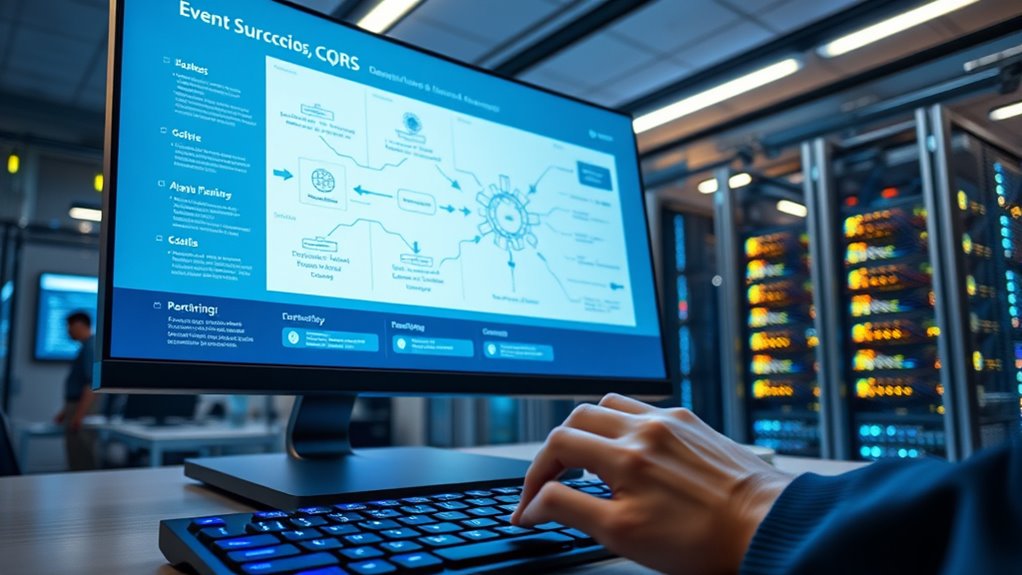
Building event-sourced systems can substantially enhance your application’s scalability and consistency, especially when you leverage the right architectural patterns. By capturing every change as a sequence of immutable events, you create a reliable history of state transitions that can be replayed or audited at any time. This approach simplifies debugging and allows for more flexible recovery strategies, guaranteeing your system remains resilient even in the face of failures. When combined with Command Query Responsibility Segregation (CQRS), you can separate the responsibilities of handling commands (writes) and queries (reads), which improves performance and scalability. In this setup, commands modify the write side, generating events that are stored in an event store, while the read side maintains a denormalized view optimized for queries. This separation allows each side to scale independently, reducing bottlenecks and guaranteeing your system can handle high throughput.
Integrating Kafka into this architecture further enhances its robustness. Kafka acts as a distributed, fault-tolerant messaging system that streams events from your event store to various consumers. When a command results in an event, Kafka captures it and guarantees it gets delivered reliably to all interested services, whether they’re responsible for updating read models or triggering downstream processes. This decouples components, making your system more flexible and easier to extend. Kafka’s partitioning capabilities enable horizontal scaling, so as your system grows, you can add more brokers to handle the increased load without sacrificing performance.
You’ll find that building such systems requires careful planning around event schemas, versioning, and idempotency. Since events are immutable, you need to define clear formats for your data and establish strategies for evolving schemas without breaking existing consumers. Idempotency becomes critical to prevent duplicate processing, especially when failures cause retries or replays. Kafka’s exactly-once delivery guarantees help in maintaining data consistency, but you must still design your application logic to handle potential message duplication gracefully.
Careful planning of schemas, versioning, and idempotency is essential for building reliable event-sourced systems.
Finally, you need to implement a solid event processing pipeline. Consumer services subscribe to Kafka topics and replay events to update read models or trigger other workflows. These services can operate asynchronously, improving overall responsiveness. As you build out this architecture, consider how to manage event ordering and consistency across distributed components. With proper design, you’ll develop a system that not only scales efficiently but also maintains a consistent state across different parts of your application. Leveraging event sourcing, CQRS, and Kafka together empowers you to create resilient, flexible, and high-performance systems that meet the demands of modern applications. Additionally, paying attention to event schema evolution ensures your system remains adaptable over time.
Frequently Asked Questions
How Does Kafka Compare to Other Messaging Systems for Event Sourcing?
Kafka excels in event sourcing because it offers high throughput, durability, and scalability, making it ideal for handling large streams of events. Unlike traditional messaging systems, Kafka stores events durably and allows consumers to replay or reprocess data easily. Its distributed architecture provides fault tolerance and low latency, giving you an edge over systems like RabbitMQ or ActiveMQ for building responsive, reliable event-driven applications.
What Are Common Challenges When Implementing CQRS With Kafka?
You might face challenges like ensuring data consistency between command and query models, managing eventual consistency delays, and handling complex event versioning. Kafka’s distributed nature can make it tricky to guarantee exactly-once processing and coordinate multiple consumers. Additionally, designing proper event schemas and handling schema evolution requires careful planning. Monitoring and troubleshooting can also become complex as your system scales and the event flow grows.
How Do I Handle Schema Evolution in Kafka Event Streams?
You handle schema evolution in Kafka event streams by using schema registries like Confluent Schema Registry. You should version your schemas, maintain backward and forward compatibility, and update schemas carefully to prevent breaking consumers. Always validate new schemas before deploying, and communicate changes clearly to your team. This way, you guarantee your event streams remain consistent, reliable, and adaptable as your data models evolve over time.
What Are Best Practices for Ensuring Data Consistency in Event-Sourced Systems?
To guarantee data consistency in event-sourced systems, you should implement idempotent event handlers so duplicate events don’t cause issues. Use distributed transactions or consensus algorithms like Kafka’s exactly-once delivery to prevent data loss or duplication. Maintain a clear event schema and versioning to handle evolution smoothly. Also, regularly verify system state against event logs, and design your system for eventual consistency when real-time accuracy isn’t critical.
How Can I Optimize Kafka for High-Throughput Event Sourcing?
To optimize Kafka for high-throughput event sourcing, you should increase partition counts to enable parallel processing and tune producer configurations like batch size and linger.ms for better batching. Use compression to reduce payload size, and adjust replication factors to balance reliability and performance. Also, monitor consumer lag closely and implement efficient consumer groups to ensure smooth, fast data ingestion without bottlenecks.
Conclusion
By embracing event sourcing with CQRS and Kafka, you unlock a resilient, scalable architecture that whispers promises of future growth. Each event becomes a building block, each command a step forward—creating a symphony of data that’s both real-time and reliable. So, immerse yourself with confidence, knowing that your system’s foundation is as solid as the events it captures—because in this dance of data, your success is written in every message you send.