

🔍 Read the full analysis: 13 Best Portable SSDs For Speed And Convenience In 2027 on ThorstenMeyerAI.com

Get business pricing on tech for your team
- Business-only prices and quantity discounts
- Tax-exempt purchasing
- Multiple users, one account, clear invoices
TL;DR
ThorstenMeyerAI.com’s guide compares 13 Samsung and SanDisk portable SSD listings, recommending the Samsung T7 1TB as a balanced option and highlighting the T9 and SanDisk Extreme models for larger workloads. Advertised top speeds depend on compatible host ports, cables and workloads, and the guide cautions buyers to verify exact model specifications.
ThorstenMeyerAI.com has published a buying guide comparing 13 portable SSD listings, with the Samsung T7 1TB presented as a balanced starting point and faster Samsung T9 and SanDisk Extreme models aimed at heavier workloads. The guide says advertised maximum speeds are not guaranteed in everyday use: buyers need compatible host ports and cables, and results vary by workload.
The guide ranks drives around advertised transfer speed, capacity, connection requirements and portability, rather than treating the fastest specification as the best choice for everyone. It recommends the T7 1TB for routine transfers because its USB 3.2 Gen 2 interface offers a broadly practical speed tier without requiring USB 3.2 Gen 2×2 support.
Samsung’s T9 models in 1TB, 2TB and 4TB capacities advertise speeds of up to 2,000 MB/s, according to the source. That figure depends on a compatible USB 3.2 Gen 2×2 connection and suitable cable; a USB-C socket alone does not establish that a device supports the required data rate.
The guide also distinguishes SanDisk’s standard Portable SSD listings from its Extreme family, which it describes as a better fit for buyers prioritizing a tougher portable design. Its capacity examples range from a 500GB option for lighter carry needs to 2TB and 4TB listings for larger photo, video or project libraries. The source warns that some listings with similar names and capacities show different speed claims, so buyers should check the exact product specification.
The 13 picks
- 1
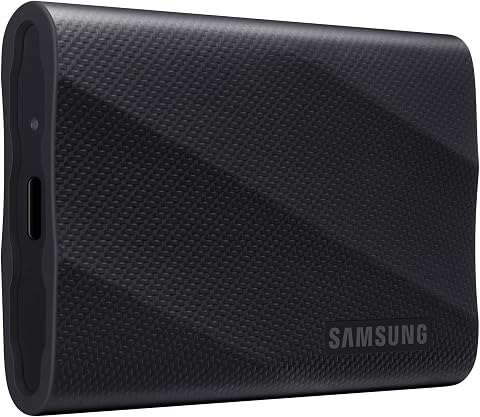 Samsung T9 Portable SSD 4TB, USB 3.2 Gen 2×2 External Solid State DriveView on Amazon →
- 2
 SanDisk Extreme Portable SSD, 4TB, Up to 2000MB/sView on Amazon →
- 3Samsung T9 Portable SSD 2TB, USB 3.2 Gen 2×2, Up to 2,000 MB/sView on Amazon →
- 4SanDisk Extreme Portable SSD, 2TB, Up to 2000MB/sView on Amazon →
- 5
 SanDisk Extreme 2TB Portable SSDView on Amazon →
- 6
 SanDisk 2TB Portable SSD, Up to 1000 MB/s Read Speed, BlackView on Amazon →
- 7Samsung T9 Portable SSD 1TB, USB 3.2 Gen 2×2, Up to 2,000 MB/sView on Amazon →
- 8SanDisk Extreme Portable SSD, 1TB, Up to 2000MB/sView on Amazon →
- 9
 Samsung T7 Portable SSD 1TB Titan Gray, USB 3.2 Gen 2, Up to 1,050MB/sView on Amazon →
- 10SanDisk 1TB Extreme Portable SSD, Up to 1050MB/sView on Amazon →
- 11SanDisk 1TB Portable SSD, Up to 1000MB/s Read Speed, BlackView on Amazon →
- 12SanDisk 500GB Portable SSD, Up to 1000MB/s Read Speed, BlackView on Amazon →
- 13
 SSK Portable SSD 500GB External Solid State Drive USB-C/USB-AView on Amazon →
How Port Choice Shapes SSD Value
The guide’s central practical point is that speed claims only matter when the rest of the setup can use them. Someone whose computer supports USB 3.2 Gen 2 may not benefit from paying extra for a model advertised at up to 2,000 MB/s if that performance requires USB 3.2 Gen 2×2. Checking the device’s specifications before purchase can help avoid paying for a speed tier it cannot reach.
Capacity and design also affect day-to-day usefulness. A smaller drive is easier to carry and may suit current work files, while larger capacities can accommodate growing media projects. A tougher design may appeal to people who travel with a drive, but it does not remove the risk of data loss. The guide advises keeping another copy of important files rather than relying on one portable SSD as a backup.
Products Worth Considering

Jackery Explorer 300 Portable Power Station, 292Wh

Kindle Paperwhite Signature Edition 32GB (2024 Model) – Metallic Black

Samsung 27-Inch Odyssey G5 QHD Gaming Monitor (G50F)
As an affiliate, we earn on qualifying purchases.
The Guide’s Buying Criteria
The source says it compared the drives by their intended workloads and likely limitations, treating manufacturer speed figures as maximum claims rather than guaranteed results. Transfer performance can vary with the host port, cable, file sizes and sustained workload; moving many small files may not match a published peak figure.
Its recommendations are organized around three tradeoffs: capacity versus portability, everyday performance versus premium speed, and rugged-style features versus simpler designs. The guide also says capacity variants are considered for the users they serve, rather than assuming a larger drive automatically performs better. It does not provide independent test results in the supplied material.
“The Samsung T7 is the balanced starting point.”
— ThorstenMeyerAI.com buying guide
Specifications Buyers Must Verify
The supplied source material does not name all 13 individual listings or give a full specification table, prices, test methods or measured transfer results. It also does not specify a publication date. The recommendations therefore cannot establish which drive is best at a particular current price or confirm real-world performance across different computers.
The source specifically flags SanDisk listings that share names or capacities but have different advertised speed claims. Exact model numbers, protection ratings, included cables and compatibility details should be checked against the relevant product listing. The material does not provide enough detail to verify the protection level of each rugged-style model.
Check Models Before Purchase
The immediate next step for readers is to compare the exact model and capacity with their device’s supported USB standard, cable and storage needs. Buyers considering a T9 or a SanDisk model advertising up to 2,000 MB/s should confirm USB 3.2 Gen 2×2 support rather than relying on the connector shape.
Prices, availability and product specifications can change, and the supplied guide does not state when it was last updated. Readers should check current manufacturer and retailer listings before buying, especially where products in the same family carry different speed claims. No later update or testing milestone is stated in the source.
Key Questions
Which portable SSD does the guide recommend as a balanced starting point?
The guide points to the Samsung T7 1TB, citing its USB 3.2 Gen 2 interface as a practical fit for everyday transfers without requiring a USB 3.2 Gen 2×2 port.
Can a Samsung T9 reach its advertised speed on any USB-C port?
No. The source says the T9’s advertised maximum of up to 2,000 MB/s depends on a compatible USB 3.2 Gen 2×2 host connection and cable. USB-C describes the connector shape, not the supported transfer speed.
How much capacity should I choose?
The guide suggests matching capacity to the files and projects you expect to keep on the drive. Its examples range from 500GB for lighter storage needs to 2TB or 4TB for larger media libraries and ongoing projects; a larger capacity is not automatically a faster drive.
Does a rugged-style SSD eliminate the need for a backup?
No. The source presents SanDisk Extreme models as options for buyers who value a tougher portable design, but says such a design cannot make data loss impossible. Keep another copy of important files on a separate device or storage service.
Source: ThorstenMeyerAI.com