
TL;DR

Get business pricing on tech for your team
- Business-only prices and quantity discounts
- Tax-exempt purchasing
- Multiple users, one account, clear invoices
A November 3, 2026, essay by Thorsten Meyer uses agriculture’s centuries-long move from most workers to a small minority to ask whether AI could automate other sectors on a similar scale. The historical employment and output figures are presented with caveats; the claim that AI could make a sector up to 90% automated is the author’s thesis, not a forecast established by evidence in the source.
In a November 3, 2026, essay, Thorsten Meyer argues that agriculture’s shift from work done by most people to work done by a small minority offers a historical test case for whether AI could sharply reduce demand for human labor in other sectors. The essay documents a long decline in farming employment, but its suggestion that automation could reach 90% of a sector within a decade or a few decades is Meyer’s thesis, not a demonstrated AI forecast.
Meyer’s account puts the change in historical perspective. A U.S. Census Bureau-published series based on economic historian Stanley Lebergott’s estimates says 73.7% of the U.S. labor force worked in agriculture in 1800. The estimate covers 1.9 million workers aged 10 and older, including about 530,000 enslaved people. The source cautions that figures before 1840 are estimates, not census counts; “about three in four” is more accurate than treating the percentage as exact.
The shift was gradual and involved successive changes in tools, farming methods and crop varieties. The essay points to a steel plough made in 1837, later machinery, and short-straw wheat developed during the Green Revolution. It cites Indian statistics showing wheat production rose from 12.3 million tonnes in 1964–65 to 26.4 million tonnes in 1971–72. These examples show how agricultural output could grow while the sector required fewer workers over time, but they do not establish that AI will produce the same pattern in other industries.
Today, the essay cites a 2025 International Labour Organization estimate that 928 million people work in agriculture worldwide, roughly one in four workers. It reports substantial differences among countries: agriculture accounts for about 43% of workers in India, compared with about 1.5% in the United States and about 1% in Germany. Those figures describe employment, not the share of food produced or the pace of future automation.
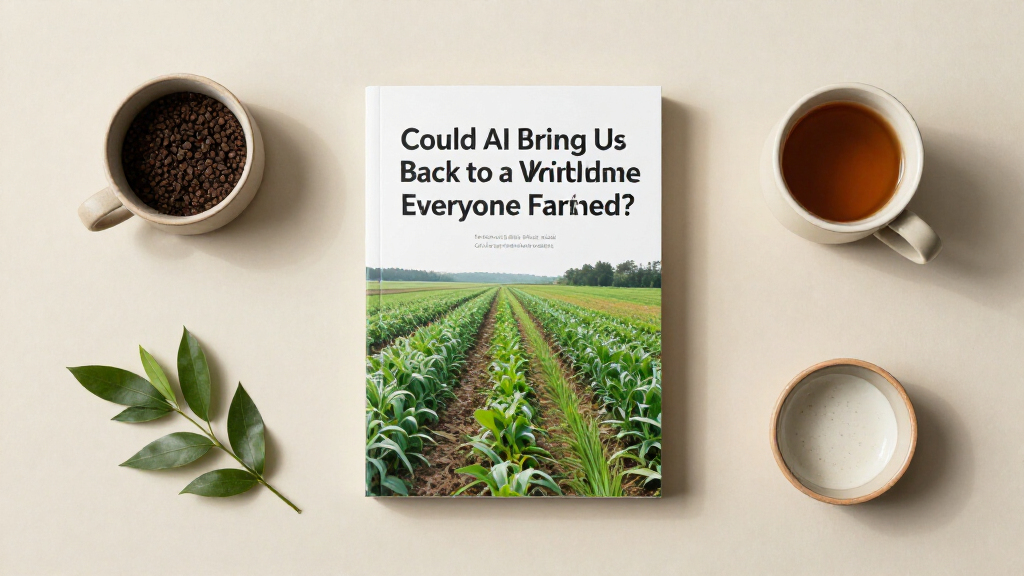
Could AI Bring Us Back To A World Where Almost Everyone Farmed?
Agriculture shows how a sector can supply more while relying on fewer workers over time. The essay uses that history to raise a question about AI, not to establish a forecast.
A long shift, many changes
Farming’s employment share declined over generations as tools, methods and crops changed.
Output can rise as labor share falls
The historical record shows agricultural production and employment can move in different directions.
- Global cereal production grew 4.2-fold from 1961.
- U.S. farm output in 2023 was nearly three times its 1948 level.
- About one in four workers worldwide worked in agriculture in 2025.
- Employment shares vary widely among countries.
The AI analogy has limits
Farming’s history offers context, but does not establish what AI will do in other industries.
A historical example
Agriculture changed over a long period through multiple technologies and practices.
A proposed thesis
The essay’s “up to 90%” automation idea is the author’s thesis, not a confirmed forecast.
Agriculture as an Automation Test
The historical example matters because it challenges the assumption that a sector needs a large share of the workforce to supply society with a basic good. Meyer cites figures showing global cereal production grew 4.2-fold from 1961, while the world population grew 2.7-fold over the same period. The essay also says U.S. farm output in 2023 was nearly three times its 1948 level with only a small rise in total inputs. The source presents these figures to argue that fewer workers do not necessarily mean less food.
For readers weighing AI’s potential effects on jobs, the analogy is suggestive but limited. Farming’s workforce fell through many decades of changes to machinery, seeds, fertilizers and infrastructure. That history points to a possible relationship between technology, output and employment; it does not show that AI will displace workers at the same rate, or that new jobs and industries will emerge in the same way. The timing and effects of any AI-led shift remain open questions.
Products Worth Considering

Apple Watch SE 3 GPS 40mm Smartwatch

Bose Smart Soundbar 700 with Alexa, Black

Logitech MX Master 4 for Mac Wireless Ergonomic Mouse, White Silver
As an affiliate, we earn on qualifying purchases.
A Two-Century Shift in Farming
The essay’s central historical point is that agriculture’s employment share declined over generations, not in a single technological shock. In the United States, the number of farm workers continued to rise until about 1910, when it reached a reported 11.8 million, even as farming’s share of the workforce was changing. In Germany, the source says agriculture’s share fell from 43% to 25% between 1882 and 1939 while the number of farm workers stayed between 8 million and 10 million.
International comparisons require care. The essay cites historical reconstructions estimating that about 85% of Japan’s gainfully occupied population worked in the primary sector in 1872, a category that included forestry and fishing as well as farming. It also reports that agriculture and forestry accounted for 43.4% of workers in Germany’s 1882 census, which the source says undercounted women working on family farms. These figures are not directly interchangeable across countries or eras.
Meyer describes the changes in agriculture as involving tools, chemistry and biology. The source mentions the steel plough, the 1908 patent for a process to produce ammonia and the first ammonia factory in 1913, as well as crop breeding in the 1960s. Together, these examples offer context for why agricultural output and employment changed, rather than evidence of a single invention causing the shift.
“My thesis, not a fact: automation could become a sector of up to 90% within a decade or a few decades.”
— Thorsten Meyer, in the November 3, 2026, essay
AI’s Employment Effects Remain Open
The essay does not specify which sectors AI could automate to the degree it suggests, what “up to 90%” measures, or how that estimate was reached. It also does not give a firm timeline: the proposed window ranges from a decade to a few decades. The figure should be read as the author’s interpretation, not a confirmed projection.
Nor does the farming comparison settle how AI will affect total employment. The source describes agriculture’s long-run history, but does not quantify current AI-driven job losses, forecast new roles, or compare adoption across industries. It remains unclear how much of the analogy applies when the technology, work tasks and economic conditions differ.
The AI Comparison Needs Evidence
The essay presents its argument as part of a series about how the economy is built, with later discussion planned on the machinery that changed farming. The next useful test for its AI thesis will be evidence specific to modern industries: measured changes in productivity and staffing, the tasks AI can perform reliably, and the time and cost of adopting it.
For now, the historical record supports a narrower conclusion: agriculture can produce far more with a much smaller share of workers than it once required, but that transformation took place over a long period and involved multiple changes. Whether AI will bring comparable employment shifts elsewhere, and how quickly, remains unconfirmed.
Key Questions
What is the essay’s main argument?
Thorsten Meyer argues that agriculture’s long decline in employment provides a case study for considering whether AI could reduce the number of workers needed in other sectors. His proposed 90% automation figure is a thesis, not an established forecast.
How many Americans worked in agriculture around 1800?
The essay cites a Census Bureau-published estimate that 73.7% of the U.S. labor force worked in agriculture in 1800. The underlying figures are estimates, and the source includes enslaved people among the workers counted.
How many people work in agriculture worldwide today?
The essay cites an International Labour Organization estimate for 2025 of 928 million agricultural workers worldwide, or about one in four workers globally.
Does the history of farming prove AI will eliminate most jobs?
No. The history shows how agricultural employment changed over a long period as technology and farming practices developed. The essay provides no proof or specific forecast that AI will lead to the same outcome in other sectors.
Source: Thorsten Meyer AI