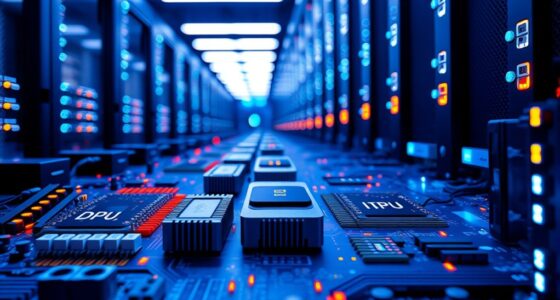
To guarantee your 5G infrastructure performs reliably and securely, you need robust observability and telemetry. This means deploying sensors, probes, and embedded monitoring across network components to gather real-time data on key metrics like latency, signal strength, and error rates. By correlating logs, metrics, and traces, you gain an all-encompassing view, enabling quick detection of issues and proactive responses. Continuing will reveal how these tools adapt to evolving networks and future demands.
Key Takeaways
- Deploy sensors and probes across network elements to collect real-time metrics like throughput, latency, and signal quality.
- Integrate logs, metrics, and traces for comprehensive visibility and quicker root cause analysis.
- Use automation and AI-driven analytics to predict issues and trigger proactive network responses.
- Visualize data through intuitive dashboards to monitor performance, detect anomalies, and ensure security.
- Continuously adapt telemetry systems to support evolving 5G use cases and handle increasing data volumes.

As 5G networks become increasingly complex and essential to modern communication, guaranteeing their reliability and performance is more critical than ever. You need robust observability and telemetry systems to monitor every aspect of the network in real-time. These systems allow you to collect, analyze, and act on data from a vast array of devices, infrastructure components, and traffic patterns. With 5G’s vast bandwidth, low latency, and diverse use cases—from autonomous vehicles to remote surgeries—you can’t afford blind spots or delayed insights. Observability tools give you an extensive view, enabling proactive detection of issues before they impact users. Telemetry, on the other hand, provides the raw data you need to understand network health, performance bottlenecks, and security threats. Ensuring data accuracy and integrity is vital for reliable insights, especially given the high speeds and volume of data generated by 5G networks.
Robust observability and telemetry are essential for ensuring 5G network reliability and performance in a complex, high-demand environment.
Implementing effective observability begins with deploying the right sensors and data collection points across your network. These include probes, agents, and embedded monitoring within network elements like base stations, core nodes, and edge devices. You should focus on capturing key metrics such as throughput, latency, packet loss, signal strength, and error rates. The goal is to gather enough contextual information to understand how different parts of the network interact and where problems might originate. You also need to guarantee your telemetry data is consistent, high-quality, and timely. This means setting up automated data pipelines that filter, aggregate, and store data efficiently, so you can access actionable insights without delays.
A critical aspect of observability is correlating data from multiple sources. You must be able to connect logs, metrics, and traces to form a unified picture of network behavior. This helps you identify patterns, root causes of failures, and potential security breaches faster. It’s not just about collecting data but making it meaningful and accessible for your operations teams. Visualization dashboards play an essential role here—they translate complex data into intuitive, real-time views that highlight anomalies or performance dips instantly. Additionally, adopting advanced telemetry techniques can further enhance network monitoring capabilities, especially as data volumes grow exponentially.
Furthermore, automating responses based on telemetry data enhances reliability. With AI-driven analytics and machine learning models, you can predict network issues before they happen and trigger automatic mitigation actions. This proactive approach minimizes downtime and maintains quality of service. As 5G continues to evolve, your observability and telemetry systems must adapt too, supporting new protocols, higher data volumes, and emerging use cases. Ultimately, by investing in extensive observability and telemetry, you ensure your 5G infrastructure remains resilient, efficient, and capable of meeting the demands of tomorrow’s connected world.

ARCCTV Solar Security Cameras Wireless Outdoor, 4MP 360° View Battery Powered Outdoor Camera, Night Vision with Spotlight, 2-Way Audio, PIR Motion Sensor, 2.4G/5G Dual Band WiFi, SD/Cloud Storage
4MP Ultra HD Resolution with Enhanced Clarity: Capture every detail with stunning 2560×1440P resolution—2X sharper than standard 1080p…
As an affiliate, we earn on qualifying purchases.
As an affiliate, we earn on qualifying purchases.
Frequently Asked Questions
How Does 5G Observability Differ From Previous Generations?
You’ll notice that 5G observability differs from previous generations through its emphasis on real-time data, higher granularity, and advanced analytics. It handles massive device connections and diverse use cases, requiring more sophisticated tools. You’ll also see enhanced automation, enabling quick detection and resolution of issues. This evolution helps you maintain ideal network performance, guarantee security, and deliver a seamless user experience across a broader range of applications.
What Are the Main Challenges in Implementing Telemetry at Scale?
You might think scaling telemetry is straightforward, but it’s complex. You face challenges like collecting vast amounts of data without overloading networks, ensuring real-time processing, and maintaining data accuracy. Security risks increase as data grows, and integrating diverse systems becomes harder. To succeed, you need robust infrastructure, efficient data management, and strong security measures, proving that scaling telemetry isn’t just about bigger data, but smarter solutions.
Which Tools Are Most Effective for Real-Time 5G Network Monitoring?
You should consider tools like Nagios, Zabbix, and Prometheus for real-time 5G network monitoring. These tools offer robust capabilities for tracking network performance, detecting anomalies, and providing instant alerts. Prometheus, with its scalable architecture and integration with Grafana for visualization, is particularly effective. Pairing these with specialized 5G monitoring platforms like NetScout or Cisco DNA Center can further enhance real-time insights and guarantee your network stays reliable and responsive.
How Can Observability Improve 5G Security and Threat Detection?
Observability gently enhances your 5G security by providing clear insights into network activities, making it easier to spot unusual patterns that could indicate threats. You can quickly identify vulnerabilities, respond proactively, and minimize risks. By continuously monitoring and analyzing data flows, you stay one step ahead of potential attacks, ensuring a resilient and robust network. This proactive approach helps you maintain trust and deliver seamless, secure experiences to your users.
What Are Future Trends in 5G Telemetry and Data Analytics?
You’ll see future trends in 5G telemetry and data analytics focus on real-time insights, AI-driven automation, and enhanced security. You’ll leverage advanced machine learning algorithms to detect anomalies quickly and predict network issues before they escalate. Additionally, edge analytics will become more prominent, enabling you to process data locally for faster decision-making. These innovations will help you optimize network performance, improve user experience, and strengthen security measures across 5G infrastructure.

KAIWEETS Network Cable Tester, RJ45 RJ11 Wire Tracer Line Finder, Tone Generator and Probe Kit, Cable Tracer Ethernet LAN Network Cat5 Cat6 for Cable Collation, Telephone Line Test
Versatile Wire Tracing: Quickly identify and trace the target cable from a bundle without damaging the insulation—ideal for…
As an affiliate, we earn on qualifying purchases.
As an affiliate, we earn on qualifying purchases.
Conclusion
By implementing robust observability and telemetry in 5G infrastructure, you can detect issues faster and guarantee seamless connectivity. Did you know that over 70% of network failures are now preventable with proper monitoring? Embracing these tools not only boosts network reliability but also prepares you for future innovations. Stay ahead by leveraging real-time insights—your network’s health depends on it. Don’t wait—invest in observability today and open the full potential of 5G.

ClickHouse Real-Time Analytics Projects: Build High-Performance Pipelines With Kafka, dbt, Logs, Security Events, And Streaming Dashboards For Modern Data Engineering
As an affiliate, we earn on qualifying purchases.
As an affiliate, we earn on qualifying purchases.
Computational Network Application Tools for Performance Management (Asset Analytics)
As an affiliate, we earn on qualifying purchases.
As an affiliate, we earn on qualifying purchases.