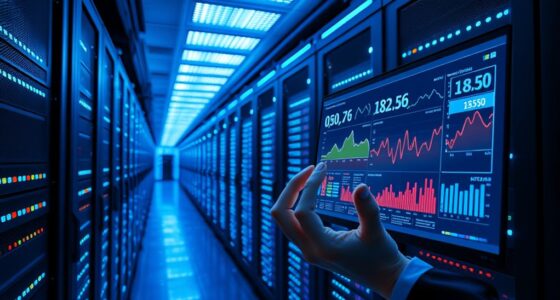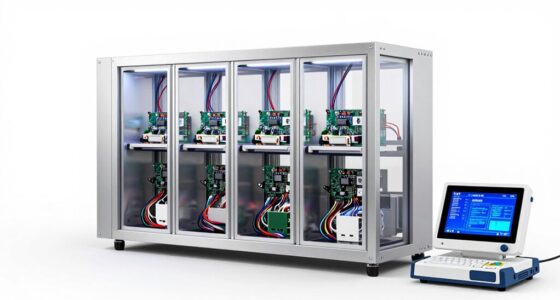

Edge computing shifts data processing from distant servers to local devices or nearby nodes, allowing you to experience faster responses and less latency. By handling data closer to its source, you can reduce network congestion, save bandwidth, and improve real-time decision-making for applications like autonomous vehicles or industrial automation. This decentralized approach also enhances privacy and guarantees continued operation during network issues. Keep exploring to discover how this shift transforms modern technology and connectivity.

Get business pricing on tech for your team
- Business-only prices and quantity discounts
- Tax-exempt purchasing
- Multiple users, one account, clear invoices
Key Takeaways
- Edge computing processes data locally near the source, reducing latency and enabling real-time responses.
- It minimizes data transmission to centralized servers, saving bandwidth and lowering operational costs.
- By decentralizing processing, edge computing enhances privacy and data security for sensitive information.
- It supports critical applications like autonomous vehicles and industrial automation requiring instant decision-making.
- Edge computing boosts network resilience by maintaining operations during outages or limited connectivity.
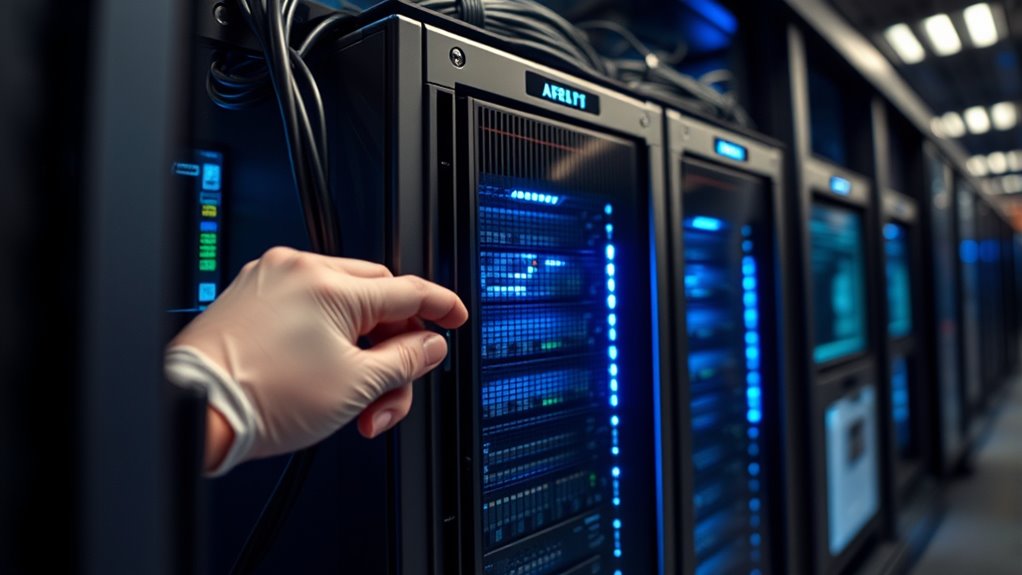
Have you ever wondered how devices like smartphones, smart cameras, and IoT sensors process data so quickly? The secret lies in where and how this data is handled. Traditional cloud computing sends all information to centralized servers far away from the source, which can introduce delays and strain network bandwidth. Edge computing changes this by shifting data processing closer to where the data is generated—right at the edge of the network. Instead of relying solely on distant data centers, edge devices handle many tasks locally, reducing latency and improving real-time responsiveness. This approach is especially crucial for applications that demand instant decisions, such as autonomous vehicles, industrial automation, and smart security systems.
Edge computing processes data locally, reducing delays and enhancing real-time response for smart devices and critical applications.
In essence, edge computing decentralizes data processing. Instead of waiting for data to travel to a cloud server and back, processing happens nearby, often directly on the device or on local servers known as edge nodes. These edge nodes are smaller, more efficient servers located within or near the devices they serve. For example, a smart security camera might analyze video footage locally to identify suspicious activity instantly, rather than sending hours of footage to a distant data center. This immediate analysis not only speeds up response times but also reduces the amount of data transmitted across networks, saving bandwidth and lowering costs.
By processing data at the source, edge computing also enhances privacy and security. Sensitive information, like personal health data or private security footage, stays closer to its origin, minimizing exposure to potential breaches during transmission. Additionally, because less data needs to travel over networks, edge computing can continue functioning smoothly even during network outages or bandwidth limitations. This resilience is essential for critical systems that require uninterrupted operation, such as healthcare devices or industrial machinery.
Implementing edge computing involves a mix of hardware and software solutions. Devices need to be equipped with enough processing power to analyze data locally, and networks must support seamless communication between edge devices and centralized systems when necessary. As technology advances, you’ll find more intelligent devices capable of self-processing, making systems smarter and more efficient. Moreover, integrating powerful processing capabilities into edge devices enables real-time analytics and decision-making without reliance on cloud connectivity. This shift toward local processing allows for faster decision-making, better resource management, and more reliable services.
Ultimately, edge computing transforms how data flows through modern networks. It empowers devices to act swiftly, reduces dependency on distant servers, and paves the way for innovative applications that require real-time insights. As more devices connect and generate data, embracing edge computing will become crucial for delivering the speed, privacy, and resilience that today’s digital world demands.
Products Worth Considering

Samsung 27 Odyssey OLED G5 (G50SF) QHD QD-OLED Gaming Monitor

Bose TV Speaker (2nd Gen) Compact Soundbar with Bluetooth and HDMI Connectivity

Logitech MX Mechanical Wireless Illuminated Keyboard, Tactile Quiet, Graphite
As an affiliate, we earn on qualifying purchases.
Frequently Asked Questions
How Does Edge Computing Impact Data Privacy and Security?
Edge computing improves your data privacy and security by processing sensitive information locally, reducing the chance of breaches during transmission. You gain more control over your data, as it stays closer to its source and isn’t constantly sent to centralized servers. However, you must also guarantee that local devices and edge nodes are well-protected, as they can become new targets for cyber-attacks if not properly secured.
What Industries Benefit Most From Edge Computing Adoption?
You’ll find manufacturing and healthcare industries benefit the most from edge computing. For example, 60% of factories using IoT devices report improved real-time decision-making with edge tech. By processing data locally, you reduce latency and enhance efficiency, ensuring quick responses and better safety protocols. This shift helps industries operate more smoothly, making your operations more reliable and responsive in today’s fast-paced, data-driven world.
How Does Edge Computing Integrate With Existing Cloud Infrastructure?
You integrate edge computing with existing cloud infrastructure by creating a hybrid setup that processes critical data locally and sends less time-sensitive information to the cloud. This approach reduces latency, improves response times, and eases bandwidth demands. You can deploy edge devices alongside cloud services, enabling seamless data flow and management. By doing so, you enhance overall system efficiency, guarantee better real-time decision-making, and optimize resource utilization across your infrastructure.
What Are the Main Challenges in Deploying Edge Computing Solutions?
You face several challenges deploying edge computing solutions, like managing diverse devices and guaranteeing data security. Network reliability can be a hurdle, causing latency or disconnections. You also need to handle limited local resources and integrate seamlessly with cloud infrastructure. Balancing these factors demands careful planning, robust security measures, and adaptable architecture to ensure smooth, efficient operations at the edge.
How Is Edge Computing Expected to Evolve Over the Next Decade?
Over the next decade, you’ll see edge computing become more integrated and intelligent, with AI and IoT driving smarter data processing right at the source. As devices become more powerful and networks faster, you’ll benefit from reduced latency, enhanced security, and real-time insights. Expect more automation and seamless connectivity, making edge solutions essential for industries like healthcare, manufacturing, and smart cities, transforming how you interact with technology daily.
Conclusion
As you embrace edge computing, you’re stepping into a future where data moves faster and smarter. But what’s coming next could revolutionize everything you know—imagine even closer processing, real-time decisions, and unprecedented connectivity. Are you ready to harness this power before others do? The shift is happening now, and the key to staying ahead might just depend on how quickly you adapt. The next chapter is unfolding—don’t get left behind.