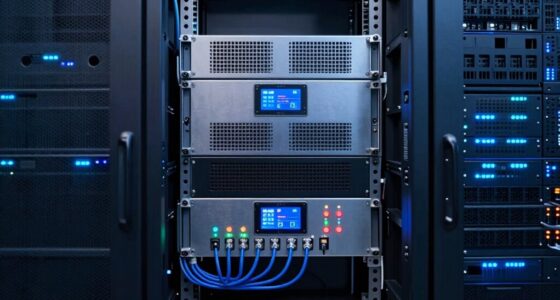
Hyperconverged infrastructure combines compute, storage, and networking into a single, streamlined system. This integration simplifies management by removing the need to handle multiple hardware components and separate tools. With centralized dashboards, you can monitor performance, troubleshoot issues, and scale easily. It boosts operational efficiency, enhances security, and supports flexible growth without overusing resources. Keeping these benefits in mind, exploring further reveals how HCI transforms and modernizes your data center environment effectively.
Key Takeaways
- Hyperconverged infrastructure integrates compute, storage, and networking into a single, simplified platform, reducing hardware complexity.
- It offers centralized management dashboards for efficient monitoring, troubleshooting, and operational control.
- Scalability is seamless, allowing easy addition of nodes or modules without disrupting existing services.
- Built-in security features like encryption and access controls enhance data protection and compliance.
- It accelerates deployment, boosts agility, and supports modernization by streamlining IT infrastructure management.

Have you ever wondered how modern data centers simplify infrastructure management? The answer lies in hyperconverged infrastructure, or HCI, which seamlessly combines compute, storage, and networking into a single, integrated system. Instead of juggling multiple hardware components and separate management tools, you get a unified platform that streamlines operations and reduces complexity. With HCI, deploying new services or scaling existing ones becomes straightforward because everything is designed to work together out of the box. This integration eliminates the need for extensive configuration or compatibility checks across different hardware vendors, saving you time and reducing the chance of errors.
When you adopt hyperconverged infrastructure, you gain the benefit of centralized management through user-friendly dashboards. These interfaces allow you to oversee your entire environment from a single console, making it easier to monitor performance, allocate resources, and troubleshoot issues. This centralized approach not only boosts operational efficiency but also minimizes the training required for your IT staff. Instead of managing disparate systems, your team can focus on strategic initiatives rather than day-to-day maintenance. As a result, you can respond faster to business needs and innovate more quickly.
Another advantage of HCI is its scalability. As your organization grows, you can add new nodes or modules with minimal disruption. Since compute, storage, and networking are tightly integrated, expanding your infrastructure is as simple as plugging in additional units, which are automatically recognized and configured. This elasticity means you don’t have to overprovision resources in advance, reducing capital expenses and ensuring you only pay for what you need. Plus, hyperconverged systems often support software-defined storage, enabling flexible allocation of storage resources and improving overall efficiency.
Security is also enhanced with hyperconverged infrastructure. Because everything is managed centrally and runs on a unified platform, implementing consistent security policies across your environment becomes easier. Features like encryption, access controls, and automated backups are built into the system, helping you meet compliance requirements and protect sensitive data. Additionally, because HCI reduces hardware complexity, there are fewer points of failure, which improves system reliability and uptime—crucial factors for maintaining business continuity.
In essence, hyperconverged infrastructure transforms traditional data centers into agile, manageable, and scalable environments. By combining compute, storage, and networking within a single system, it simplifies complex IT landscapes, accelerates deployment, and enhances security. If you’re looking to modernize your infrastructure and focus more on strategic initiatives rather than routine maintenance, embracing HCI offers a compelling solution that aligns with the future of IT. Including virtualization technology can further optimize resource utilization and operational flexibility.

Hyper-Converged Infrastructure Simplified: Hardware Sizing, SDS, SDN and Backup Strategies with Proxmox solutions: The Essential Guide
As an affiliate, we earn on qualifying purchases.
As an affiliate, we earn on qualifying purchases.
Frequently Asked Questions
How Does HCI Impact Overall IT Agility?
You’ll find that HCI greatly boosts your IT agility by simplifying deployment and management. It allows you to quickly scale resources up or down, respond faster to business needs, and reduce downtime. With integrated infrastructure, you spend less time on maintenance and more on strategic projects. Overall, HCI helps you be more flexible, efficient, and responsive, giving your IT team the agility to adapt swiftly to changing demands.
What Are the Key Security Considerations for HCI?
You should focus on securing data both at rest and in transit, ensuring encryption is enabled across your HCI environment. Regularly update your software to patch vulnerabilities, and implement strong access controls with multi-factor authentication. Monitor your system continuously for suspicious activity, and back up your data regularly. Additionally, consider network segmentation to limit lateral movement of threats, and educate your team on security best practices to reduce human error.
Can HCI Be Integrated With Existing Legacy Systems?
Yes, you can integrate HCI with your existing legacy systems. While some worry about compatibility issues, modern HCI solutions are designed with flexible APIs and support for various protocols, making integration smoother. You’ll need to plan carefully, ensuring hardware and software compatibility, but it’s achievable without overhauling your entire infrastructure. This integration allows you to leverage HCI’s benefits while maintaining your current systems.
What Are the Typical Cost Savings With HCI?
You can typically see significant cost savings with HCI, often around 30-50%, by reducing hardware purchases, streamlining management, and lowering maintenance costs. Since HCI consolidates compute, storage, and networking into a single platform, you eliminate the need for multiple vendors and complex integrations. Plus, its scalability allows you to grow incrementally, avoiding large upfront investments and optimizing resource utilization for better financial efficiency.
How Scalable Is Hyperconverged Infrastructure Over Time?
You might think hyperconverged infrastructure is a static setup, but it’s surprisingly scalable. You simply add nodes as your needs grow, making expansion seamless and cost-effective. Ironically, what seems like a rigid system actually adapts effortlessly over time. You won’t hit a ceiling; instead, you’ll find your infrastructure expanding just as effortlessly as your business demands. This flexibility guarantees your system keeps pace without major disruptions or costly overhauls.

Implementing VxRail HCI Solutions: A complete guide to VxRail Appliance administration and configuration
- Comprehensive VxRail HCI Implementation Guide: Administering and configuring VxRail appliances
As an affiliate, we earn on qualifying purchases.
As an affiliate, we earn on qualifying purchases.
Conclusion
By embracing hyperconverged infrastructure, you’re transforming your IT landscape into a unified, agile powerhouse. Think of it as the backbone of your digital future—streamlined, resilient, and ready to evolve. Don’t let complexity hold you back; instead, harness its potential like a key opening new possibilities. As the saying goes, “The whole is greater than the sum of its parts.” With hyperconvergence, you hold the key to smarter, more efficient infrastructure.

Hyperconverged Infrastructure Data Centers: Demystifying HCI (Networking Technology)
As an affiliate, we earn on qualifying purchases.
As an affiliate, we earn on qualifying purchases.
software-defined storage appliances
As an affiliate, we earn on qualifying purchases.
As an affiliate, we earn on qualifying purchases.