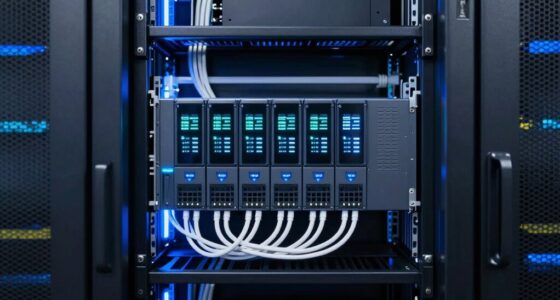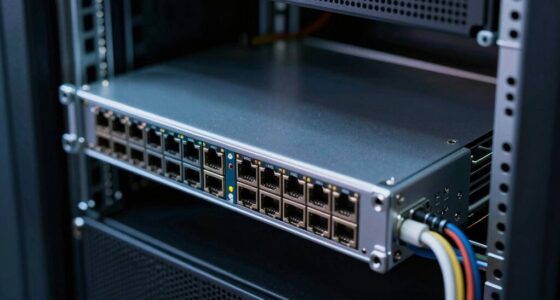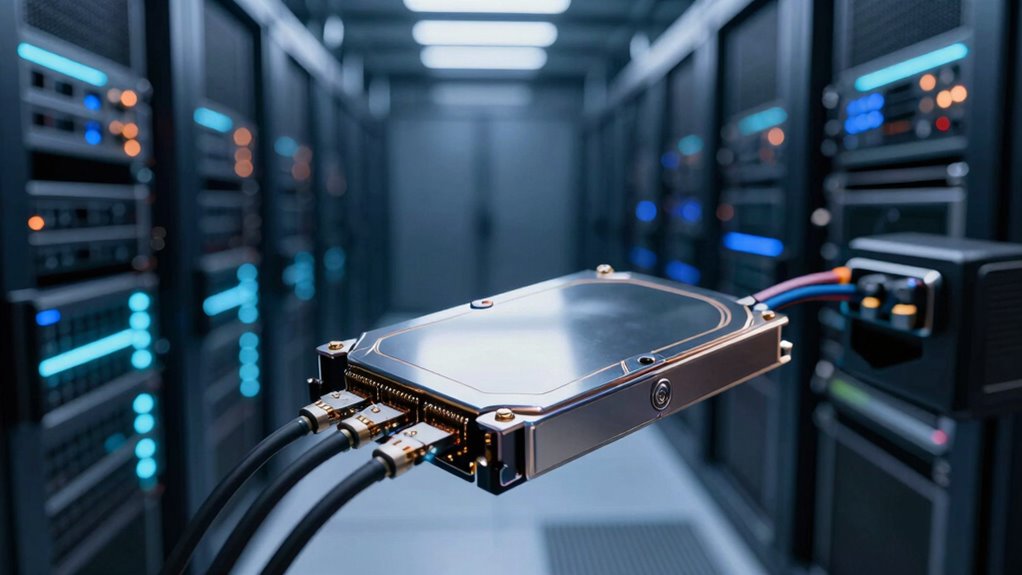

Your AI training performance relies heavily on storage throughput because fast data transfer keeps your GPUs and CPUs busy and avoids delays. When storage is slow, it creates bottlenecks that pause your training process, extending time and increasing costs. Upgrading to high-speed storage solutions like NVMe SSDs can boost data flow and improve efficiency. Keep exploring to discover how optimizing storage can enable even faster training and better results.

Get business pricing on tech for your team
- Business-only prices and quantity discounts
- Tax-exempt purchasing
- Multiple users, one account, clear invoices
Key Takeaways
- Higher storage throughput enables faster data transfer, reducing I/O bottlenecks during training.
- Faster storage minimizes GPU/CPU idle times, increasing overall training efficiency.
- Improved throughput supports handling larger datasets without slowing down the training process.
- Efficient data pipelines and high-speed storage reduce wait times, accelerating model iteration.
- Enhanced storage capabilities lead to more cost-effective and scalable AI training workflows.

As AI training models grow more complex and data-intensive, storage throughput becomes a critical factor in achieving the most favorable performance. When you’re training deep learning models, large datasets need to be read, processed, and written back rapidly. If your storage can’t keep up with these demands, data transfer slows down, leading to I/O bottlenecks that hinder overall training efficiency. These bottlenecks occur when the rate at which data moves between storage and compute resources isn’t sufficient to sustain the training process, causing idle times for your GPUs or CPUs. As a result, your training cycle extends longer than necessary, increasing costs and delaying insights.
Understanding how storage throughput impacts data transfer is essential to optimize your AI workflows. Faster storage solutions, like NVMe SSDs or high-performance SANs, boost data transfer rates, minimizing delays caused by I/O bottlenecks. When the storage subsystem can deliver data swiftly, your GPU clusters receive input without interruption, maintaining high utilization and maximizing throughput. Conversely, slower storage leads to frequent pauses as your system waits for data, which reduces overall training speed. This imbalance can also affect the stability of your training process, especially when working with real-time data streams or iterative algorithms that require rapid access to large datasets. Additionally, choosing the right storage architecture can significantly influence your system’s ability to handle high-throughput workloads.
You’ll find that the type of storage you choose directly influences how well your system handles large data loads. Traditional HDDs or lower-tier SSDs might be sufficient for smaller workloads, but they quickly become limiting as your data size grows. Upgrading to high-throughput storage options ensures smoother data transfer, helping to eliminate I/O bottlenecks. Additionally, optimizing data pipelines—such as prefetching data, using efficient file formats, and employing parallel I/O—can further improve throughput, reducing wait times during training runs. Incorporating modern storage technologies can make a substantial difference in managing increasing data demands and maintaining training efficiency. This way, your resources are dedicated to training rather than waiting on data movement, especially when implementing high-performance storage solutions.
In essence, the relationship between storage throughput and AI training performance is direct and impactful. When you prioritize high data transfer rates and minimize I/O bottlenecks, your training becomes more efficient, cost-effective, and scalable. Investing in the right storage infrastructure allows your models to train faster, providing quicker insights and maintaining competitive advantage. As you enhance your storage capabilities, you’ll find that your AI workflows become more streamlined, giving you the agility to experiment, iterate, and deploy smarter models more rapidly. Recognizing the importance of storage performance helps ensure your AI projects reach their full potential.
As an affiliate, we earn on qualifying purchases.
Frequently Asked Questions
How Does Storage Throughput Compare to Other Bottlenecks in AI Training?
Storage throughput can be a significant bottleneck in AI training, especially when large datasets require rapid data transfer. Compared to GPU compute power or network latency, slow storage increases data transfer delays, hampering overall performance. You need to optimize latency by choosing high-throughput storage solutions, ensuring data moves quickly. When storage throughput is high, it minimizes bottlenecks, allowing your AI models to train faster and more efficiently.
What Are the Cost Implications of High-Throughput Storage Solutions?
High-throughput storage solutions often come with increased costs, impacting your overall budget. While they improve data access speeds, they can introduce scalability challenges, causing you to spend more on infrastructure upgrades. To maintain cost efficiency, you need to balance performance needs with budget constraints, considering options like tiered storage or cloud solutions that offer scalable throughput without overly escalating expenses. This way, you optimize both performance and cost.
Can Software Optimizations Mitigate Storage Throughput Limitations?
Yes, software tuning can help mitigate throughput bottlenecks in storage. By optimizing data access patterns, adjusting I/O scheduling, and leveraging parallel processing, you can improve throughput and reduce delays during AI training. Implementing caching strategies and efficient data prefetching also plays an essential role. While these measures don’t eliminate hardware limitations, they considerably enhance performance, allowing your training processes to run smoother despite storage throughput constraints.
How Does Storage Throughput Impact Training Time for Different AI Models?
Storage throughput directly impacts your AI training time by influencing data transfer speeds. When throughput is high, you reduce I/O bottlenecks, allowing models to access data faster and train more efficiently. For complex models, this difference can markedly cut training duration. Conversely, limited throughput causes delays, increasing overall time. You need peak storage performance to guarantee smooth data flow, especially with large datasets or advanced AI models.
What Types of Storage Are Best Suited for High-Throughput AI Training?
Think of high-throughput storage like a lightning-fast river fueling your AI train. SSDs and NVMe drives are your best allies, offering rapid data flow essential for training. Cloud scalability lets you expand storage seamlessly, preventing bottlenecks, while data redundancy guarantees your data stays safe like a fortress, even during crashes. These storage types power your AI models efficiently, keeping the train chugging at full speed without interruption.
high performance storage for deep learning
As an affiliate, we earn on qualifying purchases.
As an affiliate, we earn on qualifying purchases.
Conclusion
Think of storage throughput as the heartbeat of your AI training journey. When it pulses steadily, your models breathe and evolve swiftly, reaching their full potential. But if it stutters or stalls, progress slows—like a machine with clogged arteries. To open peak performance, guarantee your storage flows like a mighty river, carrying your data swiftly to fuel innovation. Remember, in AI training, smooth throughput isn’t just speed; it’s the lifeblood of breakthrough discoveries.
As an affiliate, we earn on qualifying purchases.
As an affiliate, we earn on qualifying purchases.
Halloween Picks
halloween
As an affiliate, we earn on qualifying purchases.