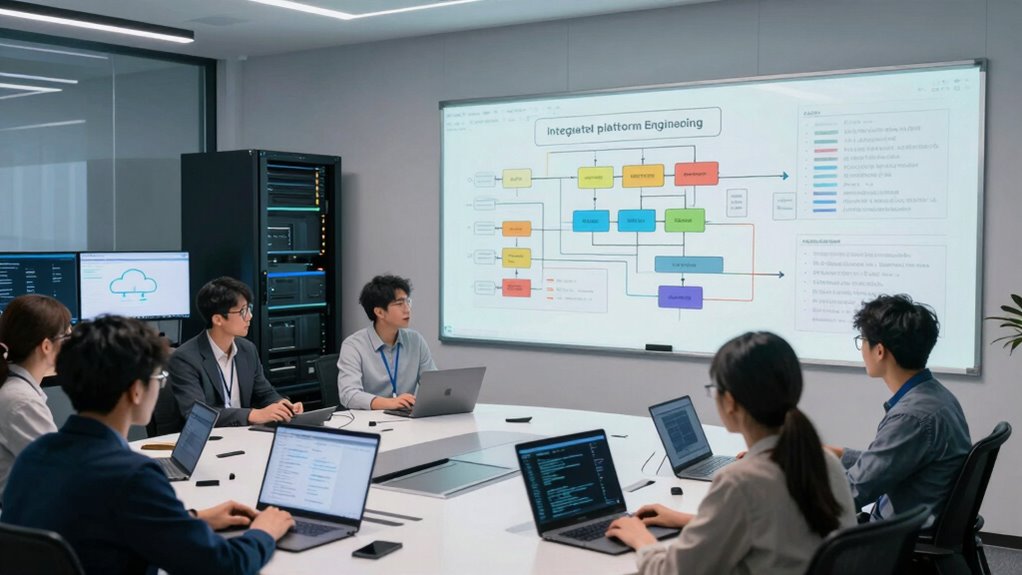

Platform engineering redefines your MLOps team by creating a unified infrastructure that streamlines workflows, emphasizing data governance, automation, and collaboration. It shifts your focus toward platform stability, security, and compliance, enabling more efficient model development and deployment. You’ll see clearer roles, with specialists handling governance and quality, and teams working seamlessly across functions. If you want to discover how these changes can best fit your organization, there’s more to explore ahead.

Get business pricing on tech for your team
- Business-only prices and quantity discounts
- Tax-exempt purchasing
- Multiple users, one account, clear invoices
Key Takeaways
- Centralized infrastructure and data governance streamline data access, security, and compliance, reducing team complexity and risk.
- Standardized workflows and collaboration frameworks foster shared responsibility and improve efficiency across team roles.
- Evolving team responsibilities shift focus toward platform stability, security, and governance, requiring specialized expertise.
- Cloud-native approaches enable continuous improvement, scalability, and flexibility in team operations and infrastructure.
- Emphasizing interpretability and visual clarity enhances trust, transparency, and model governance throughout the ML lifecycle.

Building effective platform engineering and MLOps teams is essential for streamlining machine learning workflows and guaranteeing scalable, reliable deployment of models. As you integrate platform engineering principles into your MLOps team, you’ll notice a shift in how teams collaborate and handle data governance. With a focus on building robust platforms, your team can establish clear collaboration frameworks that promote transparency, consistency, and shared responsibility across data scientists, engineers, and operations staff.
Platform engineering emphasizes creating centralized, reusable infrastructure components that support machine learning lifecycle stages. This centralization simplifies data access, versioning, and security, making data governance more manageable. When you design your team around these platform capabilities, you enable better control over data privacy, compliance, and quality. This reduces risks associated with data mishandling and ensures your models are trained on accurate, trustworthy data. Incorporating requirements traceability can further support compliance efforts by ensuring all data and model changes are documented and auditable throughout the development process, which is critical for maintaining data integrity.
Moreover, platform engineering encourages the adoption of standardized workflows and tools, which naturally fosters collaboration. Instead of siloed efforts, your team can implement collaboration frameworks that streamline communication and coordination. For instance, shared repositories, automated pipelines, and consistent environments help prevent errors and enable faster iteration. These frameworks make it easier for team members to contribute, review, and deploy models confidently, knowing everyone is operating within a unified system. Additionally, integrating energy efficiency principles can help optimize resource usage within your platform, reducing operational costs and environmental impact.
As your platform becomes more sophisticated, you’ll find that the design of your MLOps team must evolve. The roles shift from solely focusing on model performance to also managing platform stability, security, and governance. You’ll need specialists in data governance who understand regulatory requirements and can implement policies within the platform. At the same time, collaboration frameworks should promote cross-functional teamwork, ensuring that data scientists, engineers, and operators work seamlessly together.
By embedding platform engineering into your MLOps team structure, you also set the stage for continuous improvement. Automated governance checks, version control, and audit trails become integral parts of the platform, helping your team stay compliant and transparent. These features foster a culture where data quality and security are prioritized, and collaboration is built into daily workflows. Additionally, adopting cloud-native approaches can further enhance scalability and flexibility, aligning with the evolving needs of your team and infrastructure.
Furthermore, incorporating color accuracy and contrast ratio considerations from home cinema projectors can inspire your team to prioritize clarity and precision in model outputs and data visualizations, further enhancing trust and interpretability. In essence, platform engineering transforms your MLOps team from a collection of isolated specialists into a cohesive, scalable unit. You’re not just deploying models faster; you’re creating an environment where data governance is embedded in every step, and collaboration frameworks support a unified approach to building and maintaining machine learning systems. This shift ultimately leads to more reliable, secure, and scalable AI solutions.
MLOps platform engineering tools
As an affiliate, we earn on qualifying purchases.
As an affiliate, we earn on qualifying purchases.
Frequently Asked Questions
How Does Platform Engineering Impact Team Collaboration Dynamics?
Platform engineering enhances team collaboration by streamlining cross-team communication and fostering better stakeholder engagement. You’ll find it easier to share resources, align goals, and troubleshoot issues quickly. As a result, collaboration becomes more efficient, reducing misunderstandings and delays. You and your team can focus more on innovation rather than technical hurdles, making the overall process more cohesive and agile. This approach ultimately strengthens your project’s success and team synergy.
What Tools Are Essential for a Platform Engineering-Driven MLOPS Team?
Think of your MLOps team as a ship steering through vast seas. Essential tools include robust model versioning systems like DVC or MLflow, which act as your navigational charts, ensuring you track every change. Data pipeline tools such as Apache Airflow or Kubeflow become your trusted anchors, keeping data flowing smoothly and reliably. With these, you steer confidently through complex projects, maintaining control and precision in your journey.
How Do Platform Engineering Practices Influence Model Deployment Speed?
You’ll find that platform engineering practices considerably boost model deployment speed by addressing scalability challenges and establishing robust security protocols. With scalable infrastructure, you can deploy models faster across various environments without bottlenecks. Security protocols integrated into the platform ensure safe, compliant deployments, reducing delays caused by manual checks. This streamlined approach allows your team to release models quickly and reliably, ultimately accelerating your MLOps workflows and innovation cycles.
What Skills Are Most Valuable in a Platform Engineering-Focused MLOPS Team?
Imagine building a high-speed train—your team needs the right tools to keep it running smoothly. Valuable skills include mastery of data pipelines and automation frameworks, ensuring seamless data flow and deployment. Strong coding skills, cloud platform knowledge, and an understanding of scalable infrastructure are essential. These abilities help your team optimize model deployment, reduce downtime, and enhance collaboration, making your MLOps pipeline faster, more reliable, and ready to race ahead.
How Does Platform Engineering Affect Long-Term Model Maintenance?
Platform engineering streamlines long-term model maintenance by enabling automated monitoring and consistent data versioning. You can quickly identify issues with models, track data changes, and deploy updates efficiently. This focus reduces manual intervention, minimizes errors, and guarantees models stay accurate over time. By integrating these tools, you guarantee your models remain reliable, scalable, and easier to maintain, ultimately boosting your team’s productivity and the model’s performance.
data governance automation software
As an affiliate, we earn on qualifying purchases.
As an affiliate, we earn on qualifying purchases.
Conclusion
As you navigate the evolving landscape of platform engineering, imagine it as a sturdy bridge connecting your team to the vast ocean of machine learning innovations. By reshaping MLOps team design, you’re not just building structures—you’re crafting a resilient vessel that sails smoothly through complex waters. Embrace these changes, and watch your team set sail with confidence, steering through challenges with the steady helm of streamlined processes and unified purpose.
cloud-native infrastructure for machine learning
As an affiliate, we earn on qualifying purchases.
As an affiliate, we earn on qualifying purchases.
As an affiliate, we earn on qualifying purchases.
Halloween Picks
halloween
As an affiliate, we earn on qualifying purchases.