
To enhance your developer experience in Kubernetes, you’ll want to leverage the right tooling and portals. Visual dashboards like Kubernetes Dashboard, Lens, and Rancher make managing clusters easier by providing real-time insights and troubleshooting tools. Automation through CI/CD integration streamlines deployments too. These tools help you focus on your applications rather than complex configurations. Keep exploring how these solutions can transform your workday and open new levels of efficiency and control.
Listen free for 30 days with Audible
Thousands of audiobooks and originals — cancel anytime.
As an affiliate, we earn on qualifying purchases.
Key Takeaways
- Tooling and portals simplify Kubernetes management, reducing complexity and streamlining developer workflows.
- Visual dashboards and management portals enable real-time monitoring and faster troubleshooting.
- High-level tools like Helm and CI/CD integrations automate deployments, increasing efficiency and reducing errors.
- Portals like Lens and Rancher offer centralized control, role-based access, and enhanced security.
- Improved tooling enhances developer experience by making Kubernetes more accessible, manageable, and reliable.
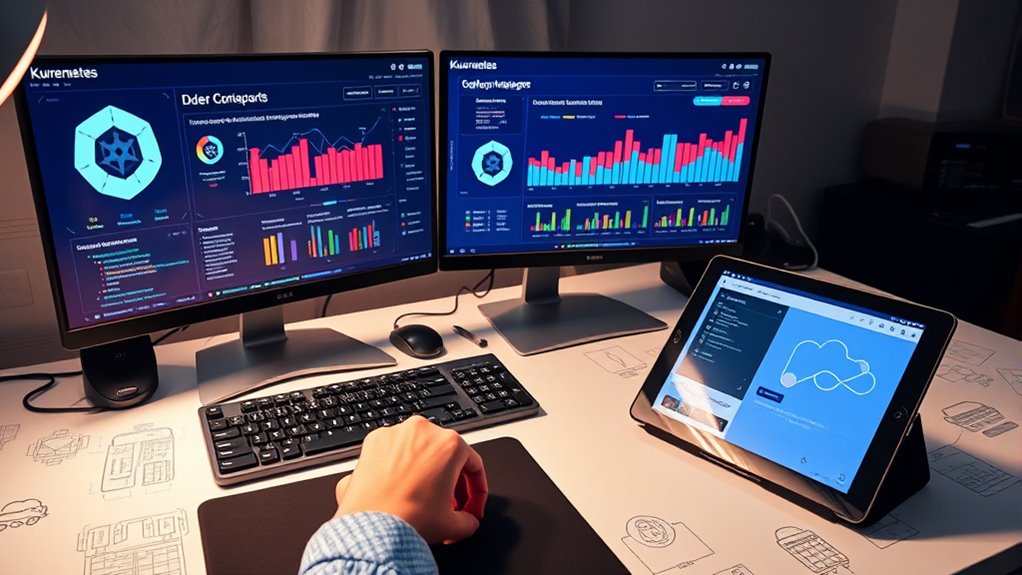
Have you ever wondered how developers steer the complex world of Kubernetes? It’s a vast ecosystem with countless moving parts, and without the right tools, it can quickly become overwhelming. This is where tooling and portals come into play, acting as your guiding light through the Kubernetes maze. These tools aren’t just conveniences; they’re essential for streamlining workflows, reducing errors, and accelerating development cycles. They help you abstract away much of the complexity, so you can focus on building and deploying rather than wrestling with Kubernetes’ intricacies.
One of the first things you’ll notice is that Kubernetes has a steep learning curve. Its declarative configuration, while powerful, can be intimidating for newcomers. That’s why developers rely on robust CLI tools like kubectl, which provide direct control over clusters, but often require deep knowledge to use effectively. To bridge this gap, many teams turn to higher-level tools like Helm, which simplifies deployment by managing complex Kubernetes manifests through charts. Helm allows you to package, version, and share applications easily, making it easier to deploy consistent environments across different clusters.
Beyond command-line tools, dashboards and portals have become invaluable. These graphical interfaces offer a visual overview of your cluster’s state, making it easier to monitor resources, troubleshoot issues, and manage deployments without memorizing commands. Kubernetes Dashboard, for example, provides an intuitive UI to see pods, services, and nodes in real-time. More advanced portals like Lens or Rancher go a step further by offering centralized management, role-based access controls, and integrated troubleshooting features. These portals reduce the cognitive load and help you quickly identify bottlenecks or failures. Additionally, reliable tooling can significantly improve your confidence in managing complex environments, especially when scaling or troubleshooting issues under pressure.
Automation is another critical aspect. Developers leverage CI/CD pipelines integrated with Kubernetes, often using tools like Jenkins, GitLab, or Argo CD. These integrations automate the deployment process, ensuring that code changes are tested, validated, and rolled out consistently. Such automation minimizes manual intervention, reduces errors, and shortens release cycles. Additionally, they provide visibility into deployment status and health, making it easier to roll back or troubleshoot if problems arise.
Ultimately, tooling and portals are about making Kubernetes more accessible and manageable. They empower you to focus on your application logic instead of wrestling with cluster configurations. By adopting these tools, you gain better control, improved efficiency, and a more reliable developer experience. Steering Kubernetes becomes less intimidating when you have the right set of tools at your fingertips—tools that transform a complex, intimidating environment into an organized, manageable platform where your development efforts can thrive.
Kubernetes dashboard management tool
As an affiliate, we earn on qualifying purchases.
As an affiliate, we earn on qualifying purchases.
Frequently Asked Questions
How Does Kubernetes Impact Developer Productivity?
Kubernetes boosts your productivity by automating deployment, scaling, and management of applications, so you spend less time on manual tasks. It provides a consistent environment across different stages, reducing errors and streamlining workflows. With powerful tooling and portals, you can quickly troubleshoot, monitor, and update your applications. This enables you to focus more on developing features rather than managing infrastructure, ultimately accelerating your project timelines and enhancing overall efficiency.
What Are the Best Practices for Onboarding New Developers?
To onboard new developers effectively, you should create clear, detailed documentation covering setup, best practices, and common troubleshooting steps. Provide hands-on training sessions and pair them with experienced team members for mentorship. Automate onboarding tasks with scripts and tools to streamline initial setup. Encourage questions and feedback to improve processes. Regularly update resources to keep pace with evolving Kubernetes features, ensuring new team members can contribute confidently and efficiently.
How Can Organizations Ensure Consistent Developer Experiences Across Teams?
To guarantee consistent developer experiences across teams, you should standardize tools, workflows, and documentation. Implement shared portals and templates that everyone uses, and provide extensive onboarding resources. Encourage regular communication and feedback to identify gaps or confusion. Automate setup processes as much as possible, and foster a culture of collaboration. By doing so, you create an environment where developers can work efficiently and confidently, regardless of their team.
What Security Considerations Are Essential for Developer Portals?
Imagine locking a treasure chest—security considerations for developer portals are just as crucial. You need to enforce strong authentication, like multi-factor, to prevent unauthorized access. Regularly update and patch the portal software, monitor for suspicious activity, and restrict permissions based on roles. Using encryption for data in transit and at rest safeguards sensitive information. These measures ensure your portal remains a secure gateway, protecting your Kubernetes environment from potential threats.
How Do Tooling Choices Affect Application Scalability in Kubernetes?
Your tooling choices directly impact application scalability in Kubernetes by influencing resource management, deployment speed, and automation capabilities. Opting for lightweight, efficient tools helps you optimize cluster resources and reduce overhead, allowing your applications to handle increased load smoothly. Automation tools streamline scaling processes, minimizing manual intervention. Well-integrated tooling guarantees your applications can grow seamlessly, maintaining performance and reliability as demand increases.
Lens Kubernetes management portal
As an affiliate, we earn on qualifying purchases.
As an affiliate, we earn on qualifying purchases.
Conclusion
As you navigate the evolving landscape of Kubernetes, remember that crafting seamless tooling and portals enhances your journey, much like Daedalus’s mastery crafted wings for flight. By prioritizing developer experience, you *unseal* greater innovation and efficiency, turning complex labyrinths into clear pathways. Embrace these tools as your Ariadne’s thread, guiding you through the intricate maze of modern cloud-native development with confidence and agility.
Rancher Kubernetes management platform
As an affiliate, we earn on qualifying purchases.
As an affiliate, we earn on qualifying purchases.
Helm package manager for Kubernetes
As an affiliate, we earn on qualifying purchases.
As an affiliate, we earn on qualifying purchases.
Flea & tick season Picks
flea and tick prevention
As an affiliate, we earn on qualifying purchases.