

The future of Kubernetes is bright with smarter AI and ML integration that will optimize resource management and predict failures before they occur. Multi-cloud and hybrid strategies will make deployments more flexible and seamless across different environments. Security features will become more robust, simplifying management and enhancing protection. Developer-friendly tools will focus on ease of use and automation, while a vibrant community will drive continuous innovation. Exploring these trends will reveal how Kubernetes will shape digital infrastructure moving forward.
Key Takeaways
- Integration of AI/ML will enhance resource management, predictive failure detection, and automate complex operations.
- Multi-cloud and hybrid strategies will enable seamless deployment, workload mobility, and consistent policy enforcement.
- Security features will become more advanced with automated vulnerability scanning and improved workload isolation.
- Developer experience will improve through simplified configuration, automation, and tighter integration with CI/CD pipelines.
- Ecosystem growth will be driven by community-driven tools, extensions, and innovative solutions tailored to emerging needs.
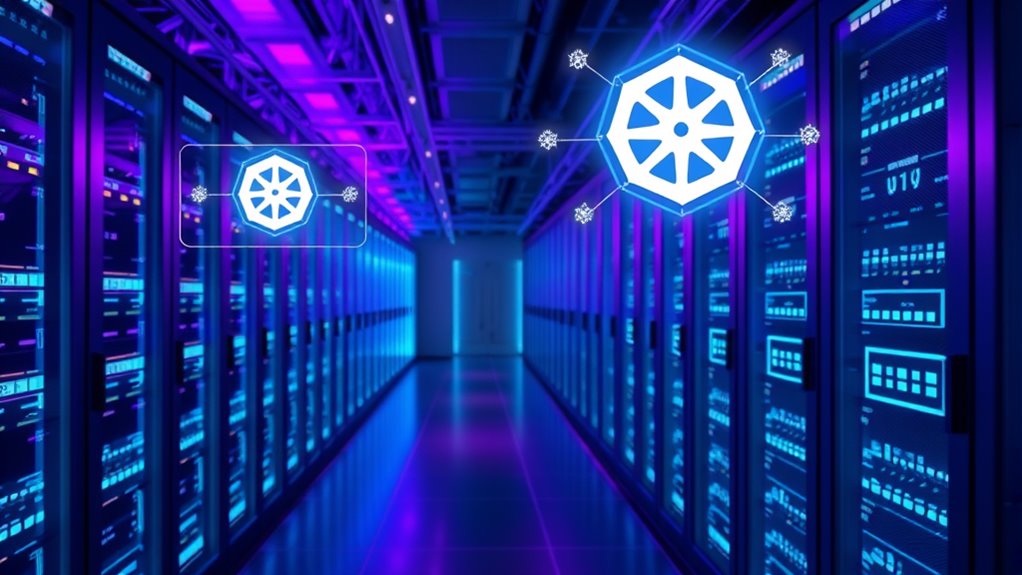
As container orchestration continues to evolve, Kubernetes remains at the forefront, driving innovation in deploying, managing, and scaling applications. You’re likely aware that Kubernetes has become the de facto standard for container management, but the future promises even more transformative changes. One key direction is increased integration with artificial intelligence and machine learning. Expect Kubernetes to become smarter at optimizing resource allocation, predicting failures before they happen, and automating complex decision-making processes. This will help you reduce downtime, improve efficiency, and cut operational costs, especially as workloads grow more complex.
Another significant trend is the expansion of multi-cloud and hybrid cloud strategies. You’ll find it easier to deploy and manage Kubernetes clusters across different cloud providers and on-premises environments. This flexibility means you won’t be locked into a single vendor, enabling you to choose the best services and pricing options for your needs. Kubernetes will continue to develop tools that facilitate seamless workload migration, consistent policy enforcement, and centralized management across diverse infrastructures. It’s all about giving you more control and agility in how you deploy applications. Additionally, the ecosystem is increasingly focusing on standardization efforts to ensure compatibility and interoperability across platforms.
Multi-cloud and hybrid strategies will simplify Kubernetes management across diverse environments, boosting control, flexibility, and workload mobility.
Security is also poised for major advancements. As Kubernetes becomes more embedded in critical business operations, there’s an increasing focus on enhancing security measures. You can expect more robust identity and access management, automated vulnerability scanning, and better isolation between workloads. These improvements aim to protect your applications from evolving cyber threats and ensure compliance with industry standards. Kubernetes will likely incorporate advanced security features directly into its core, reducing the need for additional tools and simplifying your security posture.
The ecosystem will also see a surge in developer-friendly features. Kubernetes is moving towards simplifying complex configurations, making it easier for you to deploy and manage applications without deep expertise in orchestration. Expect more intuitive interfaces, better automation, and integrated CI/CD pipelines. This shift will accelerate your development cycles, allowing you to innovate faster and respond more quickly to market demands. As the platform becomes more accessible, you’ll be empowered to focus more on building features rather than managing infrastructure.
Finally, the community-driven nature of Kubernetes will continue to foster innovation. As new tools, operators, and extensions emerge, you’ll have access to a richer ecosystem that adapts to your needs. The open-source model means you can contribute, customize, and stay at the cutting edge of technology. Your ability to leverage these advancements will be pivotal in staying competitive in an increasingly digital landscape. Overall, Kubernetes will keep evolving to support your growing needs — smarter, more flexible, and more secure than ever before.

The Machine Learning Solutions Architect Handbook: Practical strategies and best practices on the ML lifecycle, system design, MLOps, and generative AI
As an affiliate, we earn on qualifying purchases.
As an affiliate, we earn on qualifying purchases.
Frequently Asked Questions
How Will Kubernetes Adapt to Emerging Edge Computing Requirements?
You’ll see Kubernetes adapt to edge computing by enhancing its lightweight footprint and optimizing resource management. It’ll incorporate better support for device heterogeneity and connectivity challenges, enabling seamless deployment across diverse edge environments. Expect new features for local data processing, improved security, and simplified management tools tailored for resource-constrained devices. These changes will allow you to efficiently run containerized applications closer to data sources, reducing latency and bandwidth use.
What Role Will AI and Machine Learning Play in Kubernetes Management?
AI and machine learning will revolutionize Kubernetes management by automating tasks like resource allocation, fault detection, and scaling. You’ll see smarter algorithms optimizing cluster performance in real-time, reducing manual intervention. These tools will predict issues before they happen, ensuring higher reliability and efficiency. As a user, you’ll benefit from more autonomous, intelligent systems that simplify operations, allowing you to focus on development rather than infrastructure management.
How Will Security Protocols Evolve Within Kubernetes Ecosystems?
Security protocols in Kubernetes will evolve like a fortress growing stronger over time. You’ll see more advanced encryption, automated threat detection, and tighter access controls, acting as your digital shield. As vulnerabilities appear, new standards will emerge, making it harder for threats to breach your defenses. You’ll need to stay vigilant, adopting these innovations swiftly, ensuring your ecosystem remains resilient and secure amid the ever-changing landscape of cyber threats.
What Are the Plans for Improving Multi-Cloud and Hybrid Deployments?
You can expect improvements in multi-cloud and hybrid deployments through better tooling and standardization. Kubernetes plans to enhance interoperability with cloud providers, making it easier for you to manage resources across different platforms seamlessly. Expect more robust APIs, native support for hybrid architectures, and simplified deployment processes. These updates aim to give you greater flexibility, reduce complexity, and guarantee consistent performance regardless of where your workloads run.
How Will Kubernetes Support Serverless and Function-As-A-Service Architectures?
Kubernetes will enhance support for serverless and FaaS architectures through improved integrations with frameworks like Knative, enabling you to deploy functions seamlessly. It will offer better event-driven capabilities, auto-scaling, and simplified developer workflows. You’ll find it easier to run serverless workloads alongside traditional applications, gaining flexibility and efficiency. Expect more native tools and community-driven projects that make serverless deployment on Kubernetes more straightforward, empowering you to focus on building rather than managing infrastructure.

(TWO SIDED) Kubernetes – Deployment, Scaling and Management Sweatshirt
Kubernetes is an open platform that automates container orchestration, enabling seamless deployment, automatic scaling, self-healing, and efficient management…
As an affiliate, we earn on qualifying purchases.
As an affiliate, we earn on qualifying purchases.
Conclusion
As you look ahead, the Kubernetes ecosystem beckons with endless possibilities, much like a horizon that constantly expands. Embrace these future directions, for they’re not just technological advancements but gateways to innovation. Will you seize the opportunity to shape this evolving landscape? Remember, the journey is ongoing, and with each step forward, you become part of a story still being written—one where your actions define the next chapter of container orchestration.

PS667 ID Card Scanner with Software – Automatic Data Extraction for Age Verification, No Subscription One Time Purchase
Complete Turnkey Solution – Hardware and software included in a single purchase with no subscription fees or ongoing…
As an affiliate, we earn on qualifying purchases.
As an affiliate, we earn on qualifying purchases.
AI for DevOps Engineers: How to Use Artificial Intelligence for AIOps, Cloud Automation, Kubernetes Troubleshooting and CI/CD Optimization
As an affiliate, we earn on qualifying purchases.
As an affiliate, we earn on qualifying purchases.