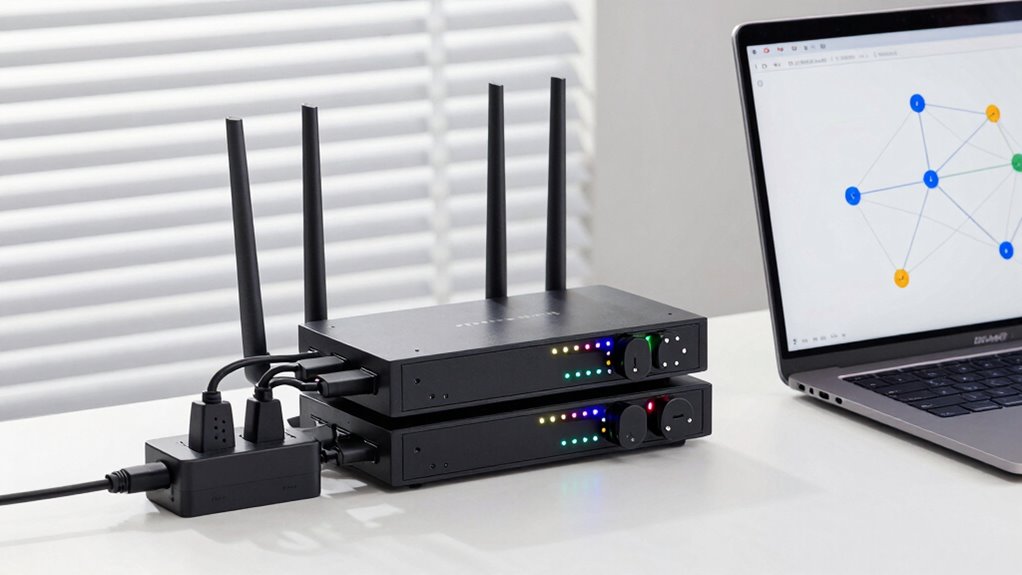

Multi-WAN routers are vital because they prioritize network resilience over raw speed. They provide redundancy, preventing your connection from dropping during outages, and guarantee your critical applications stay online. By intelligently load balancing multiple connections and switching seamlessly when needed, they keep your network stable and productive. Relying on speed alone isn’t enough—you need resilience to avoid costly disruptions. Keep exploring to discover how these features can protect your network even further.
Key Takeaways
- Multi-WAN routers prioritize network stability and continuous operation over raw speed, reducing downtime during outages.
- They enable load balancing to distribute traffic efficiently, preventing slowdowns caused by congestion.
- Failover capabilities ensure seamless switching to backup connections, maintaining connectivity during failures.
- Redundant connections enhance overall network resilience, safeguarding critical applications from disruptions.
- Strategic use of Multi-WAN routers ensures reliable, stable internet access essential for business continuity.
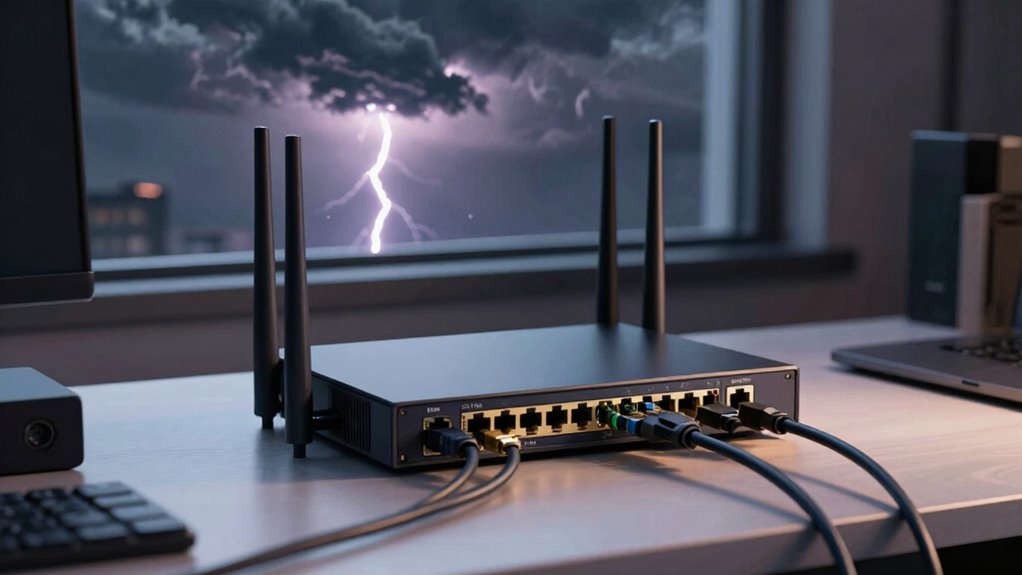
In today’s interconnected world, relying on a single internet connection can leave your network vulnerable to outages and disruptions. That’s where multi-WAN routers come into play, offering a critical edge by enhancing your network’s resilience. While many focus on speed, the real value of these routers lies in their ability to keep your operations running smoothly even when one connection fails. This is achieved through effective load balancing and failover strategies, which ensure your network remains stable and accessible under various conditions.
Load balancing distributes your internet traffic across multiple connections, preventing any one link from becoming overwhelmed. Instead of relying solely on a single bandwidth stream, your router intelligently manages how data flows through each connection, optimizing performance and reducing latency. This not only improves your overall internet experience but also spreads the risk. If one connection experiences congestion or degradation, the load balancing system shifts traffic to other links, maintaining consistent connectivity. This continuous balancing acts as a safeguard against slowdowns and ensures your network resources are used efficiently. Recognizing the importance of network resilience can help organizations prioritize these features to better withstand disruptions. Additionally, understanding biodiversity and the importance of ecological balance can inspire organizations to adopt sustainable practices that also enhance their network resilience.
Load balancing manages traffic across multiple connections to optimize performance and ensure consistent, reliable connectivity.
Many people overlook the importance of these features, mistakenly prioritizing raw speed over resilience. But in reality, having a fast connection that frequently drops or experiences interruptions is far less valuable than a stable, resilient network that can withstand outages. Multi-WAN routers help you build this resilience, ensuring that your critical applications, cloud services, and communications stay online. Their ability to intelligently manage multiple connections makes them indispensable, especially as businesses grow increasingly dependent on reliable internet access. Moreover, the integration of redundant connections further solidifies the robustness of your network, reducing potential points of failure.
Ultimately, investing in a multi-WAN router isn’t just about boosting speed; it’s about safeguarding your network against the unpredictable. Load balancing and failover strategies work together to deliver a network that’s not only faster when connections are stable but also resilient enough to handle failures gracefully. This strategic approach to connectivity keeps you operational, productive, and prepared for whatever disruptions might come your way.

TP-Link ER605 V2 Wired Gigabit VPN Router, Up to 3 WAN Ethernet Ports + 1 USB WAN, SPI Firewall SMB Router, Omada SDN Integrated, Load Balance, Lightning Protection
【Five Gigabit Ports】1 Gigabit WAN Port plus 2 Gigabit WAN/LAN Ports plus 2 Gigabit LAN Port. Up to…
As an affiliate, we earn on qualifying purchases.
As an affiliate, we earn on qualifying purchases.
Frequently Asked Questions
How Do Multi-Wan Routers Prioritize Different Internet Connections?
You can prioritize different internet connections with a multi-WAN router by configuring bandwidth management and load balancing settings. These routers assign specific weights or priorities to each connection, guaranteeing critical traffic gets bandwidth first. Load balancing distributes data loads across multiple links, optimizing performance and resilience. By setting rules for priority and bandwidth allocation, you make certain your essential applications stay connected even if one connection drops.
Can Multi-Wan Routers Handle More Than Two Internet Sources?
Yes, multi-WAN routers can handle more than two internet sources. They excel at bandwidth management and traffic balancing, allowing you to connect multiple ISPs for maximum resilience. You can configure these routers to distribute traffic based on your needs, ensuring continuous internet access even if one source fails. This setup enhances network stability and provides a flexible way to manage increasing bandwidth demands across multiple connections.
What Are the Cost Implications of Implementing Multi-Wan Routers?
Implementing multi-WAN routers involves a cost analysis that considers both upfront expenses and ongoing maintenance. You’ll need to budget for a more advanced device, which can be pricier than standard routers, plus potential setup costs. Keep budget considerations in mind, as these routers improve resilience but may require additional investments in compatible hardware and staff training. Overall, weigh the benefits of increased network stability against your organizational budget constraints.
Do Multi-Wan Routers Require Special Configuration for Failover?
Yes, multi-WAN routers require special configuration for failover. You need to set up automatic load balancing to guarantee seamless traffic distribution across multiple connections. Bandwidth aggregation helps combine the capacity of all links, providing resilience if one connection drops. You’ll configure rules to prioritize backup links and enable quick failover, so your network stays online without manual intervention. Proper setup maximizes resilience and maintains continuous connectivity.
How Do Multi-Wan Routers Impact Network Security?
Multi-WAN routers enhance your network security by allowing you to implement robust network encryption across multiple connections, making it harder for threats to infiltrate. They also support threat detection features, enabling you to monitor and respond to suspicious activity swiftly. By diversifying your connections, these routers reduce the risk of a single point of failure, keeping your network safer and more resilient against attacks.
TP-Link ER605 V2 Wired Gigabit VPN Router, Up to 3 WAN Ethernet Ports + 1 USB WAN, SPI Firewall SMB Router, Omada SDN Integrated, Load Balance, Lightning Protection
【Five Gigabit Ports】1 Gigabit WAN Port plus 2 Gigabit WAN/LAN Ports plus 2 Gigabit LAN Port. Up to…
As an affiliate, we earn on qualifying purchases.
As an affiliate, we earn on qualifying purchases.
Conclusion
Think of multi-WAN routers as your digital safety nets, catching you when one connection falls. They don’t just chase speed — they build resilience, weaving a strong safety net beneath your network’s fragile dance. With multiple pathways, your connection becomes a steadfast river, flowing steadily through any obstacle. In the game of online stability, resilience isn’t just a feature — it’s your anchor, keeping you grounded even when the storm clouds roll in.

TP-Link AX1800 WiFi 6 Router (Archer AX21 V5) – Dual Band Wireless Internet, Gigabit, Easy Mesh, Works with Alexa – A Certified for Humans Device, Free Expert Support
DUAL-BAND WIFI 6 ROUTER: Wi-Fi 6(802.11ax) technology achieves faster speeds, greater capacity and reduced network congestion compared to…
As an affiliate, we earn on qualifying purchases.
As an affiliate, we earn on qualifying purchases.
TP-Link ER605 V2 Wired Gigabit VPN Router, Up to 3 WAN Ethernet Ports + 1 USB WAN, SPI Firewall SMB Router, Omada SDN Integrated, Load Balance, Lightning Protection
【Five Gigabit Ports】1 Gigabit WAN Port plus 2 Gigabit WAN/LAN Ports plus 2 Gigabit LAN Port. Up to…
As an affiliate, we earn on qualifying purchases.
As an affiliate, we earn on qualifying purchases.