
TL;DR

Get business pricing on tech for your team
- Business-only prices and quantity discounts
- Tax-exempt purchasing
- Multiple users, one account, clear invoices
IdeaClyst is a local-first, AI-powered war room designed for founders to validate, explore, and plan ideas efficiently. It combines structured debate, real research, and a private workspace to cut through uncertainty and accelerate growth.
Ever sat down with three ideas, each promising, yet feeling the weight of uncertainty? That knot in your stomach isn’t just indecision — it’s the cost of guessing wrong. Most founders rely on gut feeling or hope, but what if you had a dedicated war room—an organized, disciplined space—that forces your ideas to prove themselves?
Enter IdeaClyst. It’s not just another AI tool; it’s a complete system that helps you test, discover, and refine your ideas—all on your own machine. This isn’t about vague “market potential” guesses. It’s about making your most expensive decisions with confidence, backed by structured debate, real-time research, and a private workspace. Ready to see how it can turn your chaos into clarity?
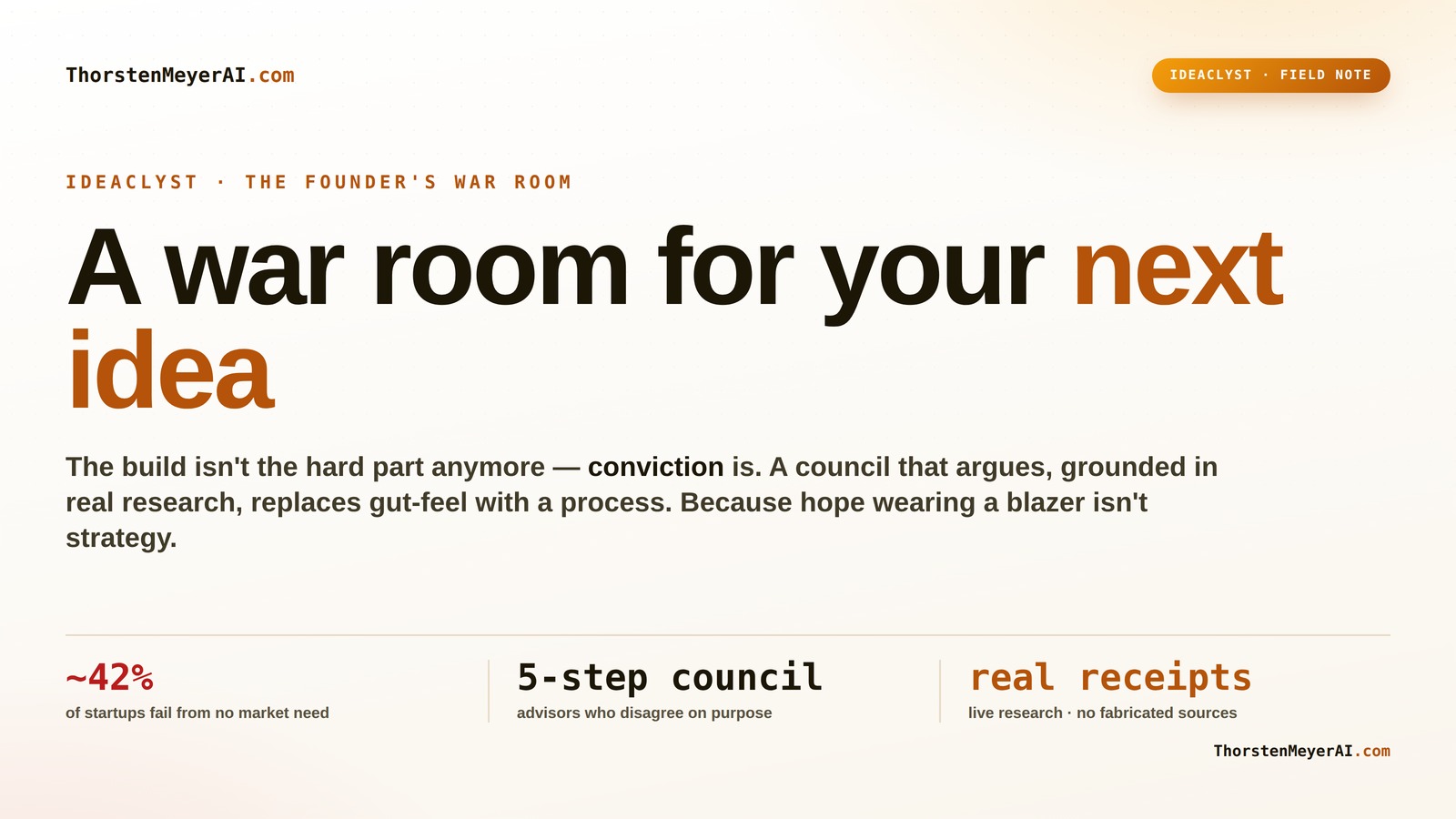
A war room for your next idea
The build isn’t the hard part anymore — conviction is. Knowing which idea deserves the next six months, and being able to defend it. Most founders answer with gut feel and optimistic math. That’s hope wearing a blazer. IdeaClyst replaces it with a process.
The most expensive decision is what to build
The single most valuable thing a tool can do is talk you out of the wrong six months. The numbers make the case better than any pitch.
Three tools in one — on your own machine
Strip away the framing and IdeaClyst is three things at once, all running locally with nothing leaving your laptop.
An AI council
Pressure-tests an idea you bring it — advisors who argue on purpose.
A discovery engine
Finds ideas you didn’t know to look for by hunting real demand signals.
A founder’s workspace
Carries winners from “interesting” all the way to “ready to build.”
Advisors who disagree on purpose
Not one confident, agreeable answer — a structured five-step deliberation where models play different roles and turn on their own work. The disagreement is the feature.
The five-step deliberation
A council that leads with the bad news surfaces the objections you’d otherwise find the expensive way, on month five.
Product strategy
Who’s it for, what’s the wedge, why now, what’s the business model.
Technical architecture
What would it actually take to build — and where’s the risk.
Critique pass
The council turns on its own work. Where’s the hand-waving? What kills this?
Second, independent critique
A different voice, a different angle — so blind spots don’t survive.
Final synthesis
Everything into one coherent founder packet: strategy, architecture, validation, plan.
When IdeaClyst cites a source, it actually fetched it
The hard departure from “ask an AI what it thinks of my startup.” It runs in a strict, real-data-only mode — if it can’t gather genuine evidence, it says so plainly rather than inventing a plausible paragraph.
Confidence with receipts
No fabricated statistics, no imaginary competitors, no made-up citations. The packet survives a skeptical co-founder or a sharp investor because the reasoning has receipts.
Market research first
Scouts the landscape before the council reasons about anything.
Competitor read
Real positioning, pricing signals, feature claims — differentiation vs. reality.
Validation with links
Not “talk to customers” — concrete signals & sources you can click.
From the blank page to build-ready
Evaluation is half the problem; the blank page is the other half. And a plan is worthless if it dies in a tab you never reopen.
Bring a space, not an idea
“AI for accountants,” “tools for indie game studios” — plus your goal and real capacity. It hunts demand signals across HN, Reddit, Product Hunt, GitHub, pricing pages.
- An honest market read — leads with the bad news when a space is hard
- An opportunity map — high pain, thin competition
- Ranked candidates — wedge, who pays, effort, risk, confidence
- each with KILL CRITERIA — when to walk away
A home and a forward path
Every promising idea gets carried forward, with every artifact in plain files on your disk.
- Validation tooling — sprint board, interview list, evidence browser
- Founder profile — a personal-fit lens; same discovery, different advice
- Build workspaces — funnel, personas, landing draft, version history
- “Build this idea” → a PRD + task queue, ready for a coding agent
Key Takeaways
- IdeaClyst’s council debate exposes flaws early, saving costly mistakes.
- Grounding ideas in real web research prevents false confidence.
- Local-first design keeps your sensitive data private and secure.
- Structured disagreement reveals blind spots that gut feeling misses.
- Use the final plan as a living document to keep your team aligned.
As an affiliate, we earn on qualifying purchases.
How IdeaClyst Turns Your Brainstorm into a Battle-Tested Plan
IdeaClyst is like having a boardroom of sharp advisors, all on your laptop. When you bring an idea—any fragment of a thought—it kicks into gear. It forms a council of AI models that examine your idea from multiple angles: strategy, tech, risks, and more.
Imagine tossing a half-formed SaaS idea into the system. Instantly, it sparks a five-step debate: Who’s the customer? How would we build it? What could go wrong? Each step produces a clear, detailed report. The magic? The final result is a Markdown file packed with insights you can own, update, and share.
As an affiliate, we earn on qualifying purchases.
Why Grounding Ideas in Real Research Matters — and How IdeaClyst Does It
Most AI tools answer based on patterns and memory, not facts. That’s a dangerous game, especially for startups. Without grounding your ideas in current, verified data, you risk making decisions based on outdated or inaccurate assumptions. IdeaClyst avoids this trap by anchoring its council in live web research, which means it pulls recent, relevant data directly from the internet during your sessions.
This approach is crucial because it ensures your validation process isn’t just a theoretical exercise but is rooted in current market realities. For example, when evaluating the potential size of a new market segment, the system retrieves recent reports, trend analyses, and consumer data, giving you a factual basis for your assumptions. This reduces the chance of pursuing ideas that seem promising on the surface but are unviable in practice, saving you from costly pivots or failures. For more on AI-driven market research, see industry insights.
private startup workspace software
As an affiliate, we earn on qualifying purchases.
As an affiliate, we earn on qualifying purchases.
The Local-First War Room: Why Your Data Stays Safe and Yours
Unlike many AI tools that rely on cloud servers, IdeaClyst runs entirely on your machine. No data leaves your laptop. That means your raw ideas, strategic plans, and research stay private. For founders with sensitive information or those wary of data breaches, this local-first design is a game-changer.
This setup offers more than just privacy; it provides peace of mind. You retain full control over your data, avoiding potential leaks or third-party access that could compromise your competitive advantage. Plus, local operation means you’re not dependent on internet connectivity or cloud service uptime—your war room is always accessible, secure, and under your control. This is especially crucial when working on proprietary technology or confidential strategies, where trust and security are paramount. Ultimately, the local-first design empowers founders to innovate freely without sacrificing security or privacy. It also means that your data integrity is maintained, and you can audit or review your research and ideas without concern for external interference or data breaches, which is increasingly important in today’s data-sensitive environment.
decision making tools for founders
As an affiliate, we earn on qualifying purchases.
As an affiliate, we earn on qualifying purchases.
The Council: Disagreeing to Find the Truth
Here’s where IdeaClyst really stands out: instead of one AI giving a yes/no, it stages a debate. Five steps, five different models, each playing a role. One argues for market fit, another warns of tech risks, a third challenges assumptions. Their disagreements aren’t bugs—they’re features. To explore more about AI debate techniques, visit this article.
This structured argument isn’t just for show; it’s a deliberate technique to surface blind spots that often go unnoticed in traditional validation. When multiple perspectives clash, it forces you to confront uncomfortable truths and hidden flaws. For example, if your idea hinges on a new technology that’s unproven, the council’s critique helps you identify whether the risks outweigh the potential rewards, encouraging you to pivot or refine before investing heavily. This multi-model debate promotes a comprehensive understanding of your idea’s strengths and vulnerabilities, ultimately leading to more resilient, well-vetted concepts. By encouraging disagreement, IdeaClyst helps you see beyond your initial assumptions and develop a more nuanced view, which is essential for avoiding costly mistakes and building stronger, more viable ideas.
From Idea to Action: How IdeaClyst Guides Your Next Step
Most tools stop at analysis. IdeaClyst takes you further. After the debate, it synthesizes everything into a clear plan—strategy, risks, validation tests, and a timeline. This final founder packet is a living document, ready to be turned into a pitch deck or development roadmap.
This comprehensive plan isn’t just a static report; it’s a dynamic blueprint that reflects the nuanced insights gained during the debate. It helps founders prioritize next steps, allocate resources, and communicate clearly with stakeholders. By translating complex discussions into actionable items, IdeaClyst reduces the guesswork and accelerates your path from idea to implementation. It effectively bridges the gap between analysis and execution, ensuring your team is aligned and prepared for the next phase of development. This step-by-step process ensures that insights are not lost and that your team can act decisively based on well-founded plans, reducing uncertainty and increasing confidence in your next moves.
Practical Tips for Setting Up Your Own War Room with IdeaClyst
- Start small: Pick one core idea and run it through the council to see how it holds up. This allows you to learn the process without overwhelming your team or resources.
- Keep your research updated: Use live web data for the latest trends and market info. Regular updates ensure your validation reflects current realities, not outdated assumptions.
- Build your own templates: Customize the final founder packet to suit your team’s workflow. Tailored templates make it easier to integrate the war room into your existing processes and ensure consistency.
- Encourage debate: Use the structured council to challenge assumptions and surface risks. Cultivating a culture of healthy skepticism helps catch issues early and fosters better decision-making.
- Review regularly: Turn your war room into a living document—update as your idea evolves. Periodic reviews keep the discussions relevant and the plans aligned with your progress and market shifts.
Measuring Success: When Your War Room Actually Works
Success isn’t just about making faster decisions. It’s about making smarter ones. Track how quickly your team can go from idea to validated plan. Notice if you’re catching risks early or uncovering new opportunities.
For example, a startup using IdeaClyst cut their idea validation phase from three months to one, saving thousands of dollars. Metrics like decision speed, risk reduction, and team confidence are your best indicators. But beyond numbers, consider qualitative feedback—are your team members more confident? Are they making better, more informed choices? The true measure of success is improvement in decision quality, not just speed. Additionally, analyze how well your validated ideas perform in the real market, tracking success rates and iteration cycles to refine your process continuously.
Common Mistakes to Avoid When Building Your Digital War Room
Don’t treat your war room as just a place to dump ideas. Keep it active. Regularly challenge assumptions, update data, and involve your team. Avoid the trap of overloading it with unfinished thoughts or outdated info.
For example, one startup left their war room stagnant for months, missing critical market shifts. A lively, engaged space keeps your ideas fresh and your team aligned. Make it a habit to review and revise regularly, ensuring the information remains relevant and actionable. Also, encourage diverse perspectives and healthy debate—stagnant or echo chamber environments diminish the value of your war room. The goal is to create a dynamic, evolving space that continuously informs smarter decisions and strategic pivots. Recognize that a static war room can foster complacency or outdated thinking, so fostering a culture of continuous improvement is key to maintaining its effectiveness and relevance over time.
Frequently Asked Questions
What exactly is a digital war room in the context of startup ideas?
A digital war room is a centralized, organized space—like IdeaClyst—that helps founders and teams test, debate, and develop ideas systematically. It brings structure, research, and structured disagreement into a private, accessible environment to make smarter decisions faster.Can I use IdeaClyst without any technical experience?
Absolutely. IdeaClyst runs locally on your machine, with a user-friendly interface designed for founders and teams. It doesn’t require coding or cloud setup—just download, install, and start organizing your ideas.How does IdeaClyst help avoid building something nobody needs?
It grounds your ideas in live web research and structured debate, uncovering risks and market realities early. This prevents costly missteps by ensuring your idea has real validation, not just your own optimistic assumptions.Is my data really private with IdeaClyst?
Yes. It’s a local-first tool, meaning all your ideas, research, and reports stay on your own device. Nothing leaves your machine unless you choose to share it.What types of ideas work best in IdeaClyst?
It’s perfect for early-stage startup concepts, product features, business models, or internal strategies. Any idea that benefits from structured debate, real research, and clear planning fits well.Conclusion
Turning chaos into clarity isn’t about working harder—it’s about working smarter. IdeaClyst acts as a digital war room, transforming fuzzy ideas into disciplined, actionable plans. If you want to stop guessing and start knowing, this tool might just change how you build.
Imagine your next big idea coming to life with confidence, backed by real research and honest debate. That’s the true power of a well-run war room. Are you ready to make your ideas unstoppable?
Fall Picks
fall essentials
As an affiliate, we earn on qualifying purchases.