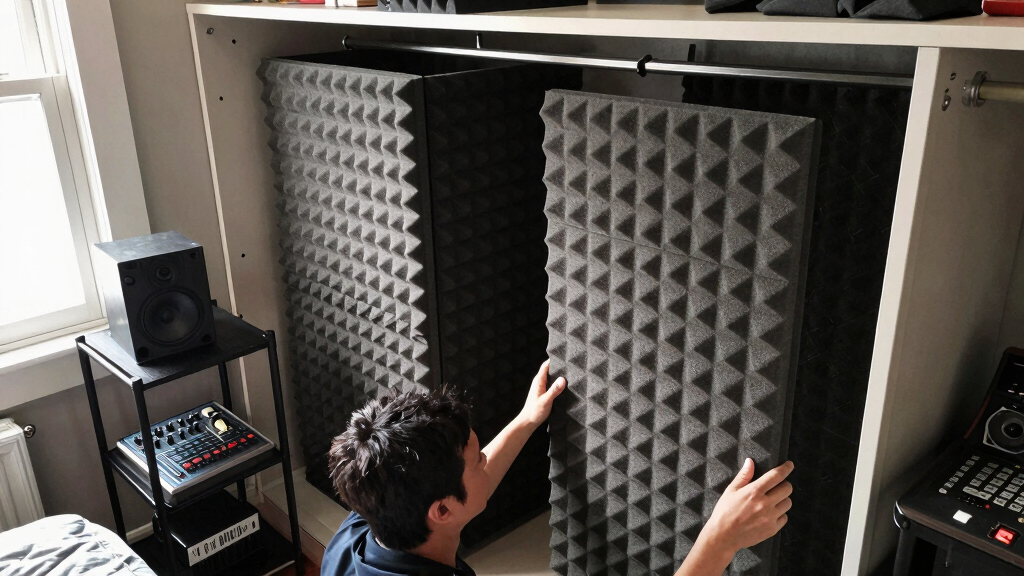

📊 Full opportunity report: Acoustic Dampening, Placement, and the “Rig in the Closet” Setup on ThorstenMeyerAI.com — validation score, market gap, and execution plan.
TL;DR
Moving your AI workstation into a closet or separate room can drastically reduce noise. Proper ventilation is essential to prevent heat buildup, making this a highly effective strategy for quiet, high-performance setups.
Putting a high-power AI workstation in a closet or separate room significantly reduces noise levels at the user’s workspace, according to technical experts.
Experts emphasize that the most effective way to reduce noise from powerful workstations is to move them away from the user, such as into another room or closet, especially since networked operation makes local proximity less necessary. This approach eliminates airborne and structure-borne noise at the source, with the added benefit of keeping the workspace quiet. Acoustic Dampening, Placement, and the ‘Rig in the Closet’ Setup.
However, placing a machine in an enclosed space introduces heat management challenges. A sealed closet or cabinet can trap heat generated by GPUs and CPUs, risking overheating and throttling. To mitigate this, proper ventilation—passive vents or active exhaust fans—is essential. Purpose-built soundproof cabinets with integrated cooling solutions are available but are costly. When managed correctly, this setup offers a quiet, efficient environment for continuous operation without noise disturbance.
Acoustic dampening
& the rig in the closet.
The most powerful noise fix isn’t a material — it’s a floor plan. A rig you can’t hear because it’s in another room beats any amount of foam. Tap the approaches in Part 1 to see what actually works.
(another room)
(levers 1–4)
(door / barrier)
(acoustic foam)
Contain the noise, not the heat
Why Moving Rigs to a Closet or Room Matters
This strategy offers a practical, often cost-effective way to achieve near-silent operation of high-performance AI rigs, improving workspace comfort and reducing noise pollution. Proper ventilation ensures hardware longevity and performance, making this approach suitable for both hobbyists and professionals relying on continuous AI inference tasks.
As an affiliate, we earn on qualifying purchases.
Placement Strategies for Noise Reduction
The hierarchy of noise mitigation prioritizes distance and isolation over acoustic treatment. Moving a rig into another room or closet is the most effective noise reduction method, especially since network-based workflows allow remote operation. Acoustic Dampening, Placement, and the 'Rig in the Closet' Setup leverages these principles, provided ventilation is carefully managed.
"The most effective noise reduction is simply moving the machine out of your immediate workspace. Once you do that, the need for acoustic foam diminishes significantly."
— Thorsten Meyer, AI Workstation Expert
As an affiliate, we earn on qualifying purchases.
Remaining Challenges in 'Rig in the Closet' Setup
While moving a rig into a closet reduces noise, the optimal ventilation solutions and their long-term reliability are still under discussion. The effectiveness of various cooling methods and cost considerations for purpose-built soundproof cabinets vary, and real-world performance can differ based on room size, ambient temperature, and hardware configuration. Further empirical data and user experiences are needed to establish best practices.
computer ventilation fan for enclosed case
As an affiliate, we earn on qualifying purchases.
As an affiliate, we earn on qualifying purchases.
Next Steps for Quiet, Efficient AI Workstations
Developers and users should focus on designing or selecting ventilation solutions tailored to enclosed spaces, such as thermostatically controlled exhaust fans and ducting. Future innovations may include integrated cooling and soundproofing units that simplify deployment. Continued testing and sharing of real-world results will refine best practices for 'rig in the closet' setups, making them more accessible and reliable.
As an affiliate, we earn on qualifying purchases.
Key Questions
Can I put my AI rig in a closet without overheating?
Yes, if proper ventilation—passive vents or active exhaust fans—is implemented to dissipate heat effectively. Proper airflow is essential to prevent overheating and maintain performance.
Is a soundproof cabinet worth the cost?
For those needing both noise reduction and thermal management, purpose-built soundproof cabinets can be a worthwhile investment, especially in shared or noise-sensitive environments.
Does moving the rig away from my workspace affect performance?
Not if the rig is operated remotely over a network. The physical location does not impact computational performance, only noise and heat management.
What are the main risks of placing a rig in a closet?
The primary risk is inadequate ventilation leading to heat buildup, which can cause thermal throttling and hardware damage. Proper airflow solutions are necessary.
Are there alternative noise reduction methods besides moving the rig?
Yes, acoustic treatments like foam panels and barriers can reduce reflections and airborne noise, but they are less effective than physical separation. Combining methods yields best results.
Source: ThorstenMeyerAI.com