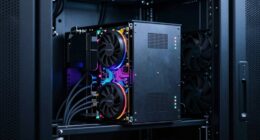

📊 Full opportunity report: The SSD Squeeze: Why Storage Joined the Party on ThorstenMeyerAI.com — validation score, market gap, and execution plan.
TL;DR
Storage prices are surging in 2026 due to increased demand from AI applications and wafer competition among memory manufacturers. Supply constraints are affecting enterprise, consumer, and industrial markets, with prices expected to remain high. Learn more about the storage industry trends.
Storage prices are rising sharply in 2026, driven by a combination of increased demand from artificial intelligence (AI) applications and a supply squeeze among major NAND flash memory producers. This development marks a departure from the decade of declining storage costs and has broad implications for consumers, enterprises, and data center storage infrastructure.
Over the past nine months, contract prices for enterprise SSDs have surged by approximately 55%, with SanDisk doubling its prices for enterprise 3D NAND. Consumer SSDs have also seen their prices roughly double or triple, with 1TB drives now costing $300–$480, up from $120–$150 in 2024. The supply constraints are largely due to NAND manufacturing lines competing with high-margin HBM and DRAM for limited fab capacity, as leading manufacturers like Samsung, SK Hynix, and Micron shift focus toward memory types with higher profitability.
AI’s expanding role in data processing and inference is also directly fueling storage demand. High-end AI GPUs require around 16TB of TLC or QLC flash, and large AI server racks can demand over 1,000TB of NAND. Generative AI applications, especially those involving retrieval-augmented generation and vector database querying, are actively consuming significant storage resources, transforming storage from a passive component into an active part of AI infrastructure.
Manufacturers have responded by tightening supply, with some, such as Micron, fulfilling only about 55–60% of their core customer demand. For a deeper dive, see our analysis on storage supply dynamics. New fabs are years away, and industry insiders suggest that the current scarcity is partly strategic, as high margins from shortages incentivize continued restraint on capacity expansion. Major firms are quietly reducing wafer targets, and profits from NAND sales are at record levels, driven by the scarcity.
The SSD squeeze: storage joined the party
Storage was the last cheap thing in computing. Not anymore — a 2TB NVMe that was $120–150 in 2024 now lists at $300–480. And this time flash isn’t only collateral damage: AI eats storage directly.
both ways
Flash got hit twice — once as collateral sharing fabs with HBM, once directly as AI inference turned fast storage into something it consumes by the petabyte. That second force won’t fade; it grows with every model, every RAG pipeline, every cache that must live somewhere fast. Buy what you need now; favor TLC with DRAM cache, don’t overpay for Gen 5, watch for counterfeits. Relief isn’t forecast before late 2027. When the cheapest component in computing has a two-year waitlist, “commodity” no longer fits. Next: The High-End PC & Workstation Tax.
Impact of Storage Shortage on Market and Innovation
The surge in NAND prices and supply constraints has immediate and long-term effects across multiple sectors. Enterprise data centers face higher costs for storage infrastructure, potentially slowing down digital transformation initiatives. Consumers experience higher prices for SSDs and are seeing reduced storage capacities in new PC models. Industrial and automotive sectors, reliant on durable NAND, face long lead times, impacting product development and deployment. This scarcity could also influence future innovation, as manufacturers prioritize high-margin enterprise and AI applications over consumer-grade storage.

WD_Black SN7100 2TB NVMe SSD – Gen4 PCIe, M.2 2280, Up to 7,250 MB/s Read Speed, Up to 6,900 MB/s Write Speed, Next Gen TLC 3D NAND, for Laptops, Handheld Gaming Devices – WDS200T4X0E
- High-Speed Performance: Up to 7,250MB/s read, 6,900MB/s write
- Next Gen TLC NAND: Enhanced durability and efficiency
- Designed for Gamers: Optimized for portable gaming devices
As an affiliate, we earn on qualifying purchases.
As an affiliate, we earn on qualifying purchases.
Historical Trends and Current Market Dynamics
For most of the last decade, storage was the most affordable component in computing builds, with NAND prices steadily declining. However, since late 2025, prices have begun to spike, driven by both supply chain constraints and escalating demand from AI applications. Major memory manufacturers have shifted focus toward high-margin memory types, reducing NAND wafer output amid record profits. This shift is compounded by the fact that NAND, DRAM, and HBM share manufacturing capacity, leading to a bottleneck. The industry’s response has been cautious, with no immediate plans for new fabs, as the current scarcity is highly profitable for producers.
Previously, the industry relied on the assumption that NAND would remain cheap, but the current market dynamics challenge this view, prompting buyers to adjust their purchasing strategies accordingly.
“We can only meet about 55-60% of our core customer demand due to limited wafer capacity and strategic prioritization.”
— A senior executive at Micron

SSK Portable SSD 1TB External Solid State Hard Drive USB C Up to 1050MB/s
- Storage Capacity: 1TB SSD (931GB on Windows)
- Fast Data Transfer: Up to 1050MB/s read speed
- Activity Indicator: LED light shows activity
As an affiliate, we earn on qualifying purchases.
As an affiliate, we earn on qualifying purchases.
Unclear Duration and Future Market Trajectory
It remains uncertain how long these supply constraints and high prices will persist. Industry insiders suggest that new fab construction will take several years to impact supply, but the current strategic restraint by manufacturers indicates that prices may stay elevated for the foreseeable future. Additionally, how AI demand will evolve and whether new capacity investments will materialize remains to be seen, making the market outlook uncertain.

fanxiang S101 1TB SSD SATA SSD 1TB Internal Solid State Drive SATA III 6Gb/s 2.5" SSD, UP to 520MB/s, 3D NAND TLC, Upgrade Laptop PC and Desktops
- Fast Data Transfer Speeds: Up to 520MB/s read/write speeds
- Enhanced System Boot Time: Boots 50% faster than HDDs
- Reliable Storage Solution: Features durable 3D NAND TLC chips
As an affiliate, we earn on qualifying purchases.
As an affiliate, we earn on qualifying purchases.
Upcoming Industry Developments and Market Adjustments
Manufacturers are expected to continue prioritizing high-margin applications, potentially prolonging supply tightness. Buyers should prepare for sustained higher prices and consider strategic stockpiling of essential storage components. Industry analysts anticipate that new fabs will begin operations in 2028, which may gradually ease shortages. Meanwhile, enterprise and industrial sectors should adapt their procurement strategies to mitigate costs and lead times.

Sturdy M.2 NVMe 2280 2260 2242 2240 2230 SSD Card Case – 24 Slot Organizer
- High Capacity Storage: Holds 24 M.2 SSDs of various sizes
- Water-Resistant & Shockproof: Made of durable, pressure-proof PP plastic
- Secure Organization: 24 precise slots prevent SSD contact and damage
As an affiliate, we earn on qualifying purchases.
As an affiliate, we earn on qualifying purchases.
Key Questions
Why are NAND prices rising so quickly in 2026?
Prices are rising due to a combination of increased AI storage demand, wafer competition with high-margin memory types, and deliberate supply restraint by manufacturers seeking higher profits amid a supply squeeze.
How is AI driving storage demand?
AI applications, especially in training and inference, require vast amounts of fast, reliable NAND storage—high-end GPUs can need over 16TB each, and large AI servers demand thousands of terabytes, transforming storage into a critical component of AI infrastructure.
Will storage prices go down soon?
Industry experts suggest that prices will remain high for several years due to the time needed to build new fabs and the ongoing strategic supply constraints by leading manufacturers.
What should buyers do in this market?
Buy only what you need now, favor TLC NAND with caches for durability, and avoid overpaying for PCIe Gen 5 drives unless necessary. Be cautious of counterfeits and purchase from reputable sources.
How will this affect consumer devices like PCs?
PC manufacturers are already shipping models with reduced storage capacities, such as 512GB instead of 1TB, reflecting the higher costs and limited supply of NAND flash.
Source: ThorstenMeyerAI.com