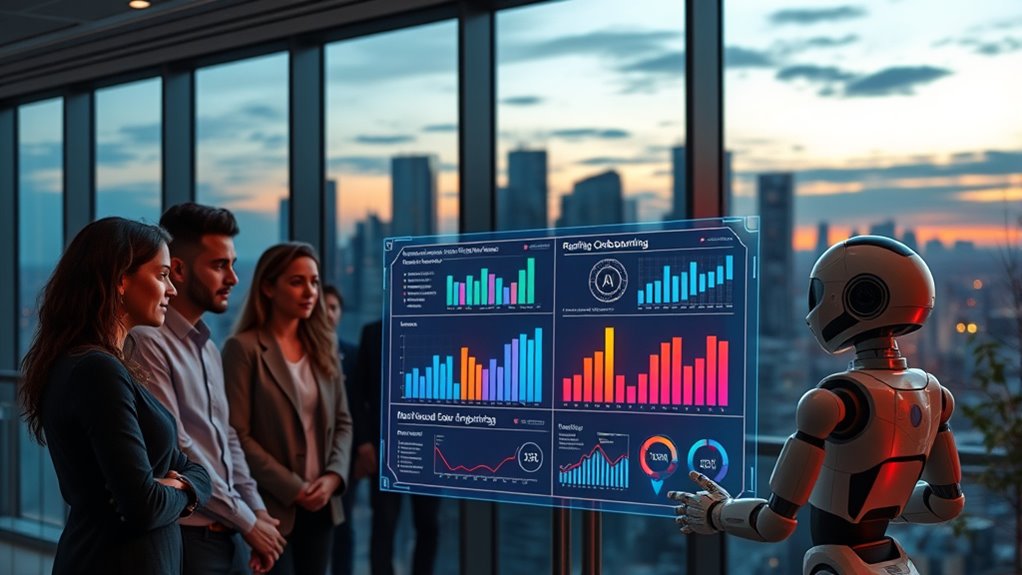

AI in human resources helps you streamline recruiting by quickly analyzing resumes, identifying top candidates, and reducing bias. It enhances onboarding with personalized messages and chatbots that answer questions round the clock. For retention, AI predicts turnover risks and supports tailored career growth plans. It also promotes ongoing engagement through real-time feedback and sentiment analysis. If you want to see how these tools can transform your HR processes, there’s more to discover ahead.
Key Takeaways
- AI rapidly screens resumes, identifies suitable candidates, and reduces hiring time while promoting diversity through bias mitigation.
- AI streamlines onboarding with personalized communication, paperwork guidance, and 24/7 chatbot support for new employees.
- AI analyzes employee data to predict turnover risks and customizes career development, improving retention and engagement.
- AI facilitates real-time feedback and sentiment analysis to address workplace issues promptly and foster a transparent culture.
- AI systems must operate ethically, protect employee data, and ensure security to maintain trust in HR processes.

Have you ever wondered how artificial intelligence is transforming human resources? It’s a game-changer that’s reshaping how you find, hire, and keep the best talent. AI streamlines many processes, allowing you to focus more on building relationships and less on tedious tasks. When it comes to recruiting, AI tools analyze thousands of resumes in seconds, identifying the most promising candidates based on skills, experience, and cultural fit. This reduces your time-to-hire and helps you avoid unconscious bias, ensuring a more diverse and qualified applicant pool. Instead of sifting through dozens of applications manually, you get a curated shortlist, allowing you to concentrate on engaging with the top contenders.
AI transforms HR by streamlining recruiting, reducing bias, and enabling better talent engagement and retention.
Onboarding also benefits markedly from AI. Automated systems can send personalized welcome messages, guide new hires through required paperwork, and schedule orientation sessions. AI-powered chatbots are available around the clock to answer common questions, providing new employees with instant support as they navigate your organization. This not only makes the onboarding process smoother but also shows new hires that your company values efficiency and care. With AI handling routine tasks, your HR team can dedicate more time to creating meaningful onboarding experiences that foster engagement and retention from the start.
Retention strategies are enhanced by AI insights that analyze employee data to predict turnover risks. By tracking patterns such as declining engagement, reduced productivity, or absenteeism, AI alerts you to potential issues before they escalate. This proactive approach enables you to intervene early with targeted support, training opportunities, or recognition programs. AI also helps personalize career development plans, suggesting growth pathways tailored to each employee’s skills and aspirations. When your team feels supported and sees opportunities for advancement, they’re more likely to stay committed long-term.
Furthermore, AI facilitates continuous feedback collection, giving you real-time insights into employee satisfaction and engagement levels. Automated surveys and sentiment analysis tools provide a pulse on your workforce, allowing you to address concerns promptly and improve your workplace environment. This ongoing feedback loop helps you foster a culture of transparency and trust, which are vital for retention. As research indicates, AI Safety measures are also crucial to ensure AI-driven HR systems operate ethically and securely, protecting employee data and privacy.

AI Hiring for Small Business: A Step-by-Step Guide to Automated Recruiting, Resume Screening, and HR Automation That Saves Time and Money in 2026 (The Reclaim Series)
As an affiliate, we earn on qualifying purchases.
As an affiliate, we earn on qualifying purchases.
Frequently Asked Questions
How Does AI Ensure Fairness in HR Decision-Making?
AI helps guarantee fairness in HR decision-making by analyzing large data sets objectively, reducing human biases. You can program AI to focus on skills and qualifications instead of subjective factors. It also continuously monitors decisions for patterns of bias, allowing you to adjust algorithms as needed. By providing consistent, data-driven insights, AI supports fairer hiring, onboarding, and retention processes, ultimately promoting equal opportunities for all candidates and employees.
What Are the Privacy Concerns With AI in HR?
While AI can streamline HR tasks, it raises privacy concerns you should consider. You might worry about sensitive employee data being collected, analyzed, or shared without clear consent. There’s also the risk of biased data influencing decisions, potentially exposing personal details unintentionally. To protect trust, guarantee transparent data practices, secure storage, and strict access controls. Being proactive helps prevent privacy issues and keeps your HR processes fair and respectful.
Can AI Replace Human Judgment in HR Processes?
AI can’t fully substitute human judgment in HR processes because it lacks empathy, intuition, and understanding of complex social nuances. While AI can handle data-driven tasks efficiently, you still need human insight to assess cultural fit, ethical considerations, and emotional intelligence. By combining AI’s speed with your judgment, you ensure fair, personalized decisions that machines alone can’t achieve. So, AI should support, not replace, your human judgment.
How Is Employee Feedback Integrated Into AI Systems?
You might wonder how employee feedback gets woven into AI systems. It’s quite clever—your feedback is collected through surveys and real-time input, then fed into algorithms that analyze patterns and sentiments. This continuous loop helps the AI adapt and improve decision-making. As you share more, the system becomes smarter, offering personalized insights and fostering a more responsive workplace. The process is dynamic, almost like the AI is learning directly from you.
What Are the Costs Associated With Implementing AI in HR?
Implementing AI in HR can cost you in several ways. You’ll need to invest in software licenses, hardware upgrades, and data security measures. Training your staff to use new systems also adds expenses. Additionally, ongoing maintenance, updates, and potential consulting fees can add up. While these costs might seem high upfront, they can streamline processes, improve decision-making, and save money long-term.

Vorteile durch Chatbots im HR Onboarding-Prozess: Welche Vorteile bietet der Einsatz von Chatbots im Personalwesen während der Eingliederung neuer Mitarbeiter? (German Edition)
As an affiliate, we earn on qualifying purchases.
As an affiliate, we earn on qualifying purchases.
Conclusion
As you see, AI transforms HR by streamlining recruiting, onboarding, and retention. It saves you time, reduces bias, and helps you connect with the right candidates faster. But aren’t you curious how much more your team could achieve with AI’s support? Embracing this technology isn’t just a trend; it’s a smart move toward building a stronger, more efficient workplace. Are you ready to harness AI’s full potential for your HR goals?
employee turnover prediction tools
As an affiliate, we earn on qualifying purchases.
As an affiliate, we earn on qualifying purchases.
employee engagement survey tools
As an affiliate, we earn on qualifying purchases.
As an affiliate, we earn on qualifying purchases.