📊 Full opportunity report: AI output review queue for customer support macros on IdeaNavigator AI — validation score, market gap, and execution plan.

Get business pricing on tech for your team
- Business-only prices and quantity discounts
- Tax-exempt purchasing
- Multiple users, one account, clear invoices
TL;DR
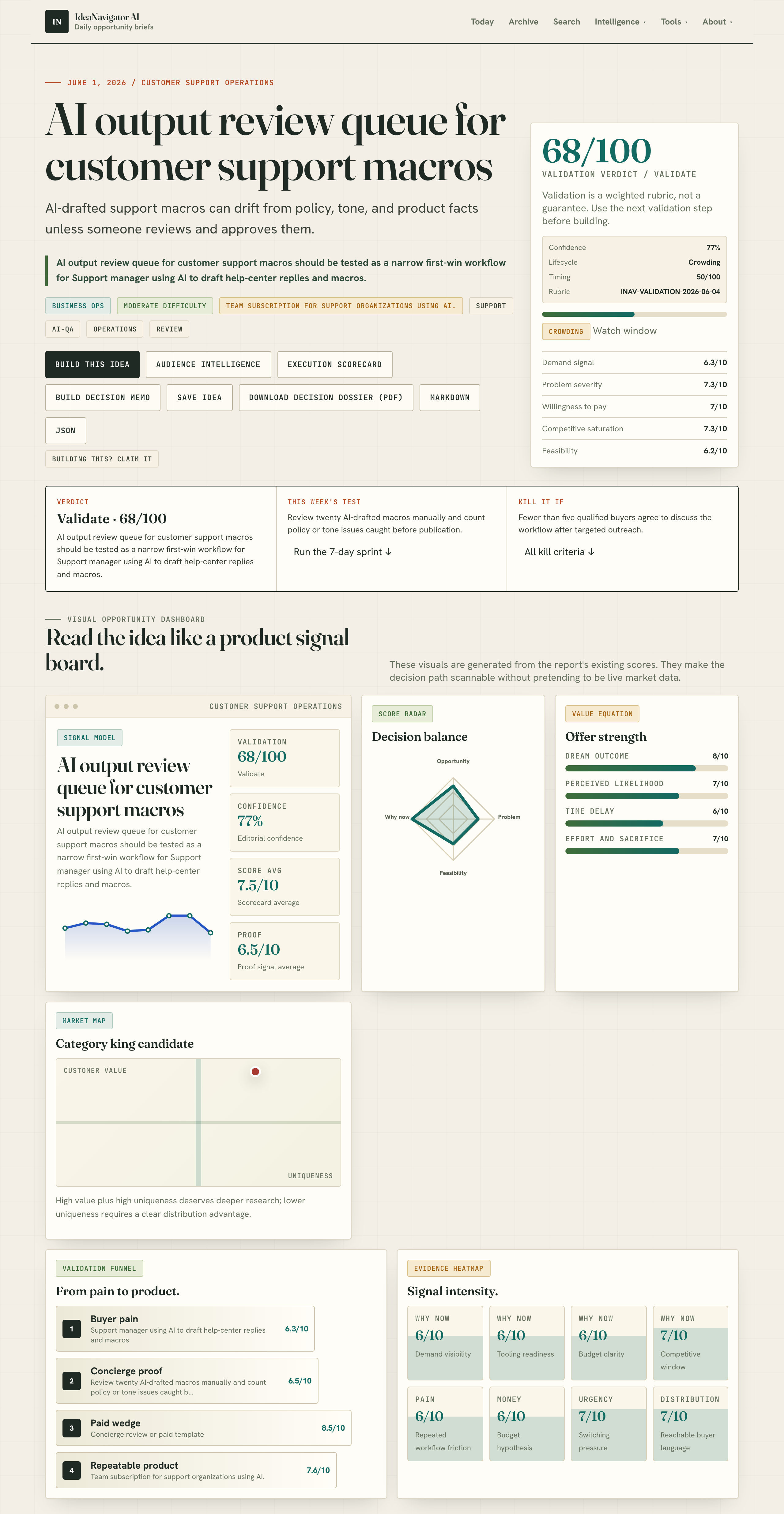
Support organizations are trialing a new AI output review queue for customer support macros to improve compliance and tone consistency. The system scores drafts for policy fit, tone, and risk before approval. This development aims to address the rapid adoption of AI in support workflows while maintaining quality control.
Support organizations are beginning to test a new AI output review queue designed specifically for customer support macros. This system aims to ensure that AI-generated support responses adhere to company policies, maintain appropriate tone, and avoid risky promises before they are published. The development responds to the rapid adoption of AI tools in customer service, which has outpaced existing approval workflows.
The review queue is intended as a first-step workflow for support managers to vet AI-drafted help-center replies and macros. According to sources familiar with the project, the system scores each draft based on criteria such as policy alignment, tone appropriateness, and potential risk factors. The goal is to catch policy violations or tone issues before they reach customers, reducing the need for manual corrections post-publication.
Support teams are currently conducting manual reviews of twenty AI-generated macros to validate the effectiveness of the system. Early feedback indicates that the review queue can identify issues related to inconsistent tone, unsupported claims, or risky promises, which are common pitfalls of automated responses. The system is designed to flag drafts that need further human review or approval, streamlining the support process without sacrificing quality.
Pricing for the system is based on a team subscription model, targeting customer support operations that integrate AI into their workflows. The developers plan to expand testing and gather more data to refine the scoring algorithms and improve accuracy before broader rollout.
Why the AI Macro Review Queue Matters for Customer Support
This development is significant because it addresses a key challenge in AI-powered customer support: ensuring that automated responses comply with company policies, maintain appropriate tone, and do not make unsupported or risky claims. As support teams adopt AI more rapidly than their approval processes can keep up, the review queue offers a scalable solution to maintain quality control.
By automating the initial vetting process, support organizations can reduce manual review time, improve response consistency, and mitigate risks associated with AI drift from policy. This approach could set a standard for integrating AI responsibly into customer service workflows, balancing efficiency gains with quality assurance.
AI customer support macro review tool
As an affiliate, we earn on qualifying purchases.
As an affiliate, we earn on qualifying purchases.
Background on AI Use in Customer Support and Policy Challenges
Over the past few years, many customer support organizations have increasingly integrated AI tools to generate help-center responses and support macros. While this accelerates response times and reduces workload, it introduces new risks related to policy violations, tone inconsistency, and unsupported claims. Currently, many teams rely on manual review processes that are often slow and inconsistent, leading to potential compliance issues.
The need for a formalized review process has become more urgent as AI adoption accelerates. Support managers have expressed concern about maintaining quality and compliance without creating bottlenecks. The testing of an AI output review queue aims to address these issues by providing an automated scoring system that flags problematic drafts for human review.
This initiative is part of broader efforts to develop scalable, AI-assisted quality controls in customer support, aligning with industry trends toward responsible AI deployment.
“The review queue scores drafts for policy fit, tone, and risk, helping support teams catch issues early.”
— an anonymous source familiar with the project
policy compliance review software for customer support
As an affiliate, we earn on qualifying purchases.
As an affiliate, we earn on qualifying purchases.
Uncertainties About System Effectiveness and Deployment
It is not yet clear how accurately the review queue will identify all policy or tone issues at scale. The system is still in testing, and further validation is needed to determine its reliability and impact on support workflows. Additionally, broader deployment details, such as integration with existing support platforms and user training, remain to be finalized.
As an affiliate, we earn on qualifying purchases.
Next Steps for Validation and Broader Rollout
Support teams will continue testing the review queue with a larger sample of AI-generated macros, aiming to refine scoring algorithms and reduce false positives. Developers plan to gather feedback from support managers and analysts to improve accuracy. The goal is to prepare for a phased rollout, with broader deployment expected once validation confirms the system’s effectiveness and reliability.
automated support response quality checker
As an affiliate, we earn on qualifying purchases.
As an affiliate, we earn on qualifying purchases.
Key Questions
How does the review queue improve support response quality?
The review queue automatically scores AI-generated macros for policy compliance, tone, and risk, helping support teams catch issues before responses reach customers.
Will this system replace manual review entirely?
No, it is designed to assist support managers by flagging drafts that need review, not to fully automate approval. Human oversight remains essential.
When will the review queue be available for wider use?
Support organizations plan to expand testing over the coming months, with broader deployment expected after successful validation and refinement.
What types of issues does the system flag?
The system flags issues related to non-compliance with policies, inappropriate tone, unsupported claims, and risky promises.
How much does the system cost?
The system is offered via a team subscription model, with pricing based on organization size and usage volume.
Source: IdeaNavigator AI
Halloween Picks
halloween
As an affiliate, we earn on qualifying purchases.